
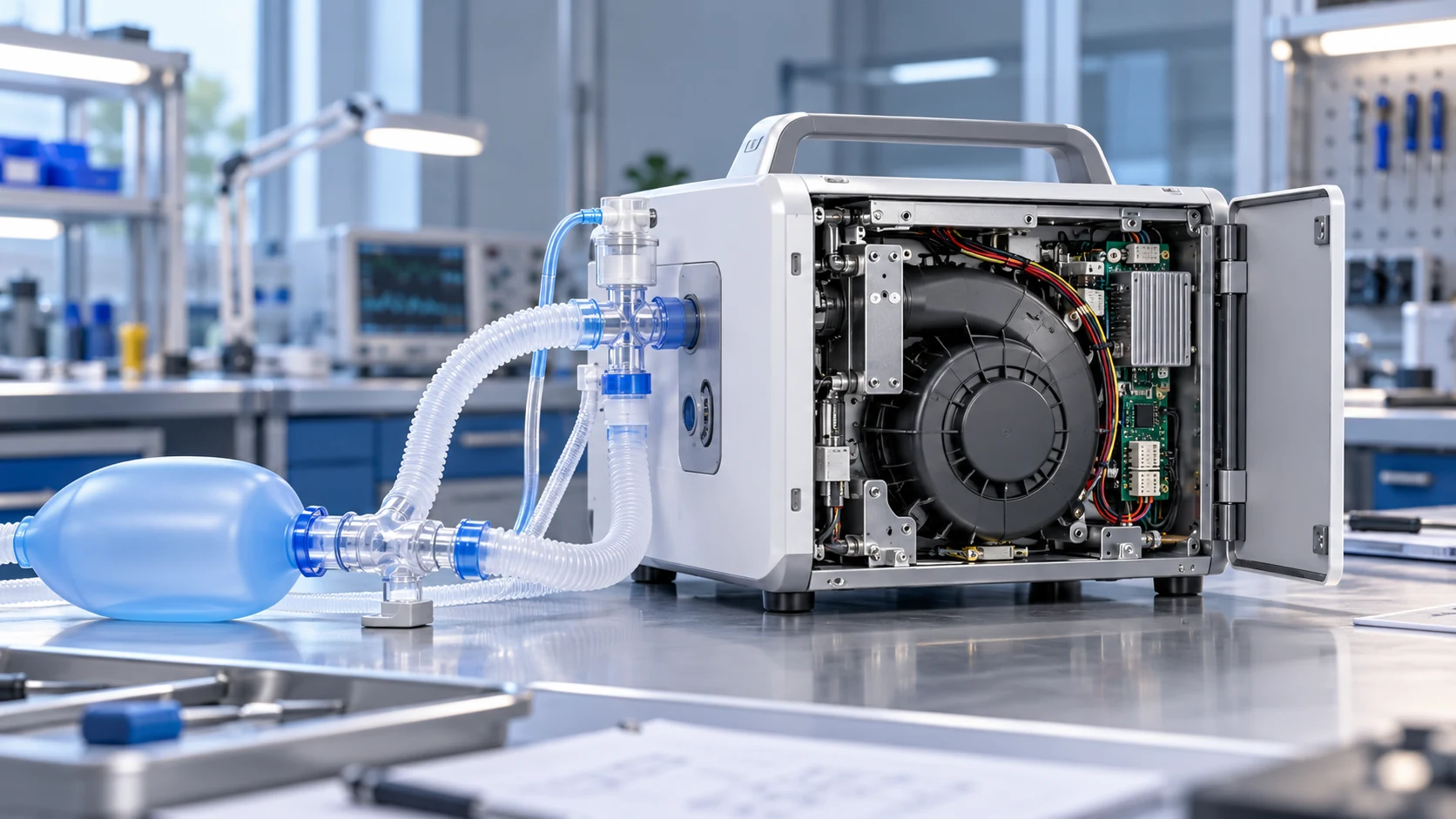
Pressure-capable airflow
Blower options for compact ducts, filters, and controlled air paths.
Compact directed airflow for respiratory and medical equipment engineering
Understanding the specific thermal and environmental demands of Ventilator and Respiratory Device Blower environments is the foundation of every Herays solution.
Medical ventilators and respiratory therapy devices — including ICU ventilators, home CPAP/BiPAP machines, high-flow nasal cannula systems, and portable emergency resuscitators — depend on precisely controlled blower performance to deliver safe and effective respiratory support. The blower sets the pressure accuracy, noise floor, response time, and reliability of the device. Fan selection for respiratory applications involves tradeoffs that do not arise in any other airflow context.
What makes respiratory blower selection fundamentally different from electronics cooling:
Herays supplies centrifugal BLDC blower modules used in CPAP, BiPAP, and ventilator designs. These are 12V and 24V BLDC centrifugal blowers with PWM speed control and 3-wire tachometer output, designed for closed-loop pressure regulation in respiratory therapy devices.
Typical evaluation specifications:
Specific models vary by the pressure-flow requirements of your device platform. Contact Herays with your target pressure-flow curve and we will identify the appropriate blower and provide engineering samples for evaluation.
Can an axial fan be used in a ventilator if it generates enough pressure? No. Even if an axial fan achieves the target static pressure at zero flow (stall pressure), its pressure-flow curve drops sharply as flow increases, making stable control across the patient’s tidal volume range impossible. Centrifugal blowers are the correct topology for any application requiring controlled pressure across a variable flow range.
How is a CPAP blower different from a BiPAP blower? CPAP delivers a single fixed pressure during both inhalation and exhalation. BiPAP delivers different inspiratory (IPAP) and expiratory (EPAP) pressures and must respond to patient-triggered breath transitions in under 100 ms, requiring more responsive PWM controller bandwidth. Both use the same blower hardware; the difference is in the control algorithm.
What documentation is available to support a 510(k) or CE MDR submission? Herays can provide component test reports, material safety data, dimensional drawings, FMEA documentation, and design history file (DHF) support documents for blowers supplied to medical device OEMs.
Herays works directly with respiratory device OEMs and their engineering teams from prototype through production. Contact us to discuss your ventilator or respiratory therapy blower requirements.
Precision-engineered DC fan technologies tailored to the performance and reliability requirements of Ventilator and Respiratory Device Blower applications.
Blower options for compact ducts, filters, and controlled air paths.
Small blower formats for constrained device layouts.
Selection support for voltage, pressure, flow, noise, and control requirements.
Herays DC fan and blower products engineered to meet the performance requirements of Ventilator and Respiratory Device Blower systems.
 DC Axial Fan
DC Axial Fan
DC Axial Fan
DC Axial Fan
DC Axial Fan
DC Axial Fan
DC Axial Fan
DC Axial Fan
DC Axial Fan
DC Axial Fan
DC Axial Fan
 DC Axial Fan
DC Axial Fan
DC Axial Fan
Our application engineers are available to help you select the right product for your system requirements.