
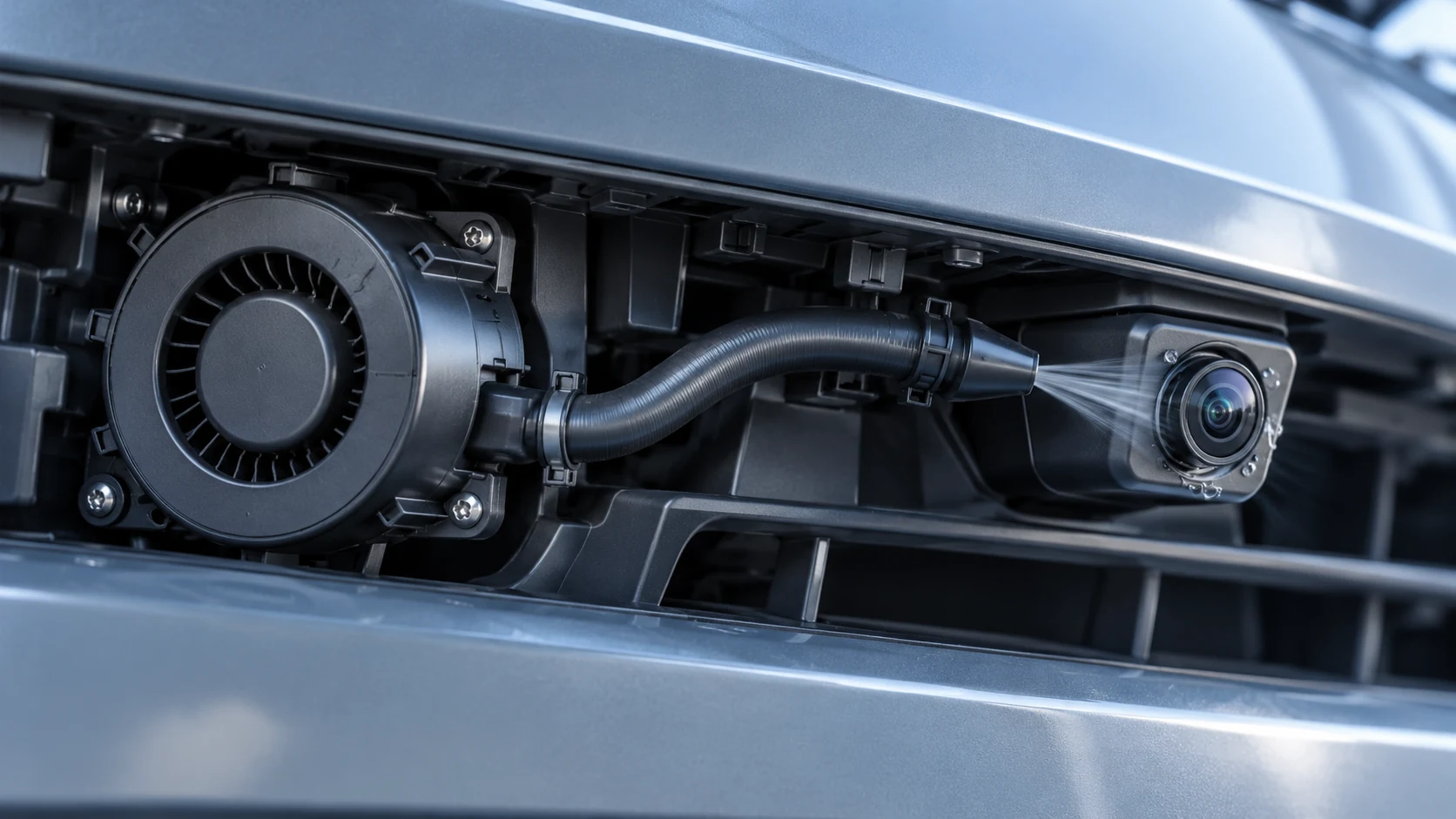
Focused air jet
Directed blower output for camera, lens, and sensor cleaning paths.
Directed airflow for sensor, camera, and lens cleaning systems
Understanding the specific thermal and environmental demands of Automotive Sensor and Camera Lens Cleaning environments is the foundation of every Herays solution.
Advanced Driver Assistance Systems (ADAS) and autonomous vehicle platforms depend on unobstructed sensor and camera vision to function correctly — a dirty lens or contaminated lidar aperture is not a nuisance, it is a safety-critical failure. Air-blast lens cleaning systems use precisely directed airflow to remove rain, snow, mud, and condensation from camera lenses, radar radomes, and lidar windows in real time during vehicle operation. The blower powering these systems must operate reliably across the extreme temperature range of automotive environments, maintain consistent air blast pressure over the vehicle’s service life, and withstand the mechanical shock and vibration of a moving vehicle without failure.
Herays supplies compact centrifugal BLDC blowers for automotive ADAS lens and sensor cleaning applications, available in 12V and 24V automotive bus voltages with ball-bearing construction rated for extended automotive temperature ranges.
Key specifications for automotive cleaning blower evaluation:
Contact Herays with your sensor cleaning nozzle geometry, required exit velocity at the lens surface, and vehicle bus voltage for specific blower sizing and automotive-grade engineering samples.
How do I determine the required blower pressure for effective lens cleaning? Work backwards from the required exit air velocity at the lens surface (typically 15–25 m/s). Calculate the pressure required to drive this velocity through your cleaning nozzle geometry using ΔP = ½ρv²/Cd², where Cd is the nozzle discharge coefficient (0.6–0.8 for typical round orifice nozzles). Add the supply tube pressure drop for your tube diameter and length. The result is the static pressure the blower must deliver at your design flow rate.
Is a water jet or air blast more effective for camera lens cleaning? Air blast is more effective for fine particulates (dust, pollen, light condensation) and is mechanically simpler. Water jet (or washer fluid) is more effective for mud, bird droppings, and heavy contamination. Most automotive OEM systems use a combination: air blast for continuous light cleaning during driving, washer fluid for periodic heavy contamination events. The air cleaning system must operate in the “rain” spray pattern during washer fluid events without the blower ingesting washer fluid.
How long should an automotive sensor cleaning blower last? Automotive component life targets are typically 10 years or 150,000 km, whichever comes first. For a blower that activates for 2–5 seconds every minute during wet or contaminated driving conditions, this translates to 2,500–6,250 operating hours over the vehicle lifetime. Ball-bearing BLDC blowers easily exceed this requirement under correct voltage and temperature conditions.
Contact Herays for automotive sensor cleaning blower specifications, IP-rated variants, and PPAP/FMEA documentation support for automotive Tier 1 and Tier 2 supply programs.
Precision-engineered DC fan technologies tailored to the performance and reliability requirements of Automotive Sensor and Camera Lens Cleaning applications.
Directed blower output for camera, lens, and sensor cleaning paths.
Small blower options for vehicle electronics and air-jet assemblies.
Wire harness, connector, voltage, and environmental requirement support.
Herays DC fan and blower products engineered to meet the performance requirements of Automotive Sensor and Camera Lens Cleaning systems.
 DC Axial Fan
DC Axial Fan
DC Axial Fan
DC Axial Fan
DC Axial Fan
DC Axial Fan
DC Axial Fan
DC Axial Fan
DC Axial Fan
DC Axial Fan
DC Axial Fan
 DC Axial Fan
DC Axial Fan
DC Axial Fan
Our application engineers are available to help you select the right product for your system requirements.