
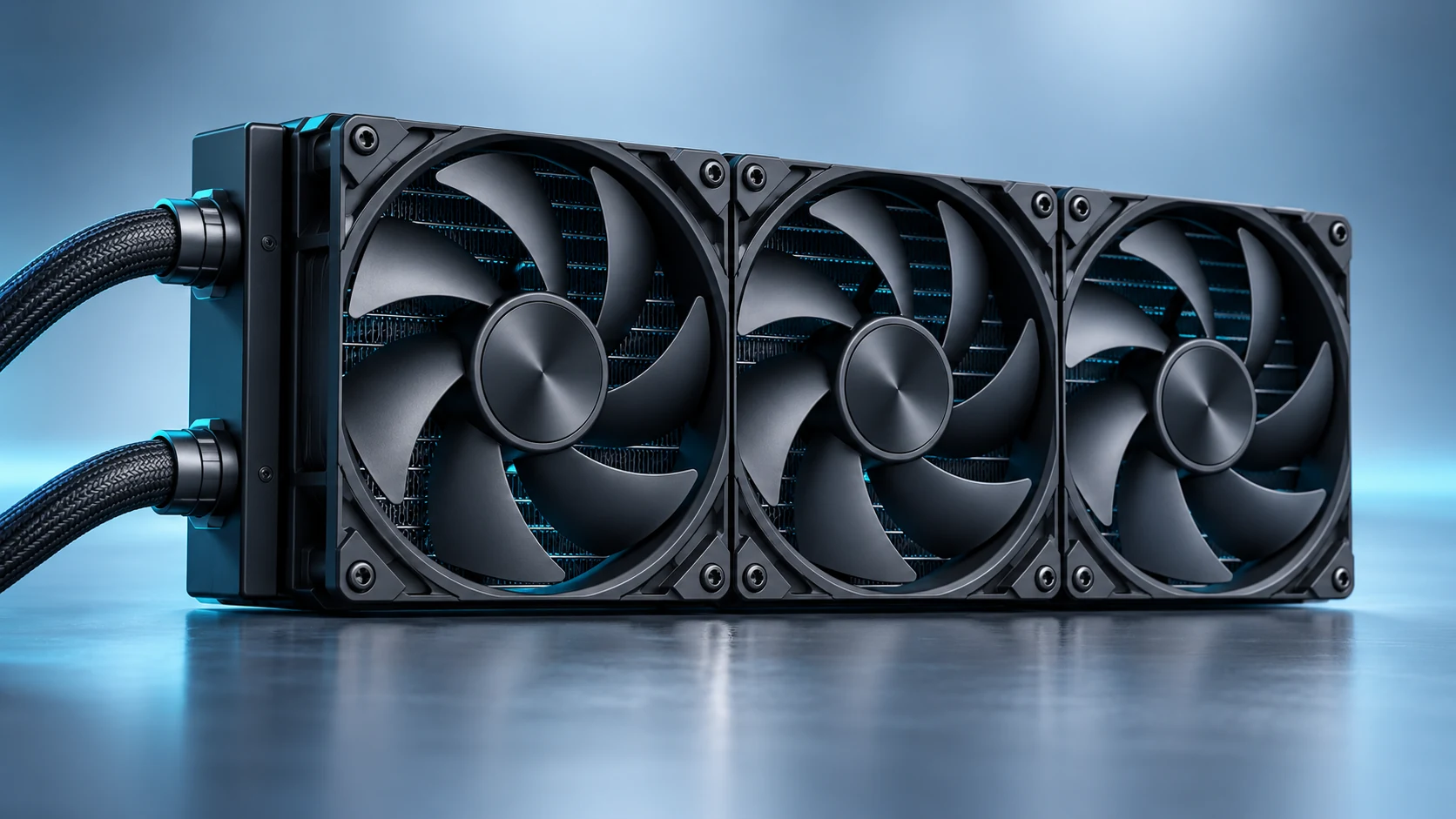
Radiator pressure
Fan options for dense fins, AIO coolers, and performance cooling products.
Pressure-focused airflow for radiators and dense fin stacks
Understanding the specific thermal and environmental demands of Liquid Cooling Radiator Fan environments is the foundation of every Herays solution.
Liquid cooling systems — used in high-performance computing, industrial power electronics, laser systems, EV battery thermal management, and medical imaging equipment — transfer heat from primary components to a remote radiator where DC fans dissipate the thermal load to ambient air. The radiator fan is the last thermal barrier between the liquid loop and the environment. Its performance directly determines whether the entire liquid cooling system achieves its temperature targets. Unlike free-air electronics cooling where airflow paths are relatively unobstructed, radiator fans must overcome the substantial static pressure imposed by dense copper or aluminum fin stacks while delivering the full airflow the thermal calculation assumed.
What makes radiator fan selection fundamentally different from standard electronics cooling:
The Herays HR1225 and HR1238 series provide the combination of high static pressure and wide speed range needed for effective radiator fan operation in both PC and industrial liquid cooling systems.
How do I determine whether I need push or pull fan configuration on my radiator? For most 120 mm radiators up to 45 mm thick, a single fan in either push or pull orientation delivers adequate performance. For thicker radiators (60+ mm), dual-row fin stacks, or dense fin counts above 20 FPI, push-pull using matched fan pairs typically recovers 15–20% additional airflow for 3–5 dBA of additional acoustic output at maximum speed — a worthwhile trade in thermally-constrained builds.
What causes a fan to produce high-frequency tonal noise through a radiator? Tonal noise occurs when the fan’s blade passing frequency (RPM/60 × blade count) coincides with a resonant frequency of the radiator fin stack or mounting frame. This is a mechanical resonance, not an airflow issue. Mitigation: use silicone anti-vibration fan mounts, change the fan speed slightly (which shifts the blade passing frequency away from the resonance), or select a different blade count.
How does fan speed affect radiator thermal performance at low load? At low heat load and low ambient temperature, the liquid coolant temperature is naturally low. Reducing fan speed to minimum reduces noise significantly with minimal penalty to coolant temperature — the system is not thermally limited. The thermal benefit of high fan speed is only realized when coolant temperature is elevated, which occurs under high load or high ambient conditions. A temperature-driven PWM controller exploits this automatically.
Contact Herays for radiator fan selection support, push-pull configuration recommendations, and matched fan pair sourcing for industrial liquid cooling system builds.
Precision-engineered DC fan technologies tailored to the performance and reliability requirements of Liquid Cooling Radiator Fan applications.
Fan options for dense fins, AIO coolers, and performance cooling products.
Flexible speed control for thermal and acoustic balance.
Lighting, cable, frame, and private-label customization.
Herays DC fan and blower products engineered to meet the performance requirements of Liquid Cooling Radiator Fan systems.
 DC Axial Fan
DC Axial Fan
DC Axial Fan
DC Axial Fan
DC Axial Fan
DC Axial Fan
DC Axial Fan
DC Axial Fan
DC Axial Fan
DC Axial Fan
DC Axial Fan
 DC Axial Fan
DC Axial Fan
DC Axial Fan
Our application engineers are available to help you select the right product for your system requirements.