
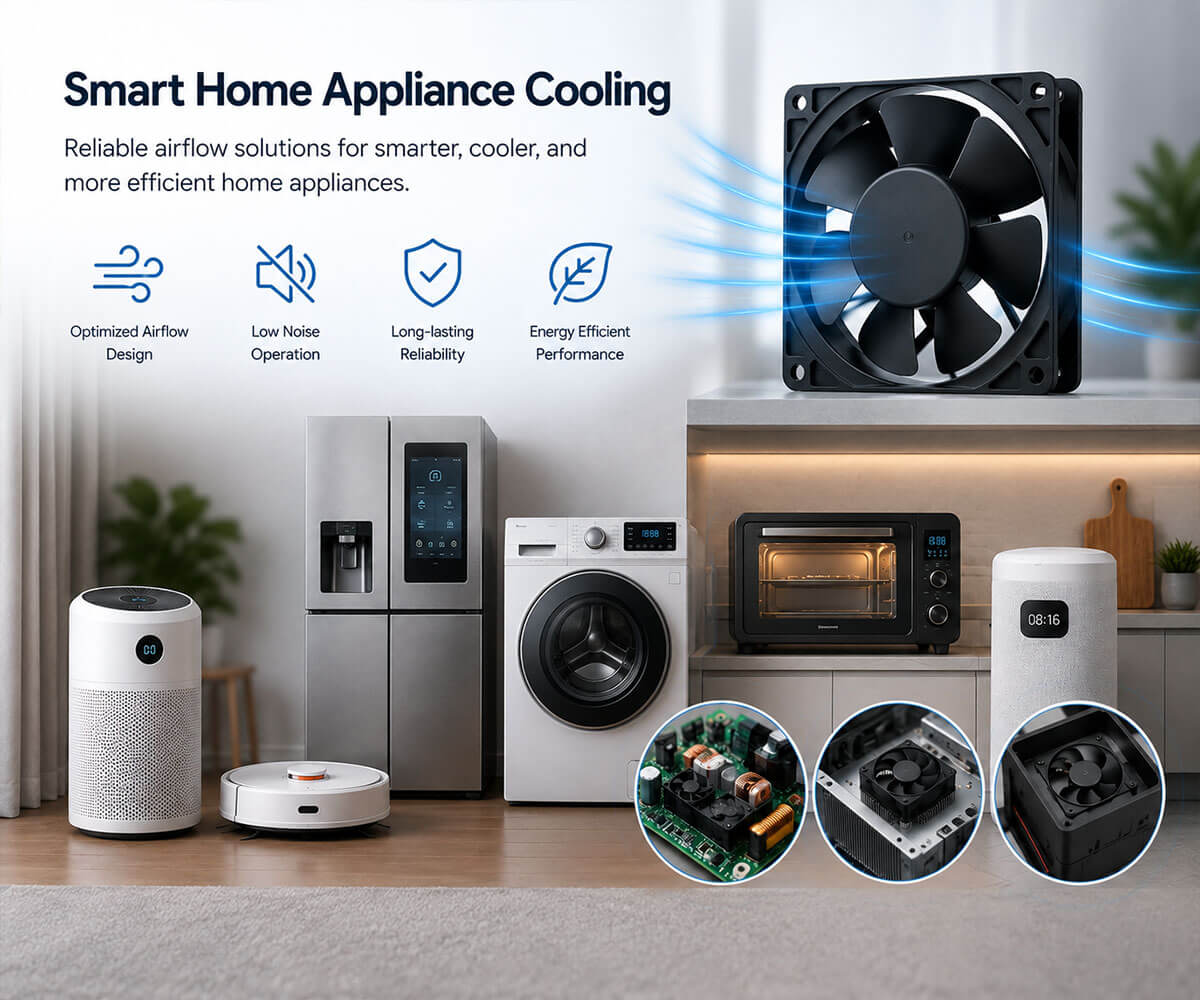
Appliance airflow
Air movement for motors, electronics, filters, and compact housings.
Compact low-noise airflow for household appliance electronics
Understanding the specific thermal and environmental demands of Smart Home Appliance Cooling Fans environments is the foundation of every Herays solution.
Smart home appliances — robot vacuum cleaners, smart speakers with amplifiers, home automation hubs, smart projectors, WiFi 6 routers with high-power chipsets, streaming media boxes, and game consoles — increasingly push thermal limits that were not present in their non-smart predecessors. The processing cores, wireless radios, and power management ICs in a modern smart home device can dissipate 10–40 W in enclosures designed for aesthetics rather than thermal management. Fan-cooled smart home devices face a unique design challenge: the product must look and sound like a consumer appliance, not an industrial computer.
Herays compact DC axial fans in 60–80 mm and 12V configurations are suitable for smart home appliance thermal management, providing quiet operation and ball-bearing reliability in the form factors required for consumer product aesthetics.
For 5V operation from USB power rails, Herays can supply 5V fans in compact formats. Contact us with your power supply voltage and available current budget.
How do I manage fan noise in a smart speaker with a Class D amplifier? Class D amplifiers are 85–90% efficient, dissipating 10–15% of output power as heat. At 50W output, this is 7.5W of heat in a compact enclosure. A 60 mm fan at 800 RPM can typically handle this load while remaining below 25 dBA. The key is ensuring the fan’s airflow path passes directly over the amplifier heatsink rather than circulating uselessly in the enclosure. Design a directed airflow channel from the fan outlet to the heatsink if the enclosure geometry allows.
What causes a smart home device fan to become louder over its lifetime? The primary causes in consumer smart home devices are: bearing lubricant loss (leading to bearing noise), dust accumulation on the impeller (leading to imbalance and vibration noise), and thermal runaway where an inadequate initial specification runs the fan faster and faster over time. Ball bearings lose lubricant much more slowly than sleeve bearings, making them strongly preferable for devices that will run for years without user maintenance.
Can I eliminate the fan entirely in a smart home device with passive cooling? At die powers below 8–10 W in a well-ventilated enclosure, passive cooling through the device housing is feasible. Above 10 W in a sealed aesthetic enclosure, passive cooling requires large fin-area heat spreaders that conflict with product design goals. Most smart devices above 15 W total system power (SoC + WiFi radio + peripherals) need active cooling to meet operating temperature specifications across the full ambient range including summer conditions.
Contact Herays for compact smart home fan specifications, 5V and 12V options, and OEM supply for consumer appliance manufacturers.
Precision-engineered DC fan technologies tailored to the performance and reliability requirements of Smart Home Appliance Cooling Fans applications.
Air movement for motors, electronics, filters, and compact housings.
Fan choices suitable for user-facing household products.
Connector, wire, label, and repeatable batch supply for appliance brands.
Compare candidate products for Smart Home Appliance Cooling Fans. Confirm the operating point, dimensions, control interface and test requirements before selecting a model.
 DC Axial Fan
DC Axial Fan
DC Axial Fan
DC Axial Fan
DC Axial Fan
DC Axial Fan
DC Axial Fan
DC Axial Fan
DC Axial Fan
Technical and application-specific questions about Herays fans for Smart Home Appliance Cooling Fans environments.
Our application engineers are available to help you select the right product for your system requirements.