
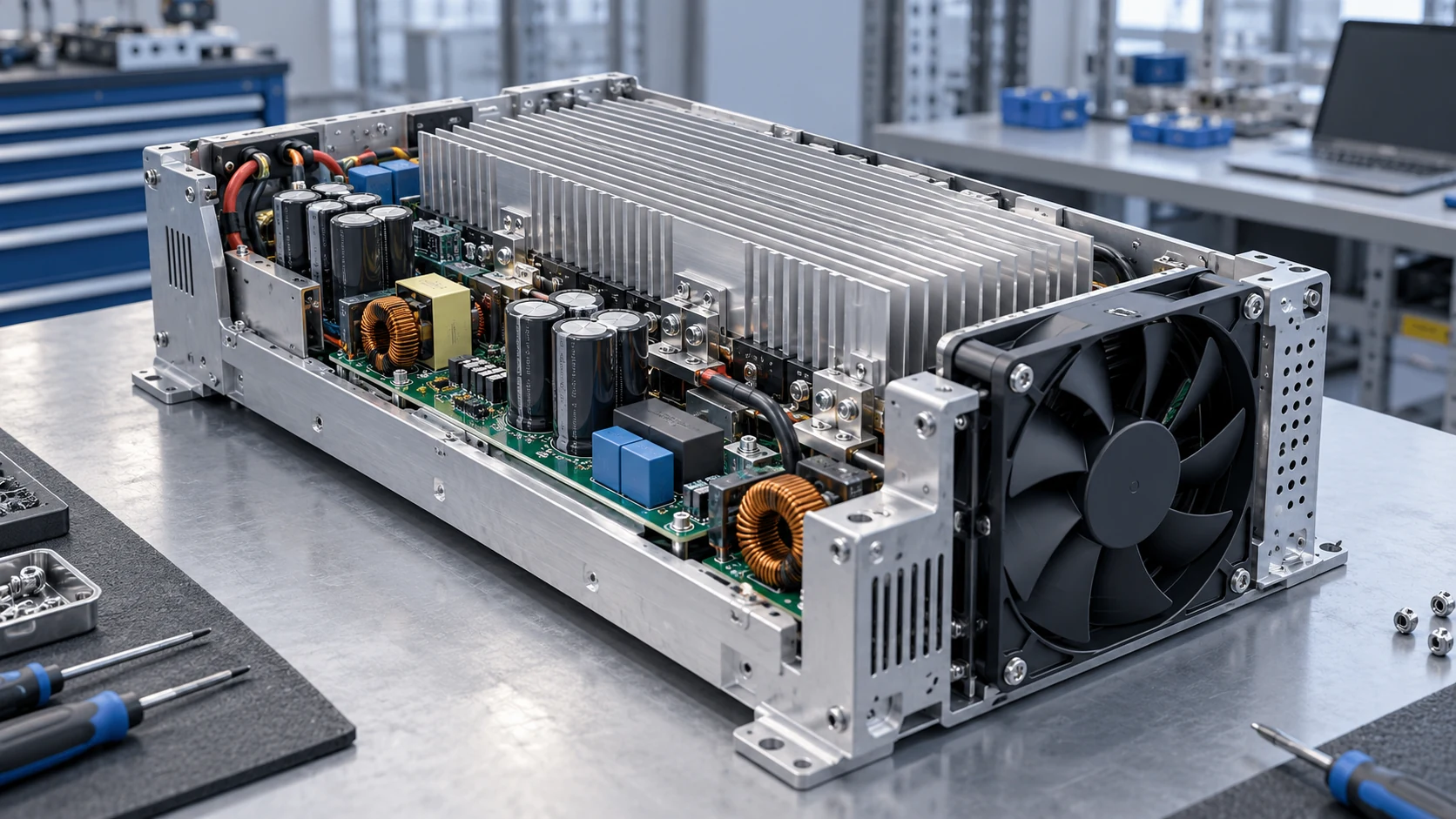
Heat-sink cooling
Directed airflow across heat sinks, power boards, and conversion modules.
Thermal management for heat sinks, power modules, and conversion equipment
Understanding the specific thermal and environmental demands of Power Electronics and Inverter Cooling environments is the foundation of every Herays solution.
Power electronics — inverters, rectifiers, AC-DC converters, DC-DC modules, and motor drives — dissipate heat through IGBT modules, MOSFETs, diodes, inductors, and transformer cores. The challenge for cooling fan selection is that these heat loads are not constant: they vary with AC line conditions, load, ambient temperature, and the specific duty cycle of the application. A fan chosen for peak load conditions at 25°C may be dramatically oversized (and noisy) at partial load, or undersized when ambient temperatures reach summer maximums.
Key fan selection criteria for power electronics thermal management:
Herays industrial axial fans are used in inverter and power converter cooling across industrial, telecom, and renewable energy applications. Available in 12V, 24V, and 48V with ball-bearing options across the range.
Tachometer output variants (−SF models) are available for all sizes and voltages, enabling the converter controller to detect fan failure and de-rate output power before thermal damage occurs — essential for any converter in unattended or remote installations.
How do I determine how much airflow my power converter needs? Start with the heatsink thermal resistance (°C/W) and the junction-to-case resistance of your switching devices. Work backwards from maximum allowable junction temperature to find the maximum allowable heatsink temperature, then calculate required airflow. Apply a 1.3× safety margin and derate by the actual system pressure drop.
Should I use PWM or analog fan speed control? PWM is strongly preferred. Analog voltage control (running the fan below rated voltage) reduces efficiency and risks startup failures at low temperatures. For any design where reliability matters, implement PWM control.
Blowing through or drawing through the heatsink? Both work. Drawing air through (fan on outlet side) allows cooler air to enter the heatsink first, which is thermally slightly better. A close-coupled fan-heatsink assembly without bypass air paths significantly outperforms one with large gaps between the fan frame and heatsink fins.
Contact Herays with your converter power dissipation, heatsink geometry, and bus voltage to get a fan recommendation and thermal management support.
Precision-engineered DC fan technologies tailored to the performance and reliability requirements of Power Electronics and Inverter Cooling applications.
Directed airflow across heat sinks, power boards, and conversion modules.
Selection by airflow, static pressure, voltage, speed, and acoustic target.
Connector, wire, label, and batch production support for equipment manufacturers.
Herays DC fan and blower products engineered to meet the performance requirements of Power Electronics and Inverter Cooling systems.
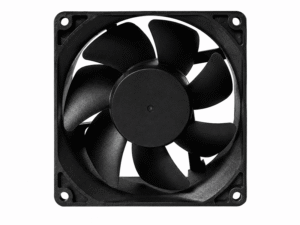 DC Axial Fan
DC Axial Fan
DC Axial Fan
DC Axial Fan
DC Axial Fan
DC Axial Fan
DC Axial Fan
DC Axial Fan
DC Axial Fan
DC Axial Fan
DC Axial Fan
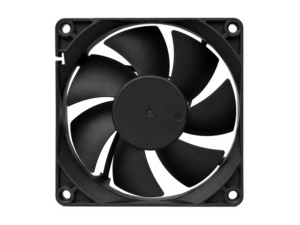 DC Axial Fan
DC Axial Fan
DC Axial Fan
Our application engineers are available to help you select the right product for your system requirements.