
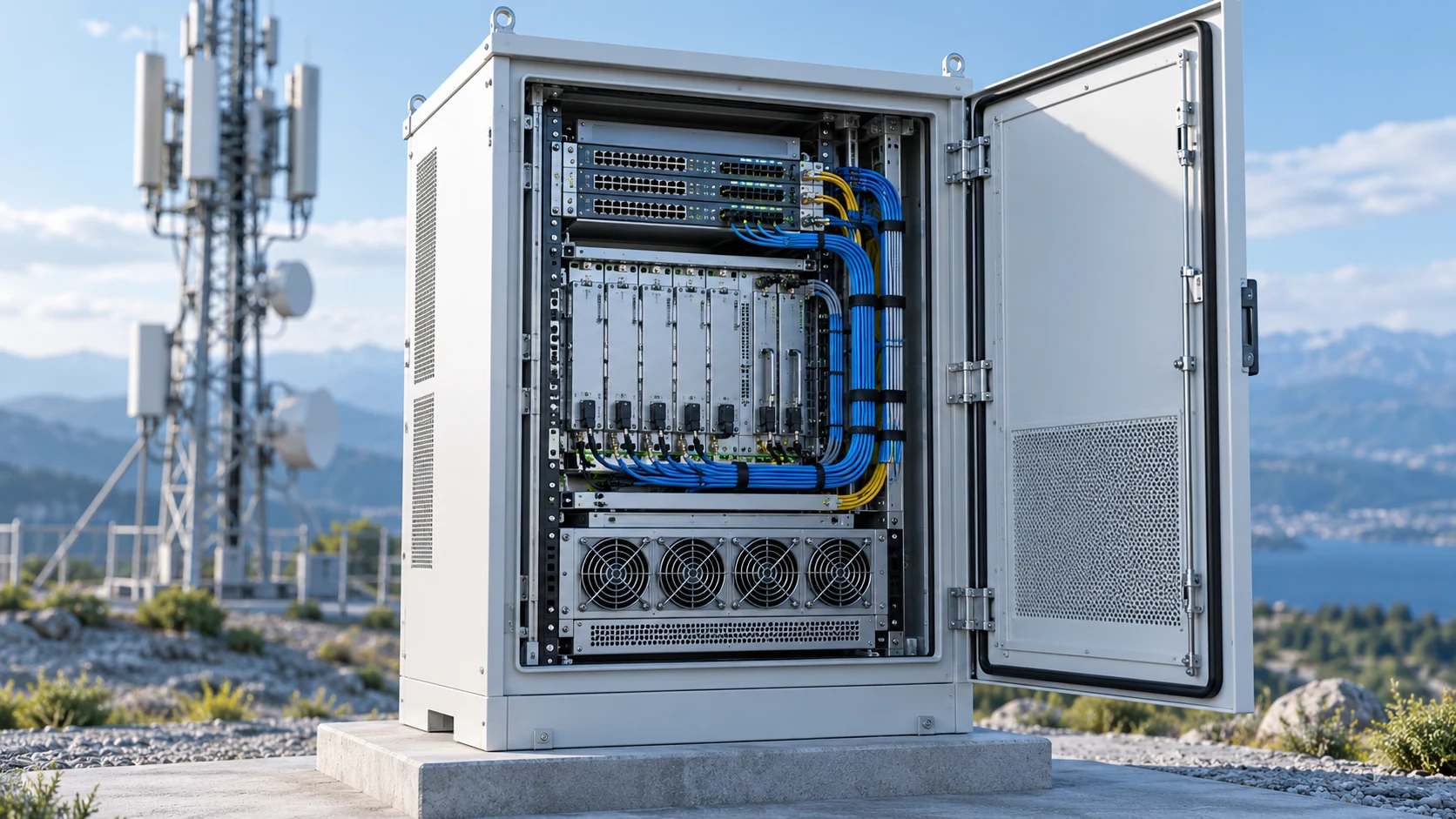
Infrastructure uptime
Fan choices for 24/7 telecom, networking, and edge equipment operation.
Reliable airflow for communication equipment and network infrastructure
Understanding the specific thermal and environmental demands of Telecom and Network Equipment Cooling environments is the foundation of every Herays solution.
Telecommunications infrastructure — base station equipment, optical transport nodes, edge computing chassis, and network aggregation units — operates under carrier-grade reliability requirements that place demands on cooling fans that no other commercial electronics application matches. A server in a data center gets routine maintenance; a fan in an outdoor base station cabinet is expected to run for 7–10 years without access. The thermal management system must be designed around this reality from the start.
What distinguishes telecom equipment cooling from general industrial applications:
Herays 48V DC axial fans are designed for telecom equipment cooling, offering ball-bearing construction, tachometer output, and CE/RoHS certification across the HR1225 and HR1238 series.
Tachometer output (−SF variants) enables the chassis management controller to monitor each fan’s actual speed, detect bearing degradation before failure, and trigger N+1 failover. This is the standard integration path for managed telecom equipment.
Is a 48V fan meaningfully different from a 24V fan with a DC-DC converter? Yes — every converter is an additional failure mode with its own MTBF. In carrier-grade equipment where the goal is achieving 99.999% uptime (“five nines”), eliminating unnecessary components is not an optimization, it’s a design requirement. A 48V-native fan removes the converter entirely from the cooling path.
How do I account for altitude derating in my airflow calculation? Multiply open-frame CFM by the ratio of air density at your installation altitude to sea-level air density. At 3,000 m altitude, air density is approximately 74% of sea level — a fan rated at 134 CFM at sea level delivers approximately 99 CFM at that altitude. Size the fan to meet your thermal requirement after this derating.
Can I use the same fan in both indoor and outdoor telecom enclosures? For outdoor enclosures, specify IP54 or higher and UV-stabilized materials. For indoor controlled environments, open-frame fans are appropriate. The electrical and mechanical specifications are otherwise the same; the difference is in the environmental protection of the fan housing and motor seal.
Herays supplies 48V cooling fans to telecom equipment OEMs and system integrators with custom cable assemblies, connector configurations, and documentation for NEBS or ETSI compliance packages. Contact us with your chassis specifications and thermal budget.
Precision-engineered DC fan technologies tailored to the performance and reliability requirements of Telecom and Network Equipment Cooling applications.
Fan choices for 24/7 telecom, networking, and edge equipment operation.
Waterproof and dust-resistant options for cabinets and exposed environments.
PWM, tachometer, connector, and voltage customization for system integration.
Herays DC fan and blower products engineered to meet the performance requirements of Telecom and Network Equipment Cooling systems.
 DC Axial Fan
DC Axial Fan
DC Axial Fan
DC Axial Fan
DC Axial Fan
DC Axial Fan
DC Axial Fan
DC Axial Fan
DC Axial Fan
DC Axial Fan
DC Axial Fan
 DC Axial Fan
DC Axial Fan
DC Axial Fan
Our application engineers are available to help you select the right product for your system requirements.