
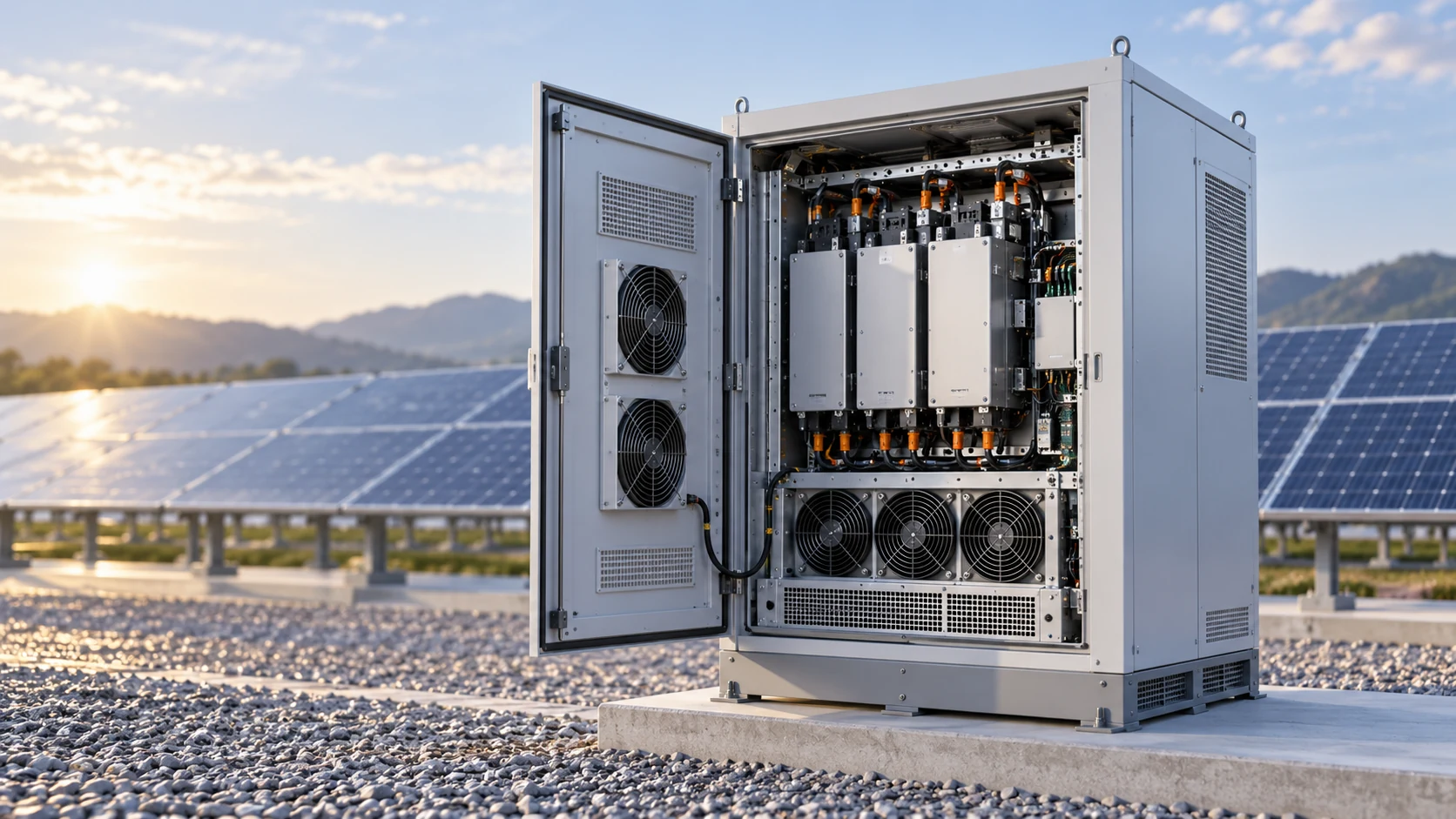
PV electronics airflow
Cooling for inverter modules, inductors, boards, and cabinet spaces.
Reliable airflow for solar power conversion and outdoor PV electronics
Understanding the specific thermal and environmental demands of Solar Inverter and PV Equipment Cooling environments is the foundation of every Herays solution.
Solar inverters — string inverters, central inverters, microinverters, and hybrid storage inverters — operate in some of the most thermally demanding environments of any power electronics application. A grid-tied string inverter with 98% efficiency still dissipates 200 W per 10 kW nameplate continuously. In outdoor enclosures where ambient air may be 45–55°C after solar heating of the cabinet, the temperature rise available for electronics cooling may be only 10–15°C above ambient — requiring significantly higher airflow than the same inverter needs in a controlled indoor installation.
Critical cooling fan requirements specific to solar inverter applications:
The Herays HR1225 and HR1238 series offer the voltage, temperature, and certification profile required for string and small central inverter cooling. All variants carry CE and RoHS certification; ball-bearing models are available across the voltage range.
−SF (tachometer) variants are available for all models above. Extended operating temperature versions (−40°C to +85°C) are available on request for extreme-climate deployments.
Why do solar inverter fans fail more often than the inverter electronics? Most inverter electronics are solid-state with MTBF measured in hundreds of thousands of hours. Cooling fans have bearings — the one moving part in the system. A fan specified at 70,000 hours MTBF at 25°C may provide only 20,000–30,000 hours at the 60–70°C operating temperatures typical inside outdoor inverter enclosures in summer. Always de-rate MTBF to actual operating temperature when projecting field replacement intervals.
Continuous fan operation or temperature-triggered? Temperature-triggered operation extends bearing life by reducing operating hours and avoids noise during low-irradiance periods. Continuous operation at fixed speed is simpler but shortens fan life. PWM speed-ramped operation is standard practice in modern string inverters.
What replacement interval should I plan for? For ball-bearing 24V fans in outdoor string inverters in warm climates (average 40°C operating temperature), plan for a 7–10 year replacement cycle. Build fan replacement into your O&M contract from project inception — proactive replacement before bearing failure prevents unplanned downtime and the energy yield loss that accompanies inverter thermal shutdown.
Herays supplies cooling fans to solar inverter OEMs and EPC contractors for new installations and field replacement programs. Contact us to discuss volume pricing, custom connector configurations, and documentation packages for your inverter platform.
Precision-engineered DC fan technologies tailored to the performance and reliability requirements of Solar Inverter and PV Equipment Cooling applications.
Cooling for inverter modules, inductors, boards, and cabinet spaces.
Protection options for heat, humidity, dust, and field installation.
Stable fan specifications for renewable energy equipment OEMs.
Herays DC fan and blower products engineered to meet the performance requirements of Solar Inverter and PV Equipment Cooling systems.
 DC Axial Fan
DC Axial Fan
DC Axial Fan
DC Axial Fan
DC Axial Fan
DC Axial Fan
DC Axial Fan
DC Axial Fan
DC Axial Fan
DC Axial Fan
DC Axial Fan
 DC Axial Fan
DC Axial Fan
DC Axial Fan
Our application engineers are available to help you select the right product for your system requirements.