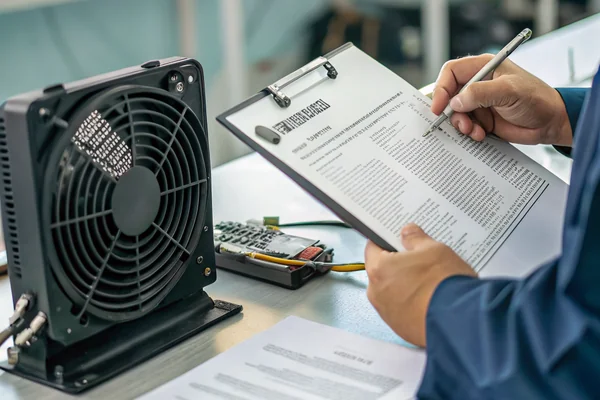
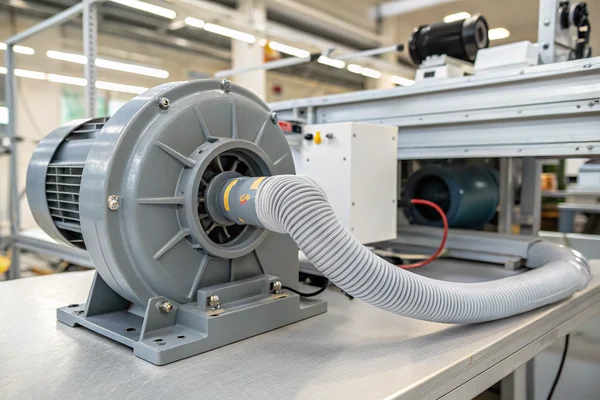
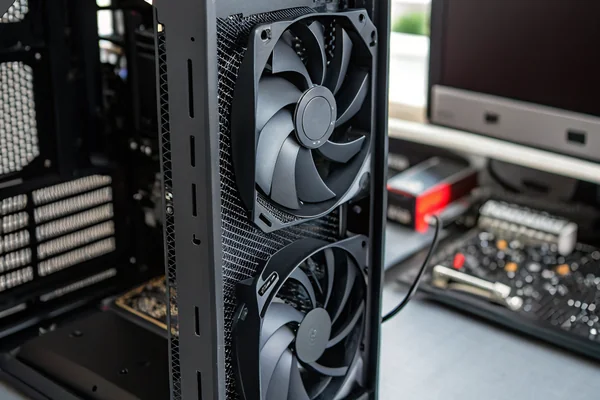
An engineer's fan kept failing inside a foundry control cabinet last year -- not from dust, not from moisture, but from heat warping the plastic frame just enough to throw the blades out of clearance. Swapping to a metal-frame fan solved it in one shipment. It's a small, unglamorous fix, and most engineers never think about frame material until a plastic one has already let them down.
- Standard plastic fan frames (ABS, PBT) are fine up to roughly 70-85°C continuous. Past that, or under sustained vibration, they can warp, crack, or creep out of tolerance -- that's the actual reason metal frames exist.
- Aluminum frames run lighter and conduct heat away from the motor housing, which matters more than people expect in sealed enclosures.
- Steel frames cost less as raw material but need a corrosion coating for anything humid or outdoor, and they're noticeably heavier -- fine for a welding cabinet, less fine for a drone.
- Specifying a metal frame just because it "sounds more rugged" is a real cost and weight tradeoff most electronics cooling applications never come close to needing.
- If your fan lives near an engine, a furnace, a foundry line, or anything that vibrates constantly for years, that's when the plastic-vs-metal question actually matters.
Table of Contents
Why Would You Choose a Metal Frame Over Plastic?
Plastic frames -- almost always ABS or PBT -- are the default for a reason. They're cheap to injection mold at volume, they're light, and for the overwhelming majority of electronics cooling jobs, they hold up fine for the life of the product. The problem shows up at the edges: sustained high heat, constant vibration, or an environment where a cracked plastic housing is a real safety or reliability risk.
ABS softens well before PBT does, and neither is built to survive indefinitely much past 70-85°C of continuous ambient. Push a plastic-frame fan into a hot cabinet, a foundry line, or an engine compartment, and you're not looking at a sudden failure -- you're looking at slow creep. The frame warps a fraction of a millimeter at a time, mounting holes stop lining up the way they used to, and eventually the blade tip clearance closes up enough to cause rubbing or a locked rotor.
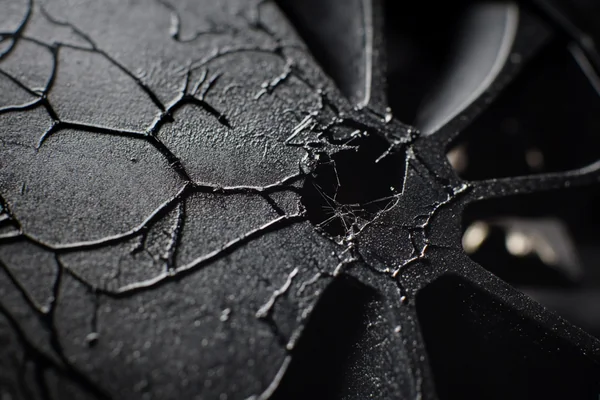
Vibration is the other trigger. Plastic fatigues under continuous cyclic stress in a way metal doesn't. A fan bolted to a compressor, an off-highway vehicle, or industrial machinery that runs 24/7 for years will show hairline stress cracks in the frame long before the motor itself gives out.
Metal frames -- aluminum or steel -- solve both problems at once, at the cost of price and weight. The question is never "is metal better," it's "does this specific application actually need it."
Aluminum vs Steel Fan Frames: Which Should You Choose?
Once you've decided you need metal, the aluminum-versus-steel question comes down to three things: heat, weight, and environment.
Aluminum is the more common choice for electronics-adjacent applications. It's roughly a third the density of steel, so a metal-frame fan doesn't suddenly become a burden in a weight-sensitive design -- this matters in telecom equipment, aerospace-adjacent gear, and anything portable. It also conducts heat well, which means the frame itself becomes a small heat sink, pulling warmth away from the motor housing rather than trapping it. Anodized aluminum resists corrosion reasonably well without extra coating, though it's not bulletproof against salt exposure.
Steel wins on raw strength and vibration resistance. If the fan is going into a welding cabinet, a stamping press enclosure, or anything that takes physical shock as well as heat, steel's stiffness and impact resistance usually outperform aluminum. The tradeoff is weight -- often more than double an equivalent aluminum frame -- and steel needs a real corrosion coating (zinc plating, powder coat, or similar) if it's going anywhere humid, since bare steel rusts.
| Factor | Aluminum Frame | Steel Frame |
|---|---|---|
| Relative weight | Light (~1/3 density of steel) | Heavy |
| Thermal conductivity | High -- frame helps dissipate heat | Low -- frame stays hotter |
| Corrosion resistance | Good bare, better anodized | Poor bare -- needs coating |
| Vibration/impact resistance | Good | Excellent |
| Typical cost | Higher | Lower raw material, coating adds back cost |
| Common use case | Telecom, sealed enclosures, weight-sensitive gear | Foundry, welding, heavy industrial machinery |
When Do You Actually Need a High-Temperature Metal Fan?
The applications where this actually matters share one thing in common: sustained heat that a standard plastic frame just wasn't built for.
Foundry and furnace cooling is the clearest case -- ambient temperatures near industrial ovens or casting lines routinely sit well above what ABS or PBT can handle long-term. Engine compartment cooling on off-highway vehicles and generators is another: heat plus constant vibration is exactly the combination that breaks plastic frames fastest. Welding equipment cooling fans face the same double load, with the added complication of metal spatter that a plastic housing handles poorly.
High-bay LED lighting fixtures and industrial oven electronics also push into this territory, less because of any single extreme temperature spike and more because of the cumulative effect of running hot, continuously, for years. In these cases, a metal-frame fan paired with a high-temperature-rated motor winding and bearing grease can extend real service life well past what a standard fan would deliver in the same slot.
It's worth being honest about the flip side: most electronics cooling, server, and PC applications never get anywhere near these temperatures, and specifying a metal frame there is just added cost and weight for no real benefit.
We've been building DC fans for over 20 years, and metal-frame requests almost always come from customers who already had a plastic-frame failure in the field -- it's rarely a first-choice spec. Our Dongguan facility runs both aluminum and steel frame options through the same validation process as our standard product line: our temperature cycling test system and drop test rig both run frame-specific test profiles, since a metal frame changes how stress transfers into the mounting points. We're IATF 16949 and ISO 9001 certified, and for any high-temperature frame spec we can pull thermal cycling data at the actual temperature your application runs at, not just the datasheet's rated maximum.
How Much Do Metal Frames Actually Improve Vibration and Durability?
This is where the physical difference between plastic and metal actually plays out over years, not just under a single stress test.
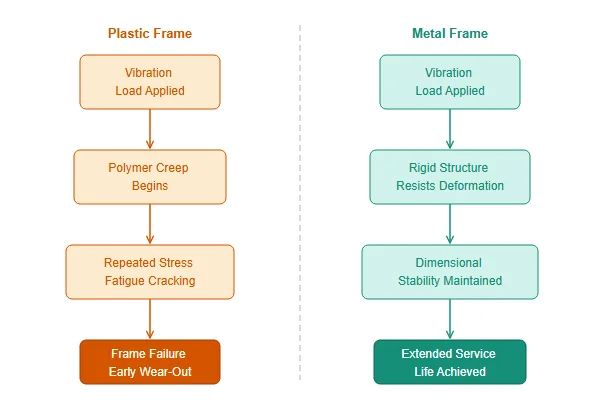
Plastic frames deform under sustained vibration through a mechanism called creep -- the material slowly, permanently deforms under continuous load, even at stress levels well below what would cause immediate failure. Over months of constant vibration, mounting holes elongate slightly, screws work loose more easily, and the frame's dimensional accuracy drifts. Metal doesn't creep the same way at normal operating temperatures; a steel or aluminum frame that's dimensionally correct on day one tends to stay that way.
The second factor is thermal cycling. Plastic has a coefficient of thermal expansion roughly 5-10x higher than aluminum or steel1, which means a plastic frame expands and contracts far more with every heat-up and cool-down cycle. Do that thousands of times over a product's life, and the repeated stress accelerates fatigue cracking in a way metal frames largely avoid.
In practice, this means a metal-frame fan in a genuinely harsh vibration or thermal-cycling environment can outlast an equivalent plastic-frame fan by a wide margin -- not because the motor or bearing is different, but because the frame itself stops being the weak point.
What Do You Give Up in Cost and Weight With Metal?
Nothing here is free. A metal-frame fan typically costs more than its plastic equivalent -- machining or stamping metal costs more per unit than injection molding plastic at volume, and that gap doesn't close much even at higher order quantities.
Weight is the other real tradeoff. Even aluminum, the lighter of the two metal options, adds noticeable weight compared to plastic, and steel adds considerably more. For anything where weight matters directly -- portable equipment, aerospace-adjacent designs, drone cooling -- that added mass has to be justified by an actual environmental need, not just a preference for "something that feels more solid."
The practical way to think about it: if your application doesn't involve sustained high heat or continuous heavy vibration, a metal frame is very likely solving a problem you don't have, at a cost and weight penalty you didn't need to pay. If it does involve either of those, the frame material stops being a minor spec and starts being the thing that determines whether the fan survives its intended service life.
FAQ
Do metal-frame DC fans need different mounting hardware than plastic-frame fans? Usually not the hardware itself, but torque specs can differ slightly since metal doesn't compress the way plastic does around a mounting screw. Check the manufacturer's recommended torque rather than assuming it matches a plastic-frame equivalent.
Can a metal frame fan use the same motor and bearing as a plastic-frame version? Often yes for standard temperature ranges, but genuinely high-temperature applications usually pair the metal frame with upgraded motor windings and high-temperature bearing grease as well -- the frame alone doesn't solve a motor that can't handle the heat.
Does an aluminum frame provide any EMI shielding benefit? Some, though it's not a substitute for proper enclosure shielding. A metal frame can help bond to a grounded chassis, which matters more in some industrial control cabinet designs than in typical consumer electronics.
Is a metal frame worth it just for a slightly quieter fan? Not on its own. Frame material has a minor effect on resonance and noise, but it's a poor reason to pay the cost and weight premium if heat and vibration aren't already a concern.
How do I know if my plastic-frame fan is actually failing from creep versus a different problem? Look for mounting holes that have elongated slightly, a frame that no longer sits flush, or blade rub that wasn't present when the fan was new. Straightforward electrical failures (bearing noise, no-start) usually aren't frame-related at all.
What certifications should I ask for on a metal-frame fan meant for industrial use? Ask for the same base certifications you'd want on any industrial fan -- ISO 9001 at minimum -- plus whatever thermal cycling or vibration test data the supplier can provide at your actual application temperature, not just the fan's rated maximum.
Frame material is one of the least glamorous specs on a fan datasheet, and it's also one of the specs most likely to get ignored right up until it's the reason a product fails in the field. If your application runs hot, vibrates constantly, or both, it's worth asking your supplier directly whether their standard plastic frame has ever been tested at your actual conditions -- not just its rated maximum.
At Herays, we've spent over 20 years building DC fans for exactly these edge cases, with in-house temperature cycling, drop testing, and dynamic balance correction equipment to validate frame and motor combinations before they ship, under ISO 9001, ISO 14001, and IATF 16949 certification.
"Thermal expansion", https://en.wikipedia.org/wiki/Thermal_expansion. Common engineering plastics have linear thermal expansion coefficients roughly 5-10x higher than aluminum or steel. ↩

Liang
I've been working with DC fans for 30 years — long enough to have seen the industry evolve from basic sleeve bearing designs to today's high-efficiency, IP68-rated systems built for the harshest environments imaginable. I founded Herays because I believed manufacturers and engineers deserved a supplier who could talk technical from day one. Not just hand over a datasheet, but actually help you select the right fan for your thermal load, your enclosure, your certification requirements. Most of what I write here comes directly from problems I've solved on the factory floor or in customer applications — medical devices, laser equipment, industrial automation, you name it. If it involves moving air efficiently and reliably, I've probably spent time thinking about it. When I'm not obsessing over airflow curves, I'm usually helping a customer figure out why their cooling system isn't performing the way their simulation said it would.
View all posts by Liang