Bolting any case fan onto a radiator works, technically -- the fan spins, air moves -- but getting genuinely good liquid cooling performance depends on choosing fans that were actually matched to what a radiator demands.
Case fans used on radiators and AIO liquid coolers need meaningfully higher static pressure capability than fans used for open case airflow, since the radiator's dense fin array creates real resistance -- choosing a fan optimized for open airflow rather than static pressure is one of the more common mismatches that quietly limits AIO cooling performance.
- AIO and custom loop radiators require fans that can maintain airflow against the fin array's resistance, making static pressure capability more important than raw free-air CFM for this specific use.
- Standard static pressure requirements for radiators scale with fin density and radiator thickness, meaning thicker or denser radiators demand correspondingly more capable fans.
- Fan placement -- push (blowing into the radiator), pull (drawing air through it), or push-pull (both) -- affects both cooling performance and noise, with different tradeoffs for each configuration.
- Fan thickness (commonly 25mm vs 38mm) affects both static pressure capability and physical clearance requirements within the case.
- The best case fans for radiator use are generally purpose-optimized for static pressure, not general-purpose case fans repurposed for this role.
Understanding why radiator fan selection genuinely differs from general case fan selection clarifies why this is worth getting right rather than treating radiator mounting as an afterthought to fan choice.
Table of Contents
How Do AIOs Actually Use Case Fans as Part of Their Cooling System?
Understanding the AIO's basic cooling mechanism clarifies exactly what job the case fans are doing.
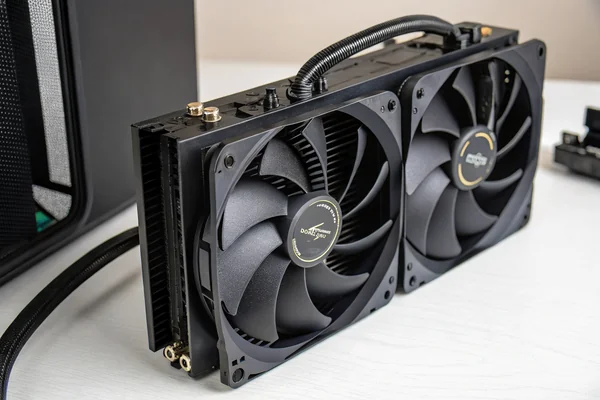
An AIO liquid cooler circulates coolant between a CPU cold plate (absorbing heat from the processor) and a radiator, where fans mounted on the radiator reject that absorbed heat to the surrounding air by pushing or pulling air through the radiator's fin array -- the fans are the final, critical step in actually removing the heat the liquid loop has collected, not just supplementary case airflow.
Why Radiator Fans Are Doing More Specialized Work Than General Case Fans
Unlike a general case fan moving air relatively freely through open space to manage overall case temperature, an AIO's radiator fans have one specific, critical job -- rejecting the CPU's heat load through a restrictive fin array -- making their performance at that specific task directly tied to the entire cooling loop's effectiveness. This is why radiator fan selection deserves more scrutiny than treating it as just another case fan position.
Why Does Static Pressure Matter So Much More for Radiator Fans Than General Case Fans?
This is the core technical reason radiator fan selection differs from general case fan selection.
Radiator fin arrays create meaningful airflow resistance that a fan optimized purely for high free-air CFM handles poorly, losing significant airflow once actually pushing against that resistance -- fans optimized for static pressure maintain much more of their airflow capability under this resistance, translating directly into better real-world radiator cooling performance.
Why a High-CFM-Rated Fan Can Still Underperform on a Radiator
A fan's headline CFM rating is measured in free air with no resistance, which can be substantially higher than what that same fan actually delivers once mounted against a radiator's fin array -- a static-pressure-optimized fan with a lower free-air CFM rating can genuinely outperform a higher-CFM general-purpose fan once both are actually tested on the same radiator, because the pressure-optimized fan maintains more of its airflow under real restriction. This is exactly why checking a fan's static pressure rating and, ideally, independent radiator-specific test data matters more than comparing free-air CFM alone for this application.
How Does Optimal Fan Placement -- Push, Pull, or Push-Pull -- Actually Affect Performance?
Fan orientation relative to the radiator is a genuine performance and noise variable worth understanding, not just a mounting preference.
Push configuration (fans blowing air into the radiator from outside the case) and pull configuration (fans drawing air through the radiator from inside the case) both work effectively, with push-pull (fans on both sides) providing the best raw thermal performance at the cost of using twice as many fans -- the right choice depends on your case's available mounting space and priority between maximum performance and simplicity.
Why Push-Pull's Performance Gain Comes With Real Tradeoffs
Push-pull configurations generally provide a measurable thermal improvement over single-side mounting by more evenly distributing airflow through the entire radiator fin depth, but this comes at the cost of doubling fan count (more cost, more noise sources, more case space required) for a performance gain that's often modest rather than dramatic, particularly on thinner radiators where a single well-chosen fan set already performs adequately. This is why push-pull is generally reserved for builders specifically chasing maximum thermal performance or working with especially thick, restrictive radiators, rather than a universal recommendation.
Does Fan Thickness (25mm vs 38mm) Actually Matter for Radiator Performance?
Fan depth is a specification worth understanding beyond just physical clearance, since it connects to real static pressure capability.
Standard 25mm-thick fans are the common default for radiator applications and work well for most builds, while thicker 38mm fans can generate meaningfully higher static pressure at a given noise level, making them worth considering specifically for thick or high-fin-density radiators where standard 25mm fans start to show their pressure limits.
Why Thicker Fans Trade Case Space for Pressure Capability
A thicker fan blade design generally allows for more aggressive pressure-generating geometry without the acoustic penalty a thinner fan would pay to achieve the same pressure, which is why 38mm fans appear specifically in high-performance radiator applications where standard 25mm options are approaching their effective limit. The tradeoff is straightforward -- 38mm fans require more physical clearance, which isn't available in every case, making this an option worth considering specifically when radiator restriction genuinely warrants it rather than a universal upgrade.

What Actually Makes a Fan a Good Choice Specifically for Radiator Use?
Bringing these factors together into practical selection criteria clarifies what to actually look for.
The best case fans for radiator use are purpose-optimized for static pressure (not general-purpose airflow-focused case fans), have published performance data at realistic radiator-resistance operating points rather than just free-air specs, and match your specific radiator's thickness and fin density in terms of required pressure capability.
Why "Best Case Fan" and "Best Radiator Fan" Are Often Different Products
A fan celebrated as an excellent general-purpose case fan for its high free-air CFM and low noise at that operating point isn't automatically the best choice for radiator duty, where its performance at a completely different (higher-resistance) operating point is what actually matters. This is why dedicated radiator-optimized fan lines exist as a distinct product category from general case fans, and why checking a fan's specific radiator or static-pressure performance data, not just its general case fan reputation, matters for this application.
Our PC case cooling fan line includes static-pressure-optimized models specifically suited to radiator and AIO applications, validated on our in-house CFM airflow test system at our Dongguan facility at realistic restricted-airflow operating points, not just free-air conditions. With over 20 years of production experience under ISO 9001 certification, we can support system integrators and AIO manufacturers with fan specifications matched to specific radiator resistance requirements.
How Should You Approach Testing Fan Options Before Committing to a Radiator Build?
For builders wanting confidence beyond datasheet comparisons, direct testing on the actual radiator resolves lingering uncertainty.
Test candidate radiator fans by measuring coolant or CPU temperature under sustained full load with each fan option installed at the same speed setting, and separately compare noise output at that matched thermal performance point -- this reveals real differences a free-air CFM or static pressure spec sheet comparison alone can't fully capture for your specific radiator.
Why Testing on Your Actual Radiator Beats Trusting General Fan Reviews
General fan reviews and independent test data are genuinely useful starting points, but the specific combination of your radiator's fin density, thickness, and case airflow environment can produce somewhat different relative results than a review tested on a different radiator model. For builders with the time and interest, testing two or three strong candidate fans directly on their actual radiator, at matched speed or matched noise level, gives the most reliable answer for that specific build.

FAQ
Do all AIO coolers come with radiator-appropriate fans included, or do I need to buy separately?
Most AIO coolers include fans matched to their specific radiator, generally chosen appropriately by the manufacturer -- aftermarket fan upgrades are typically pursued by builders seeking either better acoustic performance or higher thermal headroom than the included fans provide.
Does radiator fan speed need to be different from general case fan speed curves?
Not fundamentally, though radiator fans often benefit from slightly more aggressive curves tied to coolant or CPU temperature specifically, since they're directly responsible for rejecting the CPU's heat load rather than general case temperature management.
Can I use the same fans on a radiator that I'd use for general case airflow?
You can physically mount them, but a fan optimized for open-airflow case use may underperform on a radiator compared to a static-pressure-optimized alternative, even if both have similar free-air specifications.
Does radiator size (240mm vs 360mm) change fan selection priorities?
Larger radiators with more total fin surface area can sometimes achieve adequate cooling with less aggressive per-fan pressure requirements, though this varies by specific radiator design and isn't a strict rule across all products.
Is push or pull generally quieter for a given radiator setup?
This varies by specific fan and radiator combination rather than following a universal rule, though pull configurations are sometimes reported as marginally quieter in some setups due to more laminar airflow entering the fan versus exiting through it.
Do radiator fans need different bearing types than general case fans for reliability?
The same bearing type considerations (ball, sleeve, fluid dynamic) apply, though radiator fans often run at higher average speeds than lightly-loaded general case fans, making quality bearing selection proportionally more important for long-term radiator fan reliability.
Getting radiator and AIO fan selection right comes down to prioritizing static pressure capability and understanding how placement and thickness affect real performance, not treating it as a general case fan decision. At Herays, our Dongguan facility manufactures static-pressure-optimized case cooling fans validated for radiator applications, backed by over 20 years of experience under ISO 9001 certification. If you're specifying fans for a liquid cooling or AIO product, we're glad to help match specifications to your radiator's actual requirements.

Liang
I've been working with DC fans for 30 years — long enough to have seen the industry evolve from basic sleeve bearing designs to today's high-efficiency, IP68-rated systems built for the harshest environments imaginable. I founded Herays because I believed manufacturers and engineers deserved a supplier who could talk technical from day one. Not just hand over a datasheet, but actually help you select the right fan for your thermal load, your enclosure, your certification requirements. Most of what I write here comes directly from problems I've solved on the factory floor or in customer applications — medical devices, laser equipment, industrial automation, you name it. If it involves moving air efficiently and reliably, I've probably spent time thinking about it. When I'm not obsessing over airflow curves, I'm usually helping a customer figure out why their cooling system isn't performing the way their simulation said it would.
View all posts by Liang