Every electronic system generates heat somewhere, and getting that heat safely out of the system determines whether the design lives up to its performance and reliability targets -- or fails prematurely trying.
Thermal management for electronics engineers comes down to understanding the three modes of heat transfer, knowing how thermal resistance and junction temperature relate to component reliability, choosing between fan, heat pipe, and liquid cooling based on the specific thermal load, and approaching system-level thermal design holistically rather than solving cooling component by component in isolation.
- Heat leaves an electronic system through conduction, convection, and radiation, and understanding which mode dominates in a given design informs where thermal design effort should focus.
- Thermal resistance and junction temperature are the key parameters connecting a component's actual power dissipation to its real operating reliability and lifespan.
- Fan cooling, heat pipes, and liquid cooling each fit different thermal load ranges and design constraints, and choosing between them should follow the actual thermal budget, not habit or trend.
- System-level thermal design -- considering the whole airflow path and thermal budget together -- consistently outperforms optimizing individual components in isolation.
- Thermal management decisions made early in a design have outsized influence on final product reliability and performance compared to changes made late in development.
Building a working foundation across these core thermal management concepts gives engineers a framework for making informed cooling decisions rather than defaulting to familiar solutions regardless of fit.
Table of Contents
Why Is Thermal Management Actually Critical to Electronic System Design?
Understanding what's at stake connects thermal design decisions to real reliability and performance outcomes.
Thermal management is critical because nearly every electronic component has a maximum safe operating temperature, beyond which performance degrades, reliability drops, and outright failure becomes increasingly likely -- effective thermal design keeps components within their safe operating range across the product's full range of real-world operating conditions, not just under ideal test conditions.
Why This Extends Beyond Simply Preventing Immediate Failure
Operating a component consistently near its thermal limit, even without triggering immediate failure, accelerates degradation mechanisms that shorten its effective service life compared to operation with adequate thermal margin -- meaning thermal management affects long-term reliability and warranty performance, not just the binary question of whether a component survives. This is why thermal design targets typically build in margin below the absolute maximum rated temperature, rather than designing right up to the limit.
What Are the Three Modes of Heat Transfer, and Why Does the Distinction Matter?
Understanding these fundamental physics mechanisms clarifies which cooling approaches actually address the heat transfer happening in a given design.
Heat leaves an electronic system through conduction (direct transfer through solid materials, like a chip to its heatsink), convection (transfer to moving air or liquid, like a fan-cooled heatsink to ambient air), and radiation (electromagnetic emission, generally a minor contributor in typical electronics cooling compared to the other two modes) -- effective thermal design addresses conduction and convection as the primary pathways, with radiation as a secondary consideration.
Why Conduction and Convection Dominate Most Practical Thermal Designs
In most electronics cooling scenarios, radiation contributes a relatively small fraction of total heat rejection compared to conduction (getting heat from the component to a heatsink or thermal interface efficiently) and convection (getting that heat from the heatsink into moving air or liquid that carries it away). This is why thermal design effort typically concentrates on optimizing the conduction path (thermal interface materials, heatsink design) and the convection path (airflow rate, heatsink fin design) rather than radiation, except in specialized applications like spacecraft thermal design where radiation becomes the dominant heat rejection mechanism due to the vacuum environment.
| Heat Transfer Mode | Mechanism | Typical Role in Electronics |
|---|---|---|
| Conduction | Direct transfer through solids | Chip-to-heatsink path |
| Convection | Transfer to moving fluid (air/liquid) | Heatsink-to-ambient path |
| Radiation | Electromagnetic emission | Generally minor, except vacuum environments |
How Do Thermal Resistance and Junction Temperature Actually Connect to Reliability?
These two parameters translate abstract thermal physics into concrete, actionable design targets.
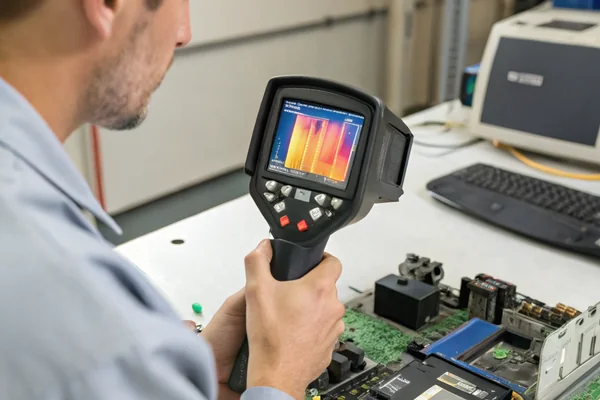
Thermal resistance (measured in °C/W) quantifies how effectively heat flows from a component's junction to ambient air through the complete thermal path, while junction temperature is the actual operating temperature at the semiconductor die itself -- keeping junction temperature within its rated range, calculated using thermal resistance and actual power dissipation, is the fundamental thermal design target for any electronic component.
Why This Calculation Connects Directly to Real-World Component Lifespan
Junction temperature is calculated as ambient temperature plus power dissipation multiplied by total thermal resistance from junction to ambient -- a straightforward formula, but one that requires accurate power dissipation and thermal resistance figures to produce a meaningful result. Exceeding a component's rated junction temperature, even without immediate failure, accelerates known semiconductor degradation mechanisms, which is why datasheet junction temperature limits should be treated as genuine design constraints, not conservative padding to be safely exceeded.
How Do You Actually Choose Between Fan Cooling, Heat Pipes, and Liquid Cooling?
Matching cooling technology to actual thermal load and design constraints, rather than defaulting to familiarity, produces better outcomes.
Fan cooling suits low-to-moderate thermal loads with adequate space for airflow, heat pipes efficiently move heat from a concentrated source to a remote heatsink location within moderate thermal budgets, and liquid cooling becomes justified for high thermal loads or space-constrained designs where air-cooling's airflow requirements can't be practically accommodated -- the right choice follows the actual thermal budget and physical constraints, not general preference.
Why Escalating Cooling Technology Isn't Always the Right Answer
Liquid cooling isn't simply a universally "better" upgrade from fan cooling -- it adds real cost, complexity, and potential failure modes (leaks, pump reliability) that aren't justified unless the actual thermal load or space constraint genuinely requires it. Similarly, heat pipes solve a specific problem (moving heat efficiently from a hot, space-constrained source to a location with better heatsink real estate) rather than being a universal upgrade over direct heatsink-and-fan cooling. Matching the cooling technology to the actual engineering problem, rather than assuming more sophisticated technology is automatically better, produces more appropriate and cost-effective designs.
Why Does System-Level Thermal Design Outperform Component-by-Component Optimization?
Treating thermal management as an integrated system problem, rather than a series of isolated component decisions, produces measurably better real-world results.
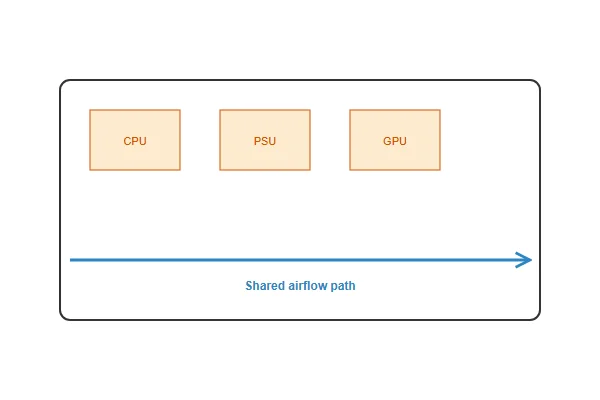
System-level thermal design considers the complete airflow path, thermal budget across all heat-generating components together, and their physical interaction within the enclosure, rather than optimizing each component's cooling in isolation -- this holistic approach catches interaction effects (like one component's exhaust heat becoming another's intake air) that component-by-component optimization misses.
Why Component Interaction Effects Are Easy to Miss Without a System View
A heatsink and fan combination optimized in isolation for a single component can still underperform in the actual assembled system if that component's cooling airflow draws from air already heated by a nearby component, or if the enclosure's overall airflow path creates unexpected restriction or recirculation. This is why experienced thermal engineers model and validate the complete system airflow path and thermal budget together, rather than treating each component's cooling as an independent design problem solved in isolation from its neighbors.
When in the Design Process Should Thermal Management Actually Be Addressed?
Timing thermal design consideration correctly has an outsized effect on both final product quality and development cost.
Thermal management should be considered from early system architecture decisions -- component placement, enclosure sizing, airflow path planning -- rather than treated as a late-stage problem to solve once the mechanical and electrical design is otherwise finalized, since thermal constraints often conflict with decisions made for other reasons if not considered concurrently.
Why Late-Stage Thermal Fixes Are Consistently More Expensive and Less Effective
A product design finalized without early thermal consideration often locks in component placement, enclosure geometry, and airflow paths that make effective cooling difficult or impossible to retrofit without significant rework, forcing compromises (undersized fans, inadequate heatsinks, thermal throttling) that could have been avoided with earlier consideration. This is why experienced engineering teams involve thermal design considerations from early system architecture discussions, not as a final check before production, since early-stage flexibility to adjust component placement or enclosure sizing largely disappears once other design decisions have been locked in.
We support engineering teams with thermal management component selection -- fans and blowers validated on our in-house CFM airflow, static pressure, and thermal cycling testing equipment at our Dongguan facility -- and we're glad to be involved early in system-level thermal design discussions rather than only at the final component sourcing stage. With over 20 years of production experience under ISO 9001 and IATF 16949 certification, we understand how early engagement improves final thermal design outcomes.

FAQ
How do I estimate a new design's total thermal load before physical prototypes exist?
Summing component datasheet power dissipation figures under expected operating conditions provides an initial estimate, though validating against actual measured power draw on early prototypes refines this figure as the design matures.
Does ambient temperature variation need to be factored into thermal design margin?
Yes -- designing only for typical room-temperature ambient conditions risks inadequate cooling in warmer real-world deployment environments, making a reasonable ambient temperature range part of the thermal design target rather than a single assumed value.
Is thermal simulation software necessary, or can hand calculations be sufficient?
For simple designs, hand calculations using standard thermal resistance formulas can be adequate, but complex systems with multiple interacting heat sources generally benefit from thermal simulation software that can model airflow and heat interaction more comprehensively.
How does component derating relate to thermal management specifically?
Component derating -- operating below maximum rated specifications for improved reliability -- interacts directly with thermal design, since a component operated with more thermal margin below its rated junction temperature limit generally achieves better long-term reliability.
Does thermal management differ significantly between consumer and industrial electronic designs?
The underlying physics principles are identical, though industrial designs often target wider ambient temperature ranges, longer service life expectations, and harsher environmental conditions, generally requiring more conservative thermal margins than typical consumer product design.
What's the most common thermal management mistake engineers make in new designs?
Treating thermal management as a late-stage add-on rather than an early design consideration is consistently cited as one of the most common and costly mistakes, since it locks in constraints that make effective cooling significantly harder to achieve after the fact.
Effective thermal management comes down to understanding fundamental heat transfer physics, applying accurate thermal resistance and junction temperature calculations, and addressing cooling as a system-level design consideration from early in development. At Herays, our Dongguan facility supports thermal management component selection with real testing data, backed by over 20 years of experience under ISO 9001 and IATF 16949 certification. If your team is working through thermal design for a new product, we're glad to be involved in that conversation early.

Liang
I've been working with DC fans for 30 years — long enough to have seen the industry evolve from basic sleeve bearing designs to today's high-efficiency, IP68-rated systems built for the harshest environments imaginable. I founded Herays because I believed manufacturers and engineers deserved a supplier who could talk technical from day one. Not just hand over a datasheet, but actually help you select the right fan for your thermal load, your enclosure, your certification requirements. Most of what I write here comes directly from problems I've solved on the factory floor or in customer applications — medical devices, laser equipment, industrial automation, you name it. If it involves moving air efficiently and reliably, I've probably spent time thinking about it. When I'm not obsessing over airflow curves, I'm usually helping a customer figure out why their cooling system isn't performing the way their simulation said it would.
View all posts by Liang