Two fans that both move air can behave completely differently depending on one fundamental design choice -- whether the blade spins around an axis parallel to airflow or perpendicular to it -- and picking the wrong one for your airflow pattern wastes the fan's actual strengths.
Tangential (cross-flow) fans move air in a long, uniform sheet along their entire length, while axial fans move air in a concentrated circular column along their rotational axis -- the right choice depends entirely on whether your application needs wide, even airflow distribution or concentrated, high-volume airflow through a compact opening.
- Axial fans move air parallel to their rotational axis in a concentrated circular airflow pattern, the design most people picture when thinking of a "fan."
- Tangential (cross-flow) fans move air perpendicular to their rotational axis, producing a long, uniform sheet of airflow along the fan's entire length.
- Tangential fans excel at applications needing wide, even airflow distribution across a long, narrow space, like heaters or air curtains.
- Axial fans generally offer higher airflow efficiency and are far more common in general electronics cooling and ventilation applications.
- Choosing between them should be driven by your specific airflow distribution need, not by which type is more commonly used in general.
Understanding the fundamental mechanical difference between these two fan types clarifies why they excel in genuinely different applications.
Table of Contents
What Actually Is a Tangential (Cross-Flow) Fan, Mechanically Speaking?
Understanding this less-familiar fan type's basic design is the starting point for comparing it to axial fans.
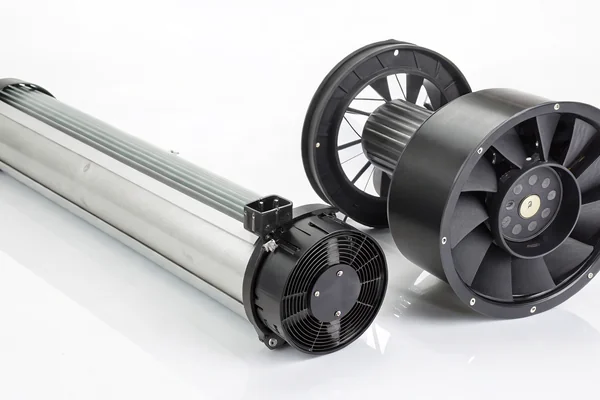
A tangential fan uses a long, cylindrical impeller with many small blades running its full length, drawing air in radially and expelling it perpendicular to the impeller's rotational axis -- this produces a continuous, uniform sheet of airflow along the fan's entire length rather than a concentrated circular airstream.
Why the Cylindrical Impeller Design Produces Such a Different Airflow Pattern
Because a tangential fan's impeller spans its full working length with air entering and exiting radially along that entire span, the resulting airflow is distributed evenly across the fan's length rather than concentrated in a single circular column the way an axial fan's output is -- this is a fundamentally different airflow geometry, not just a different housing shape around similar underlying mechanics. This is why tangential fans are also called cross-flow or transverse fans, describing how air moves across rather than along the rotational axis.
How Does an Axial Fan's Airflow Pattern Actually Differ From a Tangential Fan's?
Contrasting the more familiar axial fan design clarifies the practical difference in airflow behavior.
An axial fan's blades rotate around an axis parallel to the direction of airflow, pulling air in on one side and pushing it out the other in a concentrated, roughly circular column matching the fan's blade diameter -- this is the airflow pattern most people picture when they think of a standard cooling fan.
Why Axial Fans Concentrate Airflow Rather Than Distributing It
An axial fan's entire airflow output passes through a circular area defined by its blade sweep, meaning the airflow is inherently concentrated into that circular footprint rather than spread along a length the way a tangential fan's output is -- this makes axial fans well suited to applications needing airflow through a specific, localized opening (like a heatsink or vent) rather than uniform coverage across a wide area. This concentrated airflow pattern is also generally more efficient per watt than a tangential fan's design, which is part of why axial fans dominate general electronics cooling applications.
Where Do Tangential Fans Actually Have a Genuine Performance Advantage?
Understanding tangential fans' specific strength clarifies when they're the objectively better choice.
Tangential fans excel specifically in applications requiring uniform airflow distribution across a wide, narrow space -- electric space heaters, air curtains, and certain document scanners and printers use tangential fans precisely because their long, even airflow sheet outperforms what an axial fan (or an array of them) could achieve as elegantly for this specific need.
Why Achieving Uniform Wide-Area Airflow With Axial Fans Requires Real Compromises
Replicating a tangential fan's uniform, wide airflow coverage using axial fans would require either a single very large fan (often impractical for the application's form factor) or an array of smaller axial fans (introducing uneven airflow between units and added complexity), while a single tangential fan achieves this coverage naturally through its fundamental design. This is why tangential fans, despite being less common overall than axial fans, remain the clearly superior choice for the specific subset of applications genuinely requiring wide, even airflow distribution.
Why Do Axial Fans Dominate General Electronics Cooling Despite Tangential Fans' Wide-Area Advantage?
Understanding why axial fans remain the default choice for most applications despite tangential fans' specific strengths.
Most electronics cooling applications need airflow concentrated through a specific opening -- a heatsink, a vent, an enclosure opening -- rather than distributed evenly across a wide area, which plays directly to axial fans' strength, combined with axial fans' generally higher efficiency and simpler, more cost-effective manufacturing at small sizes.
Why Application Airflow Needs, Not General Popularity, Should Drive the Selection Decision
Axial fans' dominance in electronics cooling reflects that most cooling applications genuinely need concentrated airflow through a defined opening, not that axial fans are universally superior -- the comparison should always be grounded in your specific application's actual airflow distribution requirement rather than defaulting to whichever fan type is more common in general electronics contexts. This is why understanding your application's real airflow need, rather than following general convention, is the right starting point for choosing between these two fundamentally different fan designs.

Are There Cost and Manufacturing Differences Between Tangential and Axial Fans Worth Knowing?
Practical sourcing considerations beyond pure airflow performance.
Tangential fans are generally more complex and costly to manufacture than axial fans of comparable airflow capacity, given their longer cylindrical impeller and more intricate housing design -- this cost difference is a genuine factor to weigh against the specific airflow distribution benefit for applications where either fan type could technically work.
Why Manufacturing Complexity Translates Into a Real Cost Consideration
A tangential fan's cylindrical impeller with many small blades running its full length requires more complex tooling and manufacturing process than a standard axial fan's simpler blade and hub design, and this manufacturing complexity is reflected in generally higher per-unit cost for comparable airflow capacity. This is why tangential fans are reserved for applications where their specific wide-area airflow advantage genuinely justifies the added cost, rather than being used as a general-purpose alternative to axial fans.

How Should You Actually Decide Between the Two for a New Design?
Bringing these factors together into a practical decision framework.
Choose a tangential fan if your application genuinely requires uniform airflow distribution across a wide, narrow opening that a single axial fan or array can't elegantly achieve; choose an axial fan for the majority of applications requiring concentrated airflow through a defined opening, where axial fans' efficiency and cost advantage make them the more practical default.
Why Starting From Your Airflow Distribution Requirement Prevents a Costly Mismatch
Selecting a fan type based on general familiarity or habit rather than your application's actual airflow distribution requirement risks either overpaying for tangential fan complexity you don't need, or struggling to achieve adequate uniform coverage with axial fans in an application that genuinely calls for a tangential design. This is why explicitly identifying whether your application needs concentrated or distributed airflow, as the very first step in fan selection, prevents this type of costly mismatch before it becomes locked into a product design.
Our DC fan lineup is built around axial fan designs across our full size range, manufactured at our Dongguan facility under ISO 9001 certification. With over 20 years of production experience, we help customers evaluate whether their application's actual airflow distribution needs are best served by our axial fan products or point them toward the right alternative approach.
Can Multiple Axial Fans Ever Genuinely Substitute for a Single Tangential Fan?
This is a common design question when evaluating whether to avoid tangential fan complexity and cost altogether.
An array of axial fans can sometimes approximate the wide-area coverage of a single tangential fan, but achieving genuinely uniform airflow this way requires careful spacing and often results in visible airflow variation between individual fan zones -- for applications with strict uniformity requirements, this approach is generally a compromise rather than a true equivalent.
Why Uniformity Requirements Determine Whether the Axial Array Approach Is Acceptable
Between each axial fan in an array sits a zone with comparatively lower airflow, creating a scalloped rather than uniform airflow profile across the covered width, which may be perfectly acceptable for applications with loose uniformity requirements but problematic for applications like precision drying or heating where airflow evenness directly affects product quality. This is why the decision to use an axial fan array instead of a tangential fan should be based on how strictly your application actually requires airflow uniformity, not simply on avoiding a tangential fan's higher unit cost.
FAQ
Can a tangential fan be used as a direct replacement for an axial fan?
Generally no -- the different airflow pattern and mounting geometry mean these fan types aren't interchangeable without redesigning the airflow path and enclosure around the new fan type's specific characteristics.
Are tangential fans louder than axial fans for the same airflow output?
This varies by specific design and application, but tangential fans' more complex airflow path can introduce different noise characteristics than axial fans, making direct noise comparison dependent on the specific models involved.
Do tangential fans come in DC-powered versions like axial fans?
Yes, tangential fans are available in DC-powered configurations for applications like portable heaters and compact electronics requiring their specific wide-area airflow characteristics.
Is a tangential fan ever used just for general cooling instead of axial fans?
It's uncommon, since general cooling applications rarely need the wide, uniform airflow distribution tangential fans specialize in, making axial fans the more practical and cost-effective choice for most general cooling needs.
Why do some laser printers and scanners use tangential fans?
These devices often need even, consistent airflow across a wide internal area (for cooling or drying toner/ink uniformly), which plays directly to a tangential fan's strength in providing uniform airflow distribution along its length.
Does tangential fan technology continue to improve, or is it a mature, unchanging design?
Like most fan technology, tangential fan design continues to see incremental efficiency and noise improvements, though the fundamental cross-flow mechanical principle behind them has remained consistent for decades.
Choosing between tangential and axial fans comes down to matching the fan's fundamental airflow pattern to your application's actual distribution needs, not defaulting to whichever type is more familiar. At Herays, our Dongguan facility manufactures a full range of axial DC fans, backed by over 20 years of production experience under ISO 9001 certification. If you're evaluating fan type for a new design, we're glad to help clarify whether your airflow requirement is best served by an axial fan approach.

Liang
I've been working with DC fans for 30 years — long enough to have seen the industry evolve from basic sleeve bearing designs to today's high-efficiency, IP68-rated systems built for the harshest environments imaginable. I founded Herays because I believed manufacturers and engineers deserved a supplier who could talk technical from day one. Not just hand over a datasheet, but actually help you select the right fan for your thermal load, your enclosure, your certification requirements. Most of what I write here comes directly from problems I've solved on the factory floor or in customer applications — medical devices, laser equipment, industrial automation, you name it. If it involves moving air efficiently and reliably, I've probably spent time thinking about it. When I'm not obsessing over airflow curves, I'm usually helping a customer figure out why their cooling system isn't performing the way their simulation said it would.
View all posts by Liang