A cooling fan that's perfectly acceptable in a server room becomes a genuine production problem the moment it's audible on a live microphone -- broadcast and professional AV equipment operates under noise constraints most electronics never have to meet.
Broadcasting and professional AV equipment cooling fans must meet extremely strict noise limits given proximity to live microphones and critical listening environments, fit rack-mount form factors common in broadcast facilities, deliver genuinely dependable reliability for live production where failure isn't an acceptable option, and often incorporate temperature-controlled speed curves that prioritize silence during normal operation.
- Broadcast and studio equipment noise limits are typically far stricter than general commercial or industrial electronics standards.
- Rack-mount form factor compatibility is a practical, near-universal requirement given how broadcast facilities are physically built out.
- Live production reliability requirements treat fan failure as a genuinely unacceptable outcome, not just an inconvenience.
- Temperature-controlled fan curves that stay silent during normal load and only ramp up when genuinely necessary are standard practice for this category.
- Broadcast AV rack cooling design should be evaluated as an integrated system, not a collection of independently selected fans.
Understanding why broadcast and professional AV cooling operates under uniquely strict constraints clarifies what actually matters in fan selection for this category.
Table of Contents
Why Are Noise Limits for Broadcast Equipment So Much Stricter Than General Commercial Standards?
Understanding the direct production-quality stakes that drive this elevated noise requirement.
Broadcast and studio equipment often operates in close proximity to live microphones capturing audio for broadcast or recording, meaning even modest fan noise that would be entirely unnoticed in a general office or server room setting can be picked up by sensitive microphones and audibly degrade the actual broadcast or recording quality.
Why Microphone Proximity Changes the Entire Noise Calculation for This Category
A noise level that falls well within acceptable limits for equipment sitting several feet from anyone's attention becomes a genuine production problem when a sensitive microphone positioned nearby picks up and amplifies that same noise as part of the captured audio, meaning broadcast equipment noise specifications need to account for microphone sensitivity and proximity, not just general human perceptibility. This is why broadcast-grade equipment noise limits are frequently specified in absolute terms far stricter than general commercial electronics standards, reflecting this direct and unforgiving production-quality consequence.
How Much Does Rack-Mount Form Factor Compatibility Actually Constrain Fan Selection for This Category?
Understanding the physical infrastructure reality that shapes broadcast equipment design almost universally.
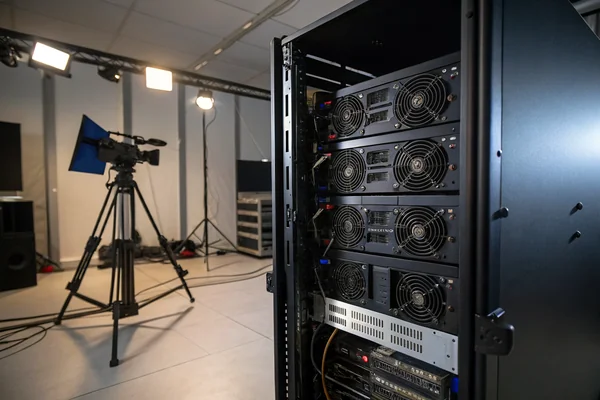
Broadcast and professional AV facilities are overwhelmingly built around standard rack-mount infrastructure (typically 19-inch rack width), meaning cooling fans for this equipment category need to fit within these standardized form factor constraints, which limits both fan size options and the depth available for cooling system design.
Why Standard Rack Infrastructure Creates a Near-Universal Physical Constraint
Unlike some equipment categories where enclosure design has more flexibility, broadcast facility infrastructure investment in standardized rack systems means equipment manufacturers need to design cooling solutions that work within this established physical constraint almost universally, rather than treating rack compatibility as an optional feature for a subset of their product line. This is why fan selection for broadcast and professional AV equipment starts from rack-mount space constraints as a near-fixed design parameter, with cooling performance and noise requirements needing to be met within that established physical envelope.
Why Does Live Production Treat Fan Failure as a Genuinely Unacceptable Outcome?
Understanding why reliability expectations in this category exceed typical equipment tolerance for occasional failure.
A cooling fan failure during live broadcast or production can lead to equipment overheating and failure at precisely the moment reliable operation matters most -- unlike many applications where a failure means scheduling a repair, live production failures happen in real time with no opportunity for a do-over, making fan reliability a genuinely elevated priority for this category.
Why the "No Do-Over" Nature of Live Production Elevates Reliability From Preference to Necessity
Most equipment failures create inconvenience and cost but can be addressed on a maintenance timeline, while a broadcast equipment failure during a live event happens in an unrecoverable moment -- the broadcast or event has already happened, and no amount of subsequent repair addresses the production failure that already occurred. This is why broadcast and live production equipment manufacturers typically specify cooling fans with genuinely elevated reliability expectations and often incorporate redundancy specifically because the cost of failure during live operation is categorically different from failure in most other equipment contexts.
How Do Temperature-Controlled Fan Curves Actually Support Broadcast Equipment's Noise Requirements?
Understanding the specific control strategy that helps reconcile cooling adequacy with strict noise limits.
Broadcast equipment commonly uses temperature-controlled fan speed curves that keep fans genuinely silent or nearly silent during normal operating loads, only ramping up speed (and accepting the associated noise increase) when internal temperature genuinely requires it -- this approach prioritizes silence during the vast majority of normal operation while retaining adequate cooling capacity for less common higher-load conditions.
Why This Approach Resolves the Tension Between Adequate Cooling and Strict Noise Requirements
Simply specifying a fan with low maximum noise output doesn't fully address broadcast equipment's needs if that fan runs continuously at a speed producing even modest but detectable noise, which is why temperature-controlled curves that keep fans at minimum speed (or fully stopped, where the thermal design allows) during normal load specifically target the actual noise-sensitive operating condition, reserving higher fan speed and associated noise for less frequent higher-load situations where cooling adequacy takes priority. This is why broadcast equipment thermal design frequently emphasizes sophisticated fan curve tuning specifically, beyond simply selecting a fan with favorable maximum-speed noise specifications.

Why Should Broadcast Rack Cooling Be Evaluated as an Integrated System Rather Than Individual Fan Selection?
Understanding why component-level fan selection alone doesn't fully address broadcast facility cooling needs.
A broadcast rack typically contains multiple pieces of equipment from different manufacturers, each with their own cooling fans, and the combined noise, airflow interaction, and thermal load of the entire rack -- not just any single component's fan specification -- determines the actual acoustic and thermal environment a broadcast facility experiences.
Why Individual Component Fan Specifications Don't Fully Predict Combined Rack Performance
Even if each individual piece of rack-mounted equipment meets its own noise specification, the cumulative noise of multiple fans operating simultaneously in a single rack, combined with potential airflow interference between adjacent equipment, can create a combined acoustic and thermal environment different from what any single component's specification sheet would suggest in isolation. This is why broadcast facility design increasingly considers rack-level cooling and acoustic planning as an integrated system consideration, not solely a matter of selecting individually well-specified components.

What Should Broadcast and Professional AV Equipment Manufacturers Actually Prioritize When Sourcing Cooling Fans?
Bringing these combined requirements together into practical sourcing guidance.
Prioritize fans with genuinely low noise validated at realistic operating speeds (not just minimum-speed specifications), confirmed rack-mount compatible form factors, elevated reliability data appropriate to live-production stakes, and sophisticated temperature-controlled speed curve capability -- these combined factors matter more for this category than general cooling fan specifications focused primarily on airflow alone.
Why This Combination Reflects Broadcast Equipment's Genuinely Distinct Requirements
Broadcast and professional AV cooling sits at the intersection of unusually strict noise requirements driven by microphone proximity, near-universal rack-mount physical constraints, elevated live-production reliability stakes, and sophisticated fan curve control needs -- evaluating candidate fans against all these factors together produces components genuinely suited to this category's unique combination of acoustic and reliability demands.
Our DC fan lineup includes low-noise models suited to rack-mount broadcast and professional AV applications, manufactured at our Dongguan facility under ISO 9001 certification. With over 20 years of production experience, we help broadcast and AV equipment manufacturers match fan noise, form factor, and reliability specifications to their specific live-production requirements.
Does Mobile Broadcast Equipment (OB Vans, Field Kits) Face Different Cooling Requirements Than Fixed Studio Racks?
Mobile and field production equipment introduces space and environmental variables beyond fixed studio installations.
Outside broadcast vans and portable field production kits combine the same strict noise requirements as fixed studio racks with additional space constraints from vehicle-based or transportable enclosures and genuine environmental exposure variability across different event locations -- making mobile broadcast cooling a meaningfully more constrained version of the same core noise and reliability challenge.
Why Mobile Production Adds Genuine Constraints on Top of Standard Broadcast Requirements
A fixed studio rack benefits from a controlled, climate-stable environment and relatively generous space allocation, while mobile broadcast equipment needs to deliver the same strict noise performance and live-production reliability within a more space-constrained, environmentally variable vehicle or portable enclosure, often while being set up and torn down repeatedly across different event locations and conditions. This is why mobile and field broadcast equipment manufacturers frequently face a more demanding combined specification challenge than their fixed-installation counterparts, even though the underlying noise and reliability priorities remain fundamentally similar.
FAQ
How is broadcast equipment fan noise typically measured and specified?
Broadcast equipment noise is often specified in dBA at a defined distance and, importantly, at the fan's actual typical operating speed rather than just maximum speed, given how relevant real-world quiet operation is for this application.
Does all professional AV equipment need broadcast-grade quiet cooling, or just equipment near microphones?
Requirements vary by specific placement -- equipment in control rooms or equipment closets away from live microphones may have more relaxed noise requirements than equipment in the same space as active recording or live audio capture.
Is passive cooling ever a viable alternative to fans for broadcast equipment given the strict noise requirements?
For lower-power equipment, passive heat sink cooling can eliminate fan noise entirely, making it an attractive option where thermal design allows, though higher-power broadcast equipment often still requires active cooling to manage heat adequately.
How does redundant cooling work in broadcast equipment given live production reliability needs?
Some broadcast equipment incorporates multiple fans with the capability to maintain adequate cooling even if one fails, allowing continued safe operation during a live event with the failed component flagged for post-event service.
Do broadcast equipment cooling fans typically cost more than general commercial equivalents?
Often yes, reflecting the more stringent noise, reliability, and sometimes rack-compatibility validation this category requires compared to general commercial fan specifications.
Does equipment placement within a broadcast facility (control room versus studio floor) change fan requirements?
Yes, significantly -- equipment on an active studio floor near live microphones generally faces much stricter noise requirements than equipment in a separate control room or equipment closet with some acoustic isolation from the live production space.
Cooling broadcast and professional AV equipment reliably comes down to meeting genuinely strict noise requirements while fitting rack-mount constraints and delivering live-production-grade reliability. At Herays, our Dongguan facility manufactures low-noise DC fans suited to rack-mount broadcast applications, backed by over 20 years of production experience under ISO 9001 certification. If you're sourcing cooling components for broadcast or professional AV equipment, we're glad to help match specifications to your production environment's requirements.

Liang
I've been working with DC fans for 30 years — long enough to have seen the industry evolve from basic sleeve bearing designs to today's high-efficiency, IP68-rated systems built for the harshest environments imaginable. I founded Herays because I believed manufacturers and engineers deserved a supplier who could talk technical from day one. Not just hand over a datasheet, but actually help you select the right fan for your thermal load, your enclosure, your certification requirements. Most of what I write here comes directly from problems I've solved on the factory floor or in customer applications — medical devices, laser equipment, industrial automation, you name it. If it involves moving air efficiently and reliably, I've probably spent time thinking about it. When I'm not obsessing over airflow curves, I'm usually helping a customer figure out why their cooling system isn't performing the way their simulation said it would.
View all posts by Liang