
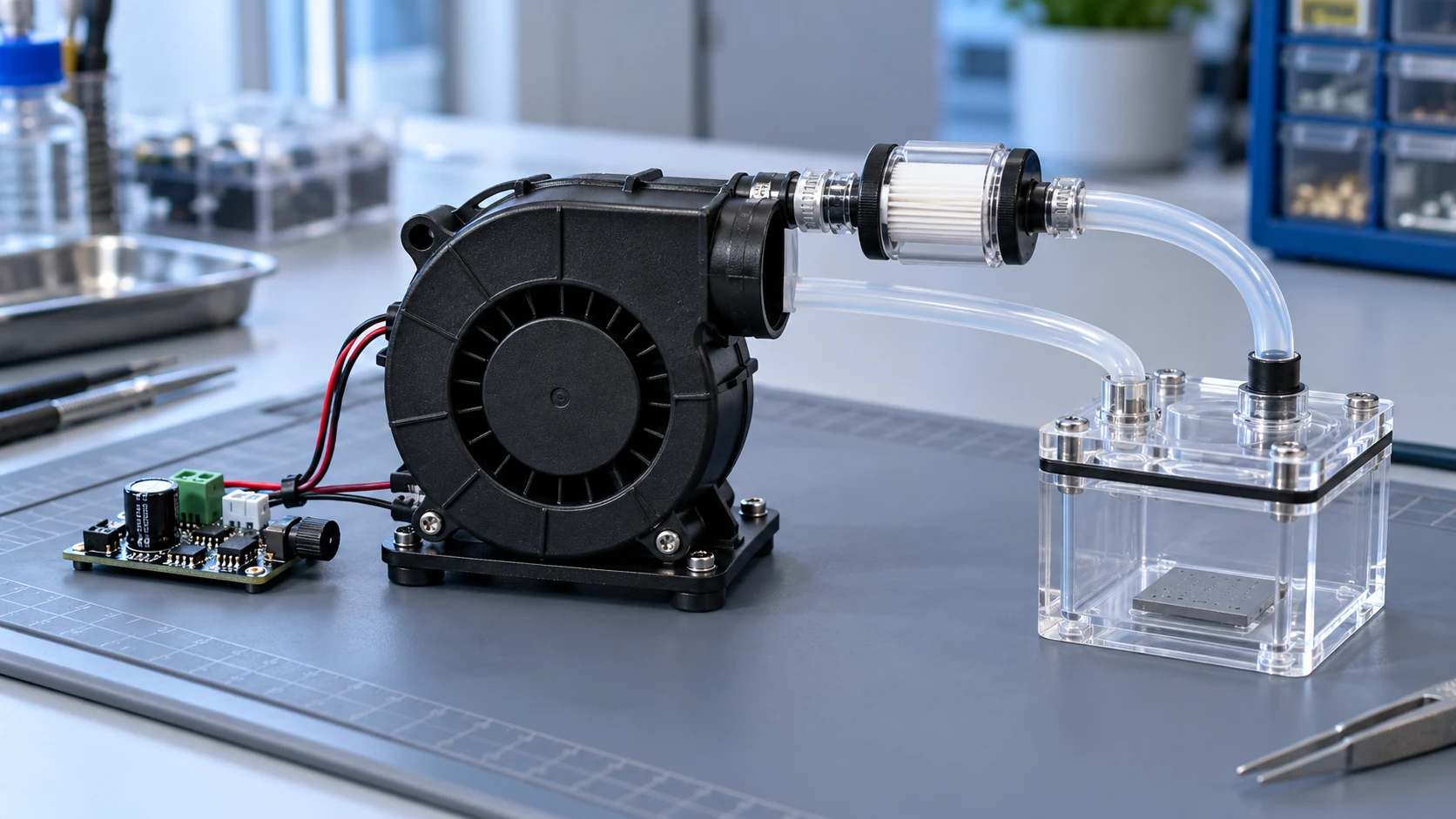
Suction airflow
Blower choices for negative-pressure and compact vacuum paths.
Pressure-capable blower airflow for suction and compact vacuum modules
Understanding the specific thermal and environmental demands of Vacuum and Negative Pressure Module environments is the foundation of every Herays solution.
Vacuum and negative pressure systems in industrial and laboratory applications — pick-and-place suction systems, vacuum hold-down fixtures, pneumatic conveying suction lines, laboratory aspirators, and small vacuum pumps — use centrifugal blowers operated in reverse (drawing air in rather than blowing it out) to generate the negative pressure (below atmospheric) that enables suction and holding force. These applications impose distinct requirements on blower selection: the machine must generate adequate vacuum depth without cavitation stall, maintain that vacuum stably at variable load, and do so continuously without the thermal issues that can arise when a blower runs sealed against high back-pressure.
Herays centrifugal BLDC blowers in vacuum (suction) configuration provide negative pressure generation for pick-and-place, vacuum hold-down, and industrial suction applications, with 24V DC operation and sealed BLDC motors for particle-free performance.
Specifications for vacuum blower module evaluation:
Contact Herays with your required vacuum depth, flow rate at working vacuum, and allowable hold-time (important for leak-rate driven system sizing) for specific vacuum blower recommendations.
What is the difference between a centrifugal blower and a vacuum pump for pick-and-place suction? Centrifugal blowers generate vacuum by centrifugal acceleration of air at the inlet; they are simple, inexpensive, and compact but limited in vacuum depth (typically 20–30 kPa maximum). Positive displacement vacuum pumps (diaphragm, piston, or rotary vane) can achieve deeper vacuum (80+ kPa) but are louder, heavier, and require maintenance. For most SMT pick-and-place and PCB handling applications, a centrifugal blower providing 30–50 kPa vacuum is entirely adequate and is the preferred design choice on grounds of simplicity and reliability.
How do I size a vacuum blower for a multi-head pick-and-place machine? The total flow requirement is the sum of all open suction ports at any given instant (typically 10–30% of total heads are placing simultaneously, so the rest have vacuum held at zero flow). Calculate the blower capacity at your working vacuum depth for the maximum simultaneous open-port scenario, then add 25% margin for suction cup wear and fitting leakage over the machine lifetime. Size up to maintain vacuum depth within ±5 kPa across this load variation.
Can a vacuum blower run continuously at maximum restriction without overheating? At maximum restriction (sealed delivery), a centrifugal blower converts all its drive power to heat with no airflow to carry it away — the motor and blower housing heat rapidly. Centrifugal blowers for vacuum service must be sized so that normal operating vacuum depth corresponds to 60–80% of maximum restriction, not 100%. Alternatively, use a bypass flow circuit that allows a small continuous airflow to cool the motor even when suction ports are all sealed.
Contact Herays to discuss vacuum blower modules for pick-and-place, conveying, and industrial suction applications, including custom outlet configurations and controller integration.
Precision-engineered DC fan technologies tailored to the performance and reliability requirements of Vacuum and Negative Pressure Module applications.
Blower choices for negative-pressure and compact vacuum paths.
Pressure-capable options for filters, ducts, and small chambers.
Voltage, connector, cable, label, and batch customization.
Herays DC fan and blower products engineered to meet the performance requirements of Vacuum and Negative Pressure Module systems.
 DC Axial Fan
DC Axial Fan
DC Axial Fan
DC Axial Fan
DC Axial Fan
DC Axial Fan
DC Axial Fan
DC Axial Fan
DC Axial Fan
DC Axial Fan
DC Axial Fan
 DC Axial Fan
DC Axial Fan
DC Axial Fan
Our application engineers are available to help you select the right product for your system requirements.