Picking between an axial fan and a blower feels like a minor spec-sheet decision until you install the wrong one and discover your airflow simply isn't reaching where it needs to go.
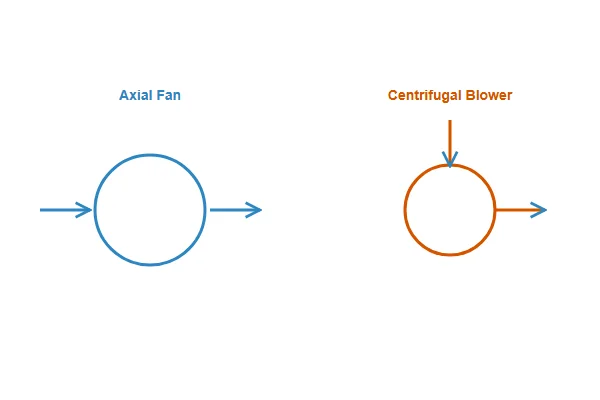
Axial fans and blowers move air through fundamentally different mechanisms -- axial fans push air parallel to their rotation axis in a concentrated column, while centrifugal blowers pull air in axially and expel it radially, generating meaningfully higher static pressure -- making the right choice entirely dependent on whether your application needs high volume through open space or airflow pushed through resistance.
- Axial fans move air parallel to their rotational axis, excelling at high-volume airflow through relatively unobstructed paths.
- Centrifugal blowers change airflow direction using impeller rotation, generating significantly higher static pressure for pushing air through restriction.
- Static pressure capability, not raw CFM, is usually the deciding factor between these two fan types for a given application.
- Blowers generally cost more and are less efficient per watt than axial fans in low-restriction applications, making axial fans the better default when pressure isn't the limiting factor.
- Physical space and mounting geometry differ meaningfully between the two types, sometimes as decisive a factor as airflow performance.
Understanding the core mechanical and performance difference between these two fan types clarifies which one actually solves your specific airflow problem.
Table of Contents
What's the Fundamental Mechanical Difference Between an Axial Fan and a Blower?
Starting with the basic mechanism clarifies why these two fan types perform so differently despite both being called "fans" in casual usage.
An axial fan's blades rotate around an axis parallel to airflow direction, moving air straight through in a column matching the blade sweep, while a centrifugal blower's impeller pulls air in along its rotational axis and flings it outward radially using centrifugal force, changing the airflow direction by roughly 90 degrees in the process.
Why This Mechanical Difference Directly Produces Their Performance Differences
The centrifugal blower's radial acceleration process inherently generates more static pressure than an axial fan's straight-through design, since the impeller's spinning motion actively works against and overcomes resistance in a way that simply pushing air forward doesn't replicate as effectively -- this is the root mechanical reason blowers outperform axial fans specifically in high-resistance applications. This is why understanding the mechanism, not just memorizing "blowers have higher pressure," helps predict how each fan type will actually behave in a new application.
Why Does Static Pressure Performance Matter So Much for Choosing Between Them?
Static pressure capability is usually the single most decisive factor in this comparison.
Static pressure measures a fan's ability to maintain airflow against resistance -- narrow ducting, filters, dense component packing -- and blowers substantially outperform axial fans of similar size in this metric, making static pressure requirement the primary lens for deciding which type your application actually needs.
Why Applications With Real Resistance Punish Axial Fans Disproportionately
An axial fan's airflow output drops off rapidly as resistance increases, since its straight-through design has limited ability to maintain flow against a restrictive path, while a blower's centrifugal design maintains meaningfully more of its airflow capability under the same resistance. This is why an application with narrow ducting, tight filtration, or dense internal obstruction will see a blower substantially outperform an axial fan with a comparable free-air CFM rating, even though the axial fan might look competitive on a simple headline spec comparison.
When Does an Axial Fan Actually Outperform a Blower for a Given Application?
Understanding axial fans' genuine advantages prevents defaulting to blowers unnecessarily.
Axial fans generally offer better efficiency (more CFM per watt) and lower cost than blowers in low-restriction applications, and their straight-through airflow geometry often fits more naturally into general cooling and ventilation applications where air simply needs to move through open space rather than against significant resistance.
Why Defaulting to a Blower "Just to Be Safe" Wastes Efficiency and Money
Choosing a blower for an application that doesn't actually face meaningful airflow resistance sacrifices the cost and efficiency advantage axial fans offer in that scenario, without gaining any real static pressure benefit the application doesn't need in the first place. This is why correctly assessing your actual airflow resistance -- not defaulting to whichever fan type seems more "powerful" -- determines the genuinely appropriate and cost-effective choice for a given application.
How Does Physical Size and Mounting Geometry Actually Factor Into the Decision?
Beyond pure airflow performance, physical installation constraints often play a decisive practical role.
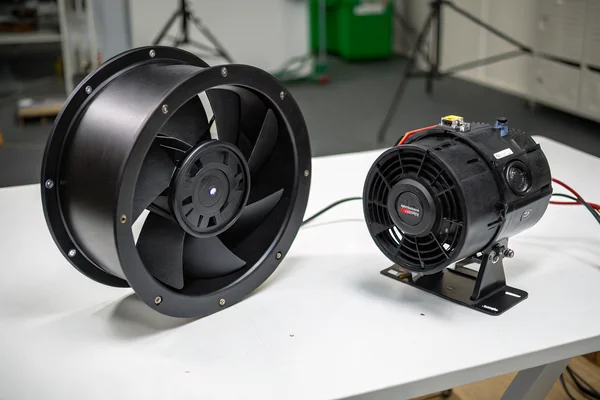
Axial fans generally have a simpler, flatter mounting profile that fits naturally into many enclosure designs, while blowers' 90-degree airflow direction change and often bulkier housing can either solve a specific space constraint (like a thin chassis needing air redirected) or create a new one, depending on the application's specific geometry.
Why Mounting Geometry Sometimes Overrides Pure Performance Comparison
An application with a genuinely thin chassis that needs to redirect airflow around internal components might find a blower's ability to change airflow direction solves a physical layout problem an axial fan's straight-through design simply can't address, regardless of which fan type would win on a pure airflow performance comparison in an unconstrained scenario. This is why physical mounting and airflow direction requirements should be evaluated alongside pressure and efficiency needs, not treated as a secondary consideration after performance specs are decided.
Are There Applications Where Both Fan Types Could Technically Work, and How Do You Choose Then?
Understanding how to make the call when the decision isn't clear-cut from resistance alone.
For applications with moderate resistance where either fan type could technically meet the airflow requirement, the decision often comes down to secondary factors -- cost, efficiency, noise character, available mounting space, and existing supply chain familiarity with one type over the other.
Why Secondary Factors Legitimately Decide Genuinely Borderline Cases
When both an axial fan and a blower can technically deliver adequate airflow for a moderate-resistance application, there's no single "objectively correct" answer, and the practical decision reasonably shifts to whichever secondary factors matter most for your specific product -- cost sensitivity, available enclosure space, or simply which fan type your team and supply chain already have established expertise with. This is why borderline cases benefit from prototype testing with both fan types where feasible, rather than assuming theoretical analysis alone will identify a clear winner.
What's the Fastest Way to Actually Decide Between an Axial Fan and a Blower for a New Design?
Bringing this comparison together into a practical, quick decision framework.
Estimate your application's actual airflow resistance (narrow ducting, filters, dense packing versus open space), check whether that resistance level clearly favors one fan type's static pressure characteristics, and if the choice remains ambiguous, weigh mounting geometry, cost, and efficiency as tie-breaking factors -- this sequence resolves most fan-type decisions without extensive testing.
Why Starting From Resistance Assessment Resolves Most Cases Quickly
The large majority of axial-versus-blower decisions become clear once you honestly assess your application's actual airflow resistance, since this single factor drives the most significant performance difference between the two fan types -- reserving more extensive comparative testing for the genuinely borderline cases where resistance alone doesn't clearly favor one type saves engineering time on the majority of more straightforward selection decisions.
Our product line includes both DC axial fans and centrifugal blowers manufactured at our Dongguan facility under ISO 9001 certification. With over 20 years of production experience, we help customers assess their application's actual airflow resistance to identify whether an axial fan or blower genuinely fits their specific project.
Do Axial Fans and Blowers Differ in How They Scale to Larger or Smaller Sizes?
Understanding how each fan type behaves as you scale up or down helps predict performance across a product size range.
Axial fan performance scales relatively predictably with blade diameter across a wide size range, while blower performance scaling is more sensitive to impeller design details, meaning a blower that performs well at one size doesn't automatically guarantee proportional performance when simply scaled up or down without re-engineering the impeller geometry.
Why Blower Scaling Requires More Careful Re-Validation Than Axial Fan Scaling
An axial fan's relatively simple blade-and-hub geometry tends to scale in a fairly predictable, linear-ish way across sizes, while a blower's more complex radial airflow path and impeller design are more sensitive to the specific proportions at a given size, meaning a design that performs excellently at one size can underperform if naively scaled to a different size without re-optimizing the impeller. This is why product lines spanning multiple sizes of the same blower design generally require more size-specific validation testing than a comparable axial fan product line would.
FAQ
Is there a rough static pressure threshold that clearly favors blowers over axial fans?
There's no single universal number since it depends on the specific fans being compared, but applications with meaningfully restrictive ducting, dense filtration, or complex internal airflow paths generally favor blowers, while open or lightly obstructed paths generally favor axial fans.
Can axial fans and blowers be used together in the same system?
Yes, this is common in some designs, using an axial fan for general open-area airflow and a blower for a specific restricted section, though this adds complexity and should be justified by genuinely different airflow needs in each location.
Are blowers always louder than axial fans for comparable airflow?
Not necessarily -- noise character differs between the two designs, and a well-selected blower isn't automatically louder than a comparable axial fan, though this varies enough by specific models that direct comparison is more reliable than a general assumption.
Does blower efficiency disadvantage matter much in battery-powered applications?
It can be significant, since blowers' generally lower efficiency per watt compared to axial fans in low-restriction scenarios directly affects battery life in portable applications, making this tradeoff worth careful evaluation for battery-powered designs.
Is one fan type generally more reliable than the other?
Reliability depends more on specific product quality, bearing type, and manufacturing than on axial versus blower design category alone -- both types can be highly reliable or prone to issues depending on the specific product and supplier.
How do I estimate my application's airflow resistance if I don't have test equipment?
Rough estimation from your design's ducting length, bend count, filter presence, and component density can guide an initial fan type decision, though actual measurement or prototype testing provides more reliable confirmation before finalizing a design.
Choosing between an axial fan and a blower comes down to honestly assessing your application's actual airflow resistance, not defaulting to whichever type seems more capable in general. At Herays, our Dongguan facility manufactures both DC axial fans and centrifugal blowers, backed by over 20 years of production experience under ISO 9001 certification. If you're deciding between fan types for a new design, we're glad to help match your specific resistance and space requirements to the right choice.

Liang
I've been working with DC fans for 30 years — long enough to have seen the industry evolve from basic sleeve bearing designs to today's high-efficiency, IP68-rated systems built for the harshest environments imaginable. I founded Herays because I believed manufacturers and engineers deserved a supplier who could talk technical from day one. Not just hand over a datasheet, but actually help you select the right fan for your thermal load, your enclosure, your certification requirements. Most of what I write here comes directly from problems I've solved on the factory floor or in customer applications — medical devices, laser equipment, industrial automation, you name it. If it involves moving air efficiently and reliably, I've probably spent time thinking about it. When I'm not obsessing over airflow curves, I'm usually helping a customer figure out why their cooling system isn't performing the way their simulation said it would.
View all posts by Liang