Two blowers can look nearly identical from the outside and still perform very differently once running, because the blade curvature inside the impeller shapes pressure, efficiency, and noise in genuinely different ways.
Forward-curved impellers deliver high airflow at lower pressure and tend to run louder for a given output, while backward-curved impellers deliver higher efficiency and better pressure capability at typically lower noise -- the right choice depends on whether your application prioritizes raw airflow volume or efficient, quieter pressure-driven performance.
- Blade curvature direction relative to the impeller's rotation is the defining design difference between forward-curved and backward-curved blowers, and it fundamentally shapes their performance character.
- Forward-curved impellers generally produce higher airflow for a given impeller size and speed, making them common in applications prioritizing volume over efficiency.
- Backward-curved impellers generally achieve higher efficiency and better performance under back-pressure, common in applications where energy efficiency or acoustic performance matters more.
- Noise characteristics differ meaningfully between the two designs, with backward-curved impellers typically producing less turbulence-related noise at a given operating point.
- Choosing between them should be driven by your application's actual pressure-volume operating point and priority (airflow, efficiency, or noise), not a general assumption that one design is universally better.
Understanding how blade curvature actually changes airflow behavior clarifies why this design choice matters more than it might initially seem for a component-level decision.
Table of Contents
What Actually Differs Between Forward-Curved and Backward-Curved Impeller Designs?
The blade geometry difference is the root cause of every downstream performance difference between these two designs.
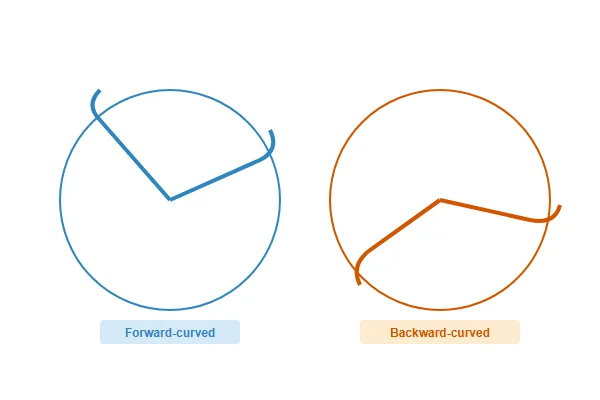
Forward-curved impeller blades curve in the same direction as the impeller's rotation, while backward-curved blades curve against the rotation direction -- this geometric difference changes how each design accelerates and directs air as it moves through the impeller, producing fundamentally different pressure-volume performance characteristics.
Why Blade Direction Changes the Underlying Airflow Physics
Forward-curved blades essentially "scoop" air more aggressively in the direction of rotation, which tends to move a larger volume of air but with less efficient energy conversion and more turbulence at the blade tips. Backward-curved blades work more like an airfoil relative to the airflow, converting rotational energy into pressure more efficiently with less turbulent loss, which is the underlying reason backward-curved designs generally achieve better efficiency and lower noise for a comparable pressure output.
Why Do Forward-Curved Impellers Excel at High Flow, Lower Pressure?
Understanding this design's specific strength clarifies where it remains the right choice despite backward-curved efficiency advantages.
Forward-curved impellers are well suited to applications needing high airflow volume at relatively low static pressure, since their blade geometry moves a large volume of air per rotation efficiently at low-restriction operating points, even though that efficiency advantage narrows or reverses as pressure requirements increase.
Why This Design Remains the Right Choice for Certain Applications
In applications where the primary requirement is moving substantial air volume against minimal resistance -- general ventilation, low-restriction cooling paths -- a forward-curved impeller's high-flow characteristic at low pressure can be genuinely well matched to the actual operating point, making the efficiency and noise disadvantages at higher pressure irrelevant since the application never operates in that regime. The mistake is applying a forward-curved design to a high-restriction application where its performance disadvantages become significant.

Why Do Backward-Curved Impellers Achieve Higher Efficiency and Pressure?
This design's advantages become more pronounced specifically as application demands shift toward higher pressure and efficiency priorities.
Backward-curved impellers convert rotational energy into pressure more efficiently than forward-curved designs, with less turbulent loss at the blade tips, making them better suited to applications with meaningful static pressure resistance where efficient energy conversion translates directly into lower power consumption for a given performance target.
Why Efficiency Advantages Compound in High-Pressure Applications
As system resistance increases, a forward-curved impeller's efficiency disadvantage becomes more pronounced, while a backward-curved impeller maintains better efficiency across a wider pressure range -- meaning the gap between the two designs widens specifically in the higher-pressure applications where backward-curved impellers are usually specified in the first place. This is why backward-curved designs dominate in industrial applications with genuine static pressure demands, where the efficiency and noise advantages have real, compounding value over the equipment's operating life.
How Does Noise Actually Compare Between the Two Impeller Types?
Acoustic performance is a genuine, measurable difference between these designs, not just a general impression.
Backward-curved impellers typically produce less turbulence-generated noise than forward-curved impellers at a comparable operating point, since their more efficient, less turbulent airflow path generates less broadband aerodynamic noise -- forward-curved designs, while capable of high airflow, tend to generate more turbulence-related noise achieving that output.
Why Turbulence Is the Common Root Cause of Both Efficiency Loss and Noise
The same turbulent airflow behavior that reduces a forward-curved impeller's energy efficiency compared to backward-curved designs also generates broadband aerodynamic noise, meaning efficiency and acoustic performance are connected outcomes of the same underlying blade geometry difference rather than two separate, unrelated characteristics. This connection is worth understanding when evaluating tradeoffs -- an efficiency-focused backward-curved selection often delivers a meaningful noise benefit as a related, not coincidental, side effect.
How Should You Actually Choose the Right Impeller Type for Your Application?
Translating these performance differences into an actual selection decision comes down to your application's real operating point and priorities.
Choose a forward-curved impeller when your application prioritizes high airflow volume at low static pressure and efficiency or noise are secondary concerns -- choose a backward-curved impeller when your application involves meaningful static pressure resistance, when energy efficiency matters for operating cost, or when acoustic performance is a genuine priority.
Why Matching to Actual Operating Point Beats a General Preference
Because these performance differences compound or diminish depending on where in the pressure-volume range your application actually operates, evaluating candidate blowers at your system's real static pressure point -- not just comparing free-air specifications -- gives a much more reliable basis for choosing between the two impeller types than a general preference for one design. A backward-curved impeller specified for a genuinely low-pressure application may not deliver a meaningful efficiency or noise benefit worth its typically higher cost, just as a forward-curved impeller in a high-pressure application will likely underperform expectations.
We manufacture DC high-speed vortex blower fans with both forward-curved and backward-curved impeller options, validated on our in-house CFM airflow and anechoic noise testing equipment at our Dongguan facility to confirm real performance at your specific operating point. With over 20 years of production experience under ISO 9001 and IATF 16949 certification, we can help match impeller design to your application's actual pressure-volume requirement.
What Should You Ask a Supplier When Specifying Impeller Type for a Custom Blower?
Custom or semi-custom blower specification benefits from a focused technical conversation about impeller design specifically.
When specifying a custom blower, ask the supplier for full P-Q curves for both impeller options at your actual target operating point, request efficiency data (not just peak performance) at that specific point, and ask about available blade count and geometry variations within each impeller type, since these secondary parameters also affect final performance.
Why the Conversation Should Go Beyond "Forward or Backward"
Impeller type is the primary design decision, but blade count and specific geometry within a chosen type also meaningfully affect final performance, meaning a productive supplier conversation goes beyond simply picking forward or backward-curved and into the specific blade design parameters available within that category. Suppliers with in-house testing capability can often provide real P-Q and efficiency data at your specific operating point rather than only generic catalog specifications, which is worth requesting directly for a custom application.

FAQ
Are backward-curved impellers always more expensive than forward-curved options?
Generally yes, given their more complex blade geometry and typically more demanding manufacturing tolerances, though the price difference should be weighed against the efficiency and noise benefits for your specific application's actual operating requirements.
Can impeller type be changed on an existing blower without replacing the whole unit?
No -- impeller design is integral to the blower's housing and motor matching, so changing impeller type requires selecting a different blower model rather than modifying an existing unit.
Do both impeller types use the same motor and control electronics?
The underlying motor and control technology can be similar across both types, since the impeller design primarily affects the aerodynamic performance rather than the electrical and control system, though specific product implementations vary by manufacturer.
Is one impeller type more durable or longer-lasting than the other?
Durability depends primarily on bearing type, motor quality, and manufacturing consistency rather than impeller curvature direction itself -- comparing specific product reliability data matters more than assuming either geometry is inherently more durable.
How do I know which impeller type my current blower uses if it's not specified?
Checking the manufacturer's datasheet or, if physically possible, visually inspecting the blade curvature direction relative to rotation can confirm the type -- manufacturers should be able to confirm this directly if it's not clearly documented.
Does impeller type affect blower size or physical footprint?
Generally the physical footprint is comparable for similar performance ratings, though specific product designs vary -- comparing actual dimensional specifications for candidate blowers is more reliable than assuming impeller type dictates size.
Choosing between forward-curved and backward-curved impeller designs comes down to matching blade geometry to your application's actual pressure-volume operating point, not defaulting to a general preference. At Herays, our Dongguan facility manufactures both impeller types validated for real-world performance for over 20 years under ISO 9001 and IATF 16949 certification. If you're specifying a blower and unsure which impeller design fits your application, we're glad to help work through the comparison.

Liang
I've been working with DC fans for 30 years — long enough to have seen the industry evolve from basic sleeve bearing designs to today's high-efficiency, IP68-rated systems built for the harshest environments imaginable. I founded Herays because I believed manufacturers and engineers deserved a supplier who could talk technical from day one. Not just hand over a datasheet, but actually help you select the right fan for your thermal load, your enclosure, your certification requirements. Most of what I write here comes directly from problems I've solved on the factory floor or in customer applications — medical devices, laser equipment, industrial automation, you name it. If it involves moving air efficiently and reliably, I've probably spent time thinking about it. When I'm not obsessing over airflow curves, I'm usually helping a customer figure out why their cooling system isn't performing the way their simulation said it would.
View all posts by Liang