RoHS gets mentioned casually on nearly every electronics datasheet, but the actual claim behind that label deserves more scrutiny than most buyers give it before assuming a fan is genuinely compliant.
RoHS compliance means a fan's materials stay below restricted thresholds for specific hazardous substances -- lead, mercury, cadmium, and several others -- and while RoHS originated as an EU directive, it's now referenced or mirrored by similar regulations in other markets, making it a practical global baseline expectation for electronic components including fans.
- RoHS restricts a defined list of hazardous substances in electronic and electrical equipment, not a broader safety or performance certification.
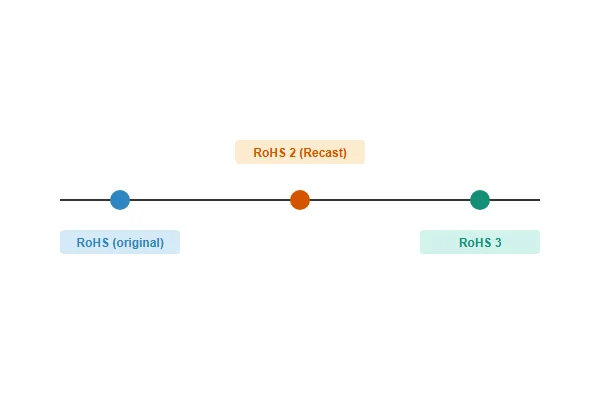
- The restricted substance list has evolved across RoHS revisions -- RoHS 2 and RoHS 3 expanded scope and added additional restricted substances over the original directive.
- Manufacturers achieve RoHS compliance through material selection and supply chain verification, documented through a material declaration rather than a physical test on every unit.
- RoHS compliance claims should be backed by actual documentation from the supplier, not just a printed logo or a general statement on a datasheet.
- RoHS compliance and REACH compliance are related but separate EU regulations -- meeting one doesn't automatically mean meeting the other.
Understanding what RoHS actually restricts -- and how manufacturers demonstrate compliance -- clarifies what documentation is worth requesting before trusting a supplier's compliance claim.
Table of Contents
What Is RoHS, and Why Does It Apply to Cooling Fans?
Understanding the regulation's actual scope and origin clarifies why it applies to a component as small as a fan.
RoHS (Restriction of Hazardous Substances) is an EU directive restricting specific hazardous substances in electrical and electronic equipment, originally adopted to reduce environmental and health risks from electronic waste -- fans fall within scope because they're electrical components containing materials (solder, plastics, metal plating) that historically could contain restricted substances.
Why Component-Level Compliance Matters for the Finished Product
A finished electronic product's RoHS compliance depends on every component within it, including fans, meeting the same restricted substance thresholds -- a single non-compliant component can compromise the entire product's compliance status. This is why component-level RoHS documentation matters even for a part as seemingly minor as a cooling fan within a larger electronic system.
Which Substances Does RoHS Actually Restrict?
Understanding the specific substance list clarifies what a compliance claim is actually certifying against.
RoHS restricts specific substances including lead, mercury, cadmium, hexavalent chromium, and several brominated flame retardants, with maximum concentration thresholds defined for each -- these are the substances a compliant fan's materials, solder, and coatings must stay below, not a general "no harmful substances" claim.
Why Knowing the Specific List Matters for Verification
A general RoHS compliance claim without reference to the specific substance list can obscure whether a supplier is actually tracking and verifying against the complete current list or making a general assumption based on using "standard" materials. Requesting a material declaration that explicitly addresses each restricted substance, rather than accepting a general compliance statement, gives more confidence that verification actually happened rather than being assumed.
| RoHS Substance Category | Examples |
|---|---|
| Heavy metals | Lead, mercury, cadmium, hexavalent chromium |
| Flame retardants | PBB, PBDE (and additional phthalates under RoHS 3) |

How Do Manufacturers Actually Achieve and Verify RoHS Compliance?
Compliance isn't achieved through testing every finished unit -- it's built into material sourcing and verified through documentation.
Manufacturers achieve RoHS compliance primarily through careful material and component sourcing -- verifying that solder, plastics, and plating materials from their own suppliers meet restricted substance thresholds -- and documenting this through a material declaration, rather than testing every finished fan for substance content, which would be impractical at production scale.
Why Supply Chain Verification Matters More Than Finished-Product Testing
Because a fan is assembled from components and materials sourced from the manufacturer's own supply chain, RoHS compliance depends heavily on that supply chain's own material declarations being accurate -- a manufacturer's compliance claim is only as reliable as their own supplier verification process. This is why established manufacturers with mature, audited supply chains generally provide more reliable RoHS compliance than newer or less rigorously managed operations, even if both claim the same compliance status on paper.
What's the Actual Difference Between RoHS 2 and RoHS 3?
Understanding how the directive has evolved helps confirm you're evaluating compliance against the current, applicable version.
RoHS 2 (also called RoHS Recast) expanded the original directive's scope to cover a broader range of electronic equipment and added CE marking requirements tied to RoHS compliance, while RoHS 3 added four additional restricted phthalate substances to the list -- both revisions expanded rather than replaced the original restricted substance framework.
Why Confirming Current Version Compliance Matters
A supplier's compliance documentation dated before RoHS 3 took effect may not reflect the additional phthalate restrictions added in that revision, meaning older documentation could be technically outdated even if it was accurate when originally issued. Confirming that a supplier's RoHS documentation reflects the current directive version, not just a general historical compliance claim, is worth verifying explicitly, particularly for older or long-standing supplier relationships.
How Do You Actually Verify RoHS Compliance From a Supplier?
Verification requires going beyond the datasheet claim to the underlying documentation and, where appropriate, testing.
Verify RoHS compliance by requesting the manufacturer's actual material declaration document (not just a datasheet mention), confirming it references the current RoHS directive version, and for high-stakes applications, considering independent third-party testing of samples rather than relying solely on manufacturer documentation.
Why Independent Verification Matters More for Certain Applications
For most general applications, a manufacturer's material declaration is sufficient due diligence, but for applications with particularly strict regulatory requirements or high liability exposure, independent third-party substance testing of actual samples provides verification that doesn't depend entirely on trusting the supplier's own documentation and supply chain oversight. Weighing whether this additional verification step is warranted depends on your specific application's risk tolerance and regulatory environment.
We provide RoHS material compliance documentation for our DC axial, case, and blower fans on request as part of standard sourcing due diligence from our Dongguan facility. With over 20 years of production experience under ISO 9001 and IATF 16949 certification, we maintain supply chain material verification as part of our quality process, and we're glad to work directly with customers on the specific compliance documentation their application requires.
What Documentation Should You Actually Request Before Finalizing a Fan Purchase?
Translating RoHS understanding into a practical procurement checklist avoids relying on assumptions at the sourcing stage.
Before finalizing a fan purchase, request the manufacturer's material declaration referencing the current RoHS directive version and specific product model, confirm whether REACH compliance is separately documented if your application requires it, and file this documentation alongside your own product's compliance records for future audit or customer inquiry needs.
Why Filing Documentation Proactively Saves Time Later
Compliance documentation requests that come reactively -- after a customer or regulatory inquiry -- take longer and create more pressure than documentation gathered proactively during initial sourcing and filed for future reference. Building the habit of requesting and archiving RoHS and related compliance documentation as a standard part of every new fan sourcing decision, rather than only when specifically asked, avoids scrambling to track down documentation under time pressure later.

FAQ
Does RoHS compliance apply outside the EU, or only for EU-bound products?
RoHS originated as an EU directive, but many other markets have adopted similar regulations (such as China RoHS), and RoHS compliance has become a practical baseline expectation in electronics sourcing globally, even for products not directly bound for the EU market.
Can a fan be RoHS compliant but not CE marked, or vice versa?
These are related but distinct compliance areas -- RoHS 2 does tie into CE marking requirements for covered products, but the specific relationship depends on the product category and applicable directives, worth confirming for your specific application.
How often should RoHS documentation be re-verified with a supplier?
Whenever sourcing a new product model, when RoHS directive revisions take effect, or periodically for long-standing supplier relationships to confirm documentation remains current and the supply chain hasn't changed in ways affecting compliance.
Does RoHS restrict anything related to fan performance, like noise or efficiency?
No -- RoHS governs material substance content only, not performance characteristics. Performance specs like airflow, noise, and efficiency are entirely separate from RoHS compliance status.
What happens if a component in my product turns out not to be RoHS compliant after shipment?
This can create significant regulatory and liability exposure depending on your target market's enforcement, which is exactly why upfront verification through actual documentation, not just trusting a general claim, matters before committing to a supplier relationship.
Is RoHS compliance more important for certain fan applications than others?
Compliance requirements generally don't vary by application type, but the consequences of non-compliance (regulatory action, market access issues) can be more significant for products in tightly regulated markets or industries, making verification diligence proportionally more important there.
RoHS compliance is a substance-restriction requirement worth verifying through actual documentation rather than trusting a datasheet claim alone. At Herays, our Dongguan facility provides RoHS material compliance documentation for our fans on request, backed by over 20 years of experience under ISO 9001 and IATF 16949 certification. If you need RoHS documentation for a specific product or application, we're glad to provide it directly.

Liang
I've been working with DC fans for 30 years — long enough to have seen the industry evolve from basic sleeve bearing designs to today's high-efficiency, IP68-rated systems built for the harshest environments imaginable. I founded Herays because I believed manufacturers and engineers deserved a supplier who could talk technical from day one. Not just hand over a datasheet, but actually help you select the right fan for your thermal load, your enclosure, your certification requirements. Most of what I write here comes directly from problems I've solved on the factory floor or in customer applications — medical devices, laser equipment, industrial automation, you name it. If it involves moving air efficiently and reliably, I've probably spent time thinking about it. When I'm not obsessing over airflow curves, I'm usually helping a customer figure out why their cooling system isn't performing the way their simulation said it would.
View all posts by Liang