A fan without the right certification can stall a product launch at customs or fail a customer's incoming audit, regardless of how well it performs on the bench.
UL and cUL matter primarily for North America, CE marking is a legal requirement for placing electronics on the EU market, and RoHS/REACH govern the chemical substances allowed in the fan's materials -- which certifications actually matter depends entirely on where your product ships and what regulatory framework governs it there.
- Certifications aren't interchangeable or universal -- UL applies to North America, CE is an EU legal requirement, and RoHS/REACH govern substances rather than safety performance.
- CE marking is a manufacturer's legal declaration of conformity, not a third-party certification, which changes how you should verify a supplier's claim of compliance.
- RoHS restricts specific hazardous substances in electronics; REACH is a broader EU chemical regulation with its own separate compliance requirements.
- A fan's datasheet claiming "RoHS compliant" without supporting documentation is a common gap -- the claim should be backed by a material declaration you can request directly.
- Verifying a manufacturer's certifications means checking the certificate against the specific product model and current expiration date, not just trusting a general company-level claim.
Understanding what each certification actually covers -- and what it doesn't -- prevents costly assumptions late in a product's development cycle.
Table of Contents
Why Do Certifications Matter This Much for a Component as Small as a Fan?
A fan is a minor line item in most bills of materials, but its certification status can block an entire product's market entry.
Cooling fan certifications matter because they're often required for the entire finished product to legally enter a target market, and a missing or invalid fan certification can force a redesign, a supplier change, or a shipment hold well after a product has otherwise cleared development.
Why This Risk Shows Up Late, Not Early
Certification requirements are frequently treated as a documentation formality during early design, checked seriously only once a product is ready to ship -- which is exactly when discovering a gap is most expensive. A fan supplier's certification status affects the finished product's own certification eligibility in many regulatory frameworks, meaning a fan swapped in late in development without matching certification can force retesting of the entire assembly, not just the fan itself. Confirming certification requirements for your specific target markets at the fan selection stage, rather than treating it as a late-stage checkbox, avoids this.
What Does UL and cUL Certification Actually Cover for North America?
UL certification addresses a specific, narrow question: does the product meet recognized safety standards for its category.
UL certification verifies that a fan meets Underwriters Laboratories' safety standards for electrical and fire hazards in the North American market, with cUL indicating the equivalent certification recognized for the Canadian market -- both focus specifically on safety, not general performance or reliability.
What UL Testing Actually Checks
UL testing evaluates specific failure modes -- overheating, insulation breakdown, fire risk under fault conditions -- rather than performance characteristics like noise or airflow. A UL-listed fan carries a UL mark and file number that can be verified directly against UL's own database, which is the most reliable way to confirm a supplier's UL claim rather than relying on a printed mark alone. For products entering the US or Canadian market, many end customers and integrators require UL certification on individual components as a condition of their own product's UL listing, making it a practical requirement even when not strictly mandated by law for the component itself.
| Certification | Governs | Primary Market |
|---|---|---|
| UL / cUL | Electrical & fire safety | US / Canada |
| CE | Multiple EU directives (safety, EMC) | European Union |
| RoHS | Restricted hazardous substances | EU (widely adopted globally) |
| REACH | Broader chemical substance regulation | European Union |
What Does CE Marking Actually Require in the European Market?
CE marking works differently from UL in a way that surprises many buyers evaluating suppliers for the first time.
CE marking is a legal declaration by the manufacturer that a product meets applicable EU directives -- covering areas like electrical safety and electromagnetic compatibility -- and unlike UL, it is not a third-party certification issued by an independent testing body, which means verifying a CE claim requires reviewing the manufacturer's technical documentation directly.
Why "Self-Declared" Doesn't Mean "Unverified"
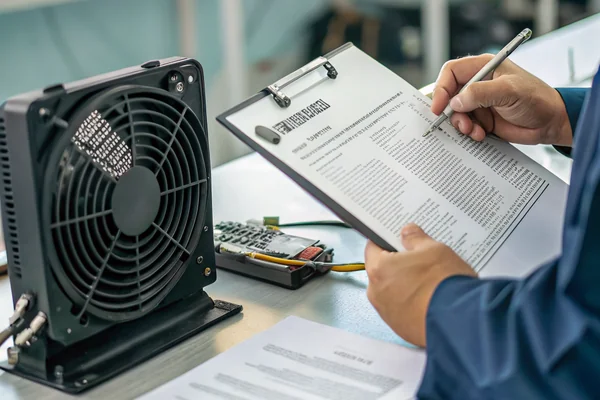
Because CE marking is a manufacturer self-declaration rather than independent certification, a legitimate CE claim should be backed by a Declaration of Conformity document and supporting test reports the manufacturer can provide on request -- the absence of that documentation is a meaningful red flag, even if the product carries a printed CE mark. Placing a non-compliant product on the EU market carries real legal liability for whoever places it there, which is why buyers sourcing fans for EU-bound products should request and review this documentation directly rather than accepting a datasheet claim at face value.
How Do RoHS and REACH Actually Differ From Each Other?
These two EU regulations are frequently confused despite governing different things.
RoHS restricts specific hazardous substances -- lead, mercury, cadmium, and several others -- in electronic and electrical equipment, while REACH is a broader EU regulation governing the registration and safety of chemical substances generally, with its own separate substance list (the Substances of Very High Concern) that a fan's materials and components need to be checked against independently.
Why Meeting RoHS Doesn't Automatically Mean Meeting REACH
RoHS compliance addresses a defined, relatively short list of restricted substances specific to electronics, while REACH's scope is far broader and covers substances beyond RoHS's list, updated periodically as new substances are added to its concern list. A fan can be fully RoHS compliant while still requiring separate REACH declaration, since the two regulations don't automatically imply each other despite frequently being requested together on the same compliance documentation. Buyers assuming one certification covers both requirements is a common and avoidable documentation gap.
How Do You Actually Verify a Manufacturer's Certification Claims?
A printed logo or a line item on a datasheet isn't sufficient proof on its own for any of these certifications.
Verify certification claims by requesting the actual certificate or declaration document tied to the specific product model, checking UL claims directly against UL's public database using the file number, and confirming expiration dates and scope -- a certification that covers a different fan model or has lapsed doesn't cover your specific product.
What to Actually Ask a Supplier For
Request the UL file number and verify it independently through UL's online database rather than trusting a printed mark, since file numbers are searchable and confirm both validity and the specific covered product. For CE, request the Declaration of Conformity document itself along with any referenced test reports. For RoHS and REACH, request the specific material declaration or substance compliance statement tied to the product, not just a general company policy statement. A supplier unable or reluctant to provide this documentation on request is itself a meaningful signal worth weighing in the sourcing decision.

Do Certification Requirements Differ Between Consumer and Industrial Applications?
The certification bar often shifts meaningfully depending on where the fan actually gets used.
Industrial, medical, and automotive applications frequently layer additional certification and testing requirements -- IATF 16949 for automotive, ISO 13485-adjacent expectations for medical devices -- on top of the baseline UL/CE/RoHS/REACH requirements that apply to most electronic products broadly.
Why Application Context Changes the Certification Conversation
A fan destined for a consumer electronics product typically needs to satisfy the baseline safety and substance certifications relevant to its target market, but a fan going into automotive, medical, or aerospace-adjacent equipment often needs to meet additional industry-specific quality system certifications on top of that baseline. This is why certification requirements should be discussed as part of the initial application context with a supplier, not assumed to be identical across every use case a fan might end up in.
Our Dongguan facility operates under ISO 9001, ISO 14001, and IATF 16949 certification, and we provide RoHS and REACH material compliance documentation for our fans on request as part of standard sourcing due diligence. We work directly with customers to confirm which certification documentation their specific target market and application requires before finalizing a design, rather than assuming a one-size-fits-all compliance package.
FAQ
Does every cooling fan need UL certification to be sold in the US?
Not every fan is legally required to carry UL certification on its own, but many end products and integrators require UL-listed components as a condition of their own product's UL listing, making it a practical requirement in many supply chains even when not strictly mandated at the component level.
Can a fan be CE marked but not actually compliant?
Yes -- because CE marking is a manufacturer self-declaration rather than independent verification, a mark can be applied without adequate underlying compliance. This is exactly why requesting the Declaration of Conformity and supporting documentation matters.
Is RoHS compliance the same everywhere, or does it vary by region?
RoHS originated as an EU directive but has been widely adopted or referenced by similar regulations in other markets, including China RoHS. The specific substance lists and thresholds can differ between jurisdictions, so confirming which RoHS variant applies to your target market is worth doing.
How often should certification documentation be re-verified with a supplier?
At minimum, whenever sourcing a new product model or when a supplier's certification is approaching its expiration date. Certifications tied to a specific product revision can also become invalid if the product's materials or design change without recertification.
Do certifications cover fan performance claims like CFM or noise ratings?
No -- UL, CE, RoHS, and REACH govern safety and substance compliance, not performance accuracy. Performance specs like airflow and noise are typically validated through separate testing standards, such as AMCA methodology for airflow.
What happens if a shipment arrives without valid certification documentation?
This varies by destination customs authority and the specific regulatory requirement, but it can range from delayed clearance to outright rejection of the shipment, which is why confirming documentation before shipment -- not after -- is the safer practice.
Certification requirements vary enough by market and application that treating them as an afterthought is one of the more expensive mistakes in fan sourcing. At Herays, our Dongguan facility operates under ISO 9001, ISO 14001, and IATF 16949 certification, with RoHS and REACH documentation available for our products on request. If you're specifying a fan for a market with specific certification requirements, we're glad to confirm what documentation applies to your situation directly.

Liang
I've been working with DC fans for 30 years — long enough to have seen the industry evolve from basic sleeve bearing designs to today's high-efficiency, IP68-rated systems built for the harshest environments imaginable. I founded Herays because I believed manufacturers and engineers deserved a supplier who could talk technical from day one. Not just hand over a datasheet, but actually help you select the right fan for your thermal load, your enclosure, your certification requirements. Most of what I write here comes directly from problems I've solved on the factory floor or in customer applications — medical devices, laser equipment, industrial automation, you name it. If it involves moving air efficiently and reliably, I've probably spent time thinking about it. When I'm not obsessing over airflow curves, I'm usually helping a customer figure out why their cooling system isn't performing the way their simulation said it would.
View all posts by Liang