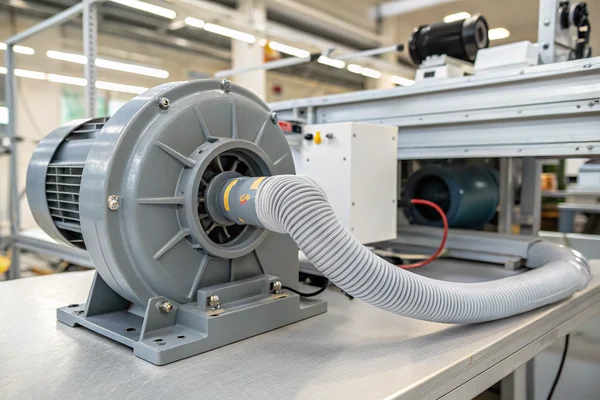
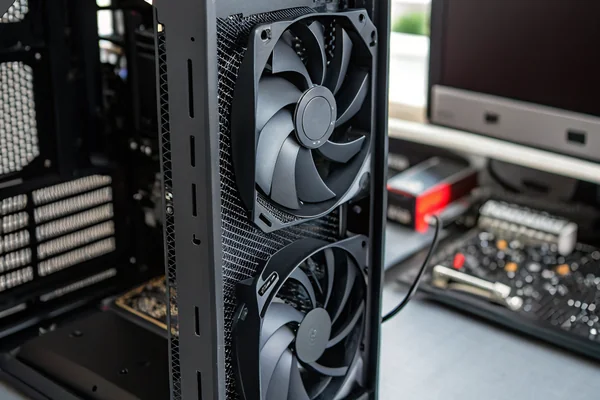
Blower noise that wasn't expected in the design phase tends to become a product problem in the field. Once noise is built into a system, fixing it after the fact is expensive and often incomplete.
DC blower fan noise comes from three distinct sources — aerodynamic turbulence at the impeller, motor commutation, and bearing mechanical noise — and which source dominates depends on the impeller design, operating speed, and the acoustic environment the blower is running in. Each requires a different mitigation approach.
- Blower fans produce a distinctly different noise character than axial fans because of how their impellers interact with the volute housing, generating both broadband turbulence noise and tonal components at blade-pass frequency.
- Impeller geometry — blade count, blade angle, and tip clearance — directly shapes both the intensity and frequency signature of aerodynamic noise, making impeller design one of the most consequential acoustic decisions in a blower.
- Motor and bearing noise are separate from aerodynamic noise and require separate mitigation strategies; confusing them leads to design changes that fix the wrong problem.
- Noise specifications on blower datasheets are measured under specific free-air test conditions and will not match installed performance without accounting for system backpressure and mounting resonance.
- The most effective noise reduction happens at the design and sourcing stage, not after installation — mounting isolation, operating point selection, and impeller geometry are the real levers.
Understanding why a blower sounds the way it does is the prerequisite for making it quieter — and for sourcing one that fits your acoustic requirements from the start.
Table of Contents
Why Does a DC Blower Fan Sound So Different From an Axial Fan?
The noise character difference is fundamental, not just a matter of degree.
DC blower fans produce a more concentrated, tonal noise signature than axial fans because their enclosed volute housing forces air through a narrow discharge point, amplifying blade-pass frequency tones and housing resonance in ways that open-frame axial fans inherently avoid.
The Volute Changes Everything Acoustically
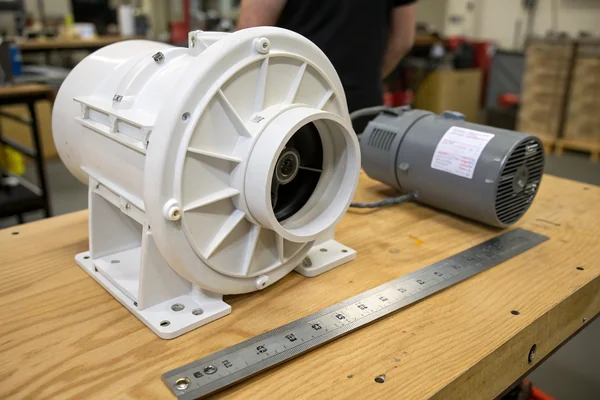
An axial fan moves air in a relatively open field — blades chop through ambient air, and the turbulence disperses in all directions. There's turbulence noise, yes, but it spreads out, and there's no enclosure to resonate at specific frequencies. A blower operates completely differently: air is drawn axially into the center of the impeller and then flung radially outward, where it's collected by a spiral volute housing and directed out through a single discharge port. That housing is a resonant cavity. Every time a blade passes the volute cutoff (the point where the housing narrows toward the discharge), it creates a pressure pulse. At typical DC blower speeds, those pulses happen dozens to hundreds of times per second, stacking into a discrete tonal frequency — blade-pass frequency — that sits above the broadband turbulence noise.
This is why a blower in a quiet room sounds more like a whine or hum than the white-noise whoosh of an axial fan. The tonal content is more perceptible to human hearing at the same measured dB(A) level, which is part of why blower noise complaints in products are disproportionately common relative to their actual sound power output. The geometry that makes blowers effective at generating static pressure — the enclosed impeller, the tight volute — is exactly what makes their acoustic character harder to manage.
Does Impeller Design Actually Control the Tonal Noise a Blower Makes?
Impeller geometry is where the most important acoustic decisions get made.
Impeller blade count, blade angle, and tip clearance between the blade tips and the volute wall together determine both the frequency and intensity of tonal noise — changing any one of these changes the acoustic signature of the blower, sometimes dramatically, which is why impeller design is an acoustic decision as much as a hydraulic one.
Blade Count Sets the Tonal Frequency
Blade-pass frequency1 scales directly with the number of impeller blades and the rotational speed. More blades at the same RPM pushes the tonal frequency higher — often into a range less perceptible to human hearing, which can make a blower subjectively quieter even if the measured dB(A) is unchanged. Some blower designs intentionally use an odd or non-uniform blade count to spread the tonal energy across adjacent frequencies rather than concentrating it at one discrete peak, reducing the perceived harshness of the noise.
Tip Clearance Is an Often Underestimated Variable
The gap between impeller blade tips and the inner wall of the volute has a disproportionate acoustic effect. Too tight, and the pressure pulses at each blade pass are stronger and sharper — louder tonal content. Too loose, and aerodynamic efficiency drops, requiring higher RPM to hit the same performance point, which raises noise through a different mechanism. This tradeoff means tip clearance is a precision manufacturing decision, not just a geometric tolerance that can be relaxed without consequence.
Blade Angle and Backward/Forward Curve Geometry
Centrifugal blower impellers come in forward-curved and backward-curved blade geometries, and the choice has real acoustic implications. Forward-curved designs move more air at lower RPM but tend to generate more broadband turbulence noise. Backward-curved or backward-inclined designs operate more efficiently at higher pressure, producing less turbulence at a given operating point and typically a cleaner acoustic profile — at the cost of needing higher RPM to generate the same flow at lower system resistance.
| Impeller Type | Typical Noise Character | Pressure Efficiency | Common Use |
|---|---|---|---|
| Forward-curved | More broadband turbulence | Moderate | High-flow, lower pressure |
| Backward-curved | Cleaner, lower turbulence | Higher | Restrictive duct/filter applications |
| Radial (straight blade) | Louder overall | Lower | High-durability, debris-tolerant |
Are Motor and Bearing the Hidden Sources Behind Blower Whine?
Motor and bearing noise is distinct from aerodynamic noise and requires separate diagnosis before it can be effectively addressed.
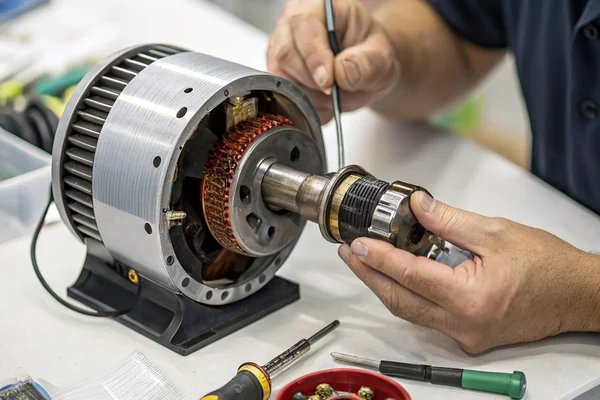
Motor commutation noise — discrete tonal spikes from switching events in DC brushless motors — and bearing mechanical noise from worn or mismatched bearing types both contribute to total blower noise independently of impeller aerodynamics, meaning a quiet impeller design doesn't automatically produce a quiet blower.
Brushless DC Commutation and Its Acoustic Fingerprint
Most DC blowers today use brushless DC motors, which eliminate the mechanical brush noise of older designs but introduce electronic commutation noise instead. PWM drive signals and motor pole commutation create current switching events at regular intervals, which translate into audible tones at frequencies determined by the motor's pole count and the PWM switching frequency. These tones can appear as high-pitched whines or harmonics that are completely independent of impeller speed — which is one diagnostic clue, since aerodynamic noise scales with RPM while commutation noise can appear even at low speeds.
Bearing Type Determines Both Noise Level and Degradation Pattern
Ball bearings2 in DC blowers offer longer rated life than sleeve bearings but introduce their own mechanical noise — specifically, the rolling-element noise that increases as bearings wear and becomes a grinding or rattling signature at end of life. Sleeve bearings are quieter when new but wear faster and can develop increased shaft play over time, which shows up acoustically as low-frequency rumble or intermittent mechanical contact noise. Fluid dynamic bearings occupy a middle position: quieter than ball bearings and longer-lived than sleeve bearings, but at higher component cost. For applications where blower noise is a primary design constraint, bearing type selection is not a secondary consideration.
Are You Reading Blower Noise Specs in a Way That Actually Predicts Installed Noise?
Datasheet noise specs carry implicit conditions that are easy to miss and consequential to get wrong.
Blower noise specifications are measured under standardized free-air or specific test conditions, typically at maximum rated speed, and they will not directly predict the noise a blower produces in a real installation with system backpressure, mounting resonance, or speed control in place — which makes published dB(A) figures a starting point, not a final answer.
What the Test Conditions on a Datasheet Actually Mean
ANSI/AMCA Standard 210 establishes laboratory methods for measuring fan and blower aerodynamic performance, and most reputable manufacturers align their acoustic measurements to consistent test setups — but the specific distance, mounting configuration, and operating point for the acoustic measurement aren't always clearly stated on a datasheet. A blower running at maximum speed in free air produces its peak noise; the same blower running at 70% speed in a ducted installation with 8mm H₂O of backpressure is acoustically a different device. System effects — airflow turbulence entering the blower intake from nearby obstructions, mounting resonances amplifying specific frequencies, acoustic reflections from enclosure walls — can add several dB to the installed noise level compared to the free-air test value.
Speed Control Is the Fastest Route to Real Noise Reduction
Because aerodynamic and motor noise both scale strongly with rotational speed, running a blower at a reduced speed through PWM control or voltage adjustment often produces dramatic noise reductions. A blower generating 52 dB(A) at full speed might drop to 43 dB(A) at 80% speed — if the application's thermal or pressure requirements allow it. This is why it's worth checking whether the blower's performance at a partially reduced speed still meets the system's airflow and pressure requirements before assuming full-speed operation is necessary.
What Are the Practical Design Moves That Actually Reduce Blower Noise?
Effective noise reduction is mostly a design and specification exercise, not a post-installation fix.
The most effective levers for reducing DC blower noise are operating point selection (running below maximum rated speed when possible), vibration-isolating mounting hardware, inlet/outlet acoustic treatment, and sourcing a blower whose impeller geometry is specifically matched to the application's pressure and flow target rather than oversized and throttled back.
Mechanical Isolation Addresses Structure-Borne Noise
A blower bolted directly to a metal chassis transfers vibration from the motor and impeller into the structure, which then re-radiates noise acoustically — sometimes amplified by resonance. Mounting the blower on elastomeric anti-vibration grommets or compliance mounts breaks the vibration transfer path and can reduce structure-borne noise contribution significantly. The benefit depends on how resonant the host chassis is; a thin metal panel will respond to isolation mounts much more noticeably than a thick rigid casting.
Inlet and Outlet Treatment for Aerodynamic Noise
Aerodynamic noise at the blower discharge travels out through the exhaust port and into the system airflow path. Adding a short length of acoustically lined duct at the outlet, or reducing abrupt flow transitions that generate additional turbulence after the discharge, can reduce the audible impact of exhaust-side aerodynamic noise. On the intake side, ensuring the blower inlet has a clear, unobstructed approach — without sharp edges or obstructions that create intake turbulence — reduces the noise generated before air even reaches the impeller.
Matching the Blower to the Operating Point
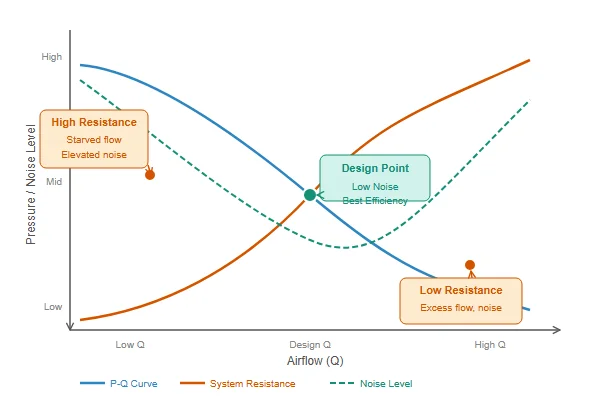
One underappreciated noise source is application mismatch: a blower selected with too much headroom for the actual system resistance ends up running in an off-peak operating region where both efficiency and noise behavior are worse than at its design point. Selecting a blower whose performance curve peak aligns with the actual system resistance — using the P-Q curve3 for the specific installation conditions rather than just maximum-rated specs — results in the blower running closer to its aerodynamic design point, with better efficiency and typically lower noise.
When Does Blower Noise Become a Sourcing Problem Rather Than a Design Problem?
Noise problems that appear late in development usually trace back to a sourcing decision made too early with too little acoustic information.
If a blower's noise character is wrong for the application — wrong frequency content, excessive tonal peaks, or higher baseline dB(A) than the budget allows — the correct fix is usually selecting a different impeller geometry or a higher-quality bearing specification, not adding acoustic treatment to a fundamentally mismatched unit.
What to Ask a Supplier Before Finalizing a Blower Selection
Standard datasheet specs are a starting point, but for noise-sensitive applications, the conversation with the supplier needs to go further. Specifically: what is the blade-pass frequency at the intended operating RPM? What bearing type is used, and what is its rated acoustic life? Is acoustic testing performed in-house on production units, or only at the design validation stage? A supplier who can answer these questions with specific data rather than general assurances is demonstrating a fundamentally different level of manufacturing control. Requesting a sample unit for acoustic evaluation in your actual enclosure and mounting configuration before finalizing an order is standard practice for applications where noise specifications are binding.
The Cost of Getting It Wrong Late
Discovering that a blower is acoustically unsuitable during system-level testing — after the chassis, inlet ducting, and mounting geometry are fixed — typically forces one of three outcomes: accepting a noise performance miss, expensive enclosure modifications, or a late-stage blower redesign that delays the program. The acoustic treatment and vibration isolation options available at that point are real mitigation paths but are never as effective as selecting an appropriately quiet blower from the beginning. Blower noise is a sourcing decision before it is a system integration problem.
Our DC High-Speed Vortex Blower Fan line is tested in-house on a dedicated anechoic noise test chamber and automated dynamic balance test and correction equipment — both of which directly address the tonal and vibration noise sources described in this article. Dynamic balance is corrected at the production stage on every unit, not just sampled at validation, because imbalance is one of the most common sources of bearing-loading noise that gets missed when only datasheet specs are reviewed. If your application has a specific noise target alongside its airflow and pressure requirements, we're glad to discuss impeller geometry and bearing options against your actual operating point.
FAQ
Why does my blower seem to get louder after months of operation even though airflow hasn't dropped much?
Bearing wear is the most common cause — as bearing surfaces degrade, mechanical noise increases before it causes enough friction to visibly reduce airflow. This is particularly common with sleeve bearings running at elevated temperatures.
Is a higher blade-pass frequency always better for perceived noise?
Not always — while higher frequencies are sometimes less intrusive in broadband noise environments, very high tonal frequencies can be acutely irritating in quiet environments. The best frequency depends on the acoustic environment the product will be used in.
Can running a blower fan at lower voltage reduce its noise?
Yes, reducing operating voltage reduces rotational speed, which reduces both aerodynamic and motor noise. The tradeoff is reduced airflow and static pressure performance, so it's only viable if the application's thermal requirements can be met at the lower performance point.
Do blower fans require more acoustic isolation than axial fans in the same application?
Generally yes — the tonal noise character of blowers, and the vibration from their higher-speed impeller rotation, typically benefits more from isolation mounting than an equivalent axial fan. This is worth budgeting for in the enclosure design.
What does dB(A) actually measure, and why isn't it always a reliable blower noise predictor?
dB(A) is sound pressure level weighted to approximate average human hearing sensitivity across frequencies. It under-represents how irritating tonal content at specific frequencies can be, which is why two blowers with identical dB(A) ratings can be perceived as very different acoustically in practice.
Should I test a blower in my actual enclosure before committing to a production order?
Yes, always for noise-sensitive applications. Enclosure resonance, inlet geometry, and mounting method all affect installed noise in ways that can't be fully predicted from free-air datasheet specs alone.
Is PWM speed control better or worse for blower noise than simple voltage reduction?
PWM control introduces its own high-frequency switching noise that can be audible, particularly at intermediate duty cycles. High-quality motor drivers with appropriate PWM frequencies above the audible range minimize this, but the quality of the driver electronics matters as much as the blower itself.
Blower noise is almost always easier to solve at the specification stage than after a system is built. At Herays, our Dongguan facility has produced and refined DC blower designs for over 20 years, with in-house anechoic noise testing and dynamic balance correction under ISO 9001, ISO 14001, and IATF 16949 certification. If your application has a noise target that matters, we're glad to work from your actual operating point rather than a catalog spec.
Blade-pass frequency is the rate at which impeller blades pass a fixed reference point — such as the volute cutoff — calculated as blade count multiplied by rotational speed in revolutions per second. In enclosed blower housings, this frequency is a primary source of tonal noise and is the first acoustic parameter worth calculating for any noise-sensitive application. ↩
Ball bearings in rotating machinery use hardened rolling elements between inner and outer races to support radial and axial shaft loads with low friction. In DC blower fans, bearing type determines both initial noise floor and how the acoustic signature changes as the bearing accumulates operating hours. ↩
The P-Q curve (pressure-flow curve) plots a fan or blower's static pressure output against volumetric airflow across its full operating range. Selecting the operating point where the system resistance curve intersects the P-Q curve at or near the blower's peak efficiency region minimizes both power draw and aerodynamic noise generation. ↩

Liang
I've been working with DC fans for 30 years — long enough to have seen the industry evolve from basic sleeve bearing designs to today's high-efficiency, IP68-rated systems built for the harshest environments imaginable. I founded Herays because I believed manufacturers and engineers deserved a supplier who could talk technical from day one. Not just hand over a datasheet, but actually help you select the right fan for your thermal load, your enclosure, your certification requirements. Most of what I write here comes directly from problems I've solved on the factory floor or in customer applications — medical devices, laser equipment, industrial automation, you name it. If it involves moving air efficiently and reliably, I've probably spent time thinking about it. When I'm not obsessing over airflow curves, I'm usually helping a customer figure out why their cooling system isn't performing the way their simulation said it would.
View all posts by Liang