Dust builds up silently, and by the time thermals spike or a fan starts grinding, the damage is already done. The right filter strategy stops that. The wrong one throttles your airflow before dust ever becomes an issue.
PC case fan filters block dust from entering the chassis and accumulating on heatsinks, fans, and boards -- but they impose a real airflow penalty that varies by filter type, mesh density, and maintenance frequency. Whether they're worth that tradeoff depends on the environment, the hardware, and how consistently they get cleaned.
- Filters intercept particulate at the intake, protecting fans and heatsinks from accumulation that degrades thermal performance over time -- but they add static pressure resistance that reduces airflow through the fan.
- The airflow penalty of a filter can range from modest to significant depending on mesh density and how dirty the filter gets between cleaning cycles; a neglected filter costs more CFM than no filter at all.
- Filter type and mounting location interact: magnetic-mount filters on intake panels are easy to clean, while filters integrated into fan frames or drive bays require more disassembly.
- Cleaning frequency matters as much as filter choice -- even a good filter maintained poorly will throttle airflow and trap heat rather than preventing it.
- Some environments and hardware configurations genuinely benefit from running filterless, with intentional positive pressure doing the dust management work instead.
Getting the filter question right means understanding what filters actually do to airflow, not just to dust -- and then working backward from the application.
Table of Contents
What Do Dust Filters Actually Do to the Air Path?
Most explanations treat filters as purely passive dust catchers, but that framing misses the airflow side of the equation.
Dust filters intercept particulate by forcing intake air through a mesh that physically traps particles, but that same mesh adds resistance to the airflow path -- increasing the static pressure the fan must overcome to move the same volume of air and reducing net CFM delivered into the chassis.
Why Filters Work Against the Fan
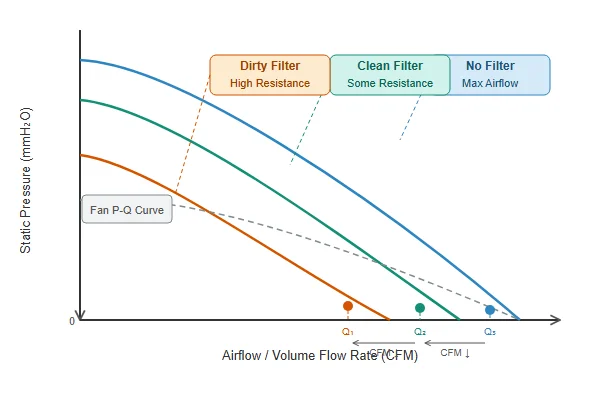
Every fan operates along a pressure-flow (P-Q) curve1, trading off static pressure against airflow volume. Adding a filter in the intake path moves the effective operating point up the pressure axis -- the fan is now working against more resistance. A clean filter adds a relatively modest resistance, typically shifting the operating point a few Pascals depending on mesh density. The same filter after a month of accumulation can add substantially more, dropping delivered airflow noticeably.
The dust interception mechanism itself is simple: mesh openings are sized to catch particles above a certain diameter while allowing air molecules to pass relatively freely. Finer mesh catches smaller particles but adds more resistance from the start. Coarser mesh has less initial resistance but lets finer dust through to accumulate on heatsink fins and fan blades instead, where it's much harder to remove.
| Filter Mesh Density | Initial Airflow Resistance | Particle Size Caught | Cleaning Frequency |
|---|---|---|---|
| Coarse (200+ micron) | Low | Larger particles only | Less frequent |
| Medium (100–200 micron) | Moderate | Most household dust | Every 4–8 weeks |
| Fine (<100 micron) | Higher | Fine particulate | Every 2–4 weeks |
This is the core tradeoff: finer protection means more airflow work for the fan, which is why filter selection can't be separated from fan selection.
How Much Airflow Does Adding a Filter Actually Cost?
The penalty is real, but its magnitude varies enough to matter for how you source and spec fans.
A clean filter typically costs between 5–15% of delivered airflow depending on mesh density and fan speed; a dirty filter can cost significantly more, sometimes enough to push chassis temperatures noticeably higher -- which is why filter cleanliness over time, not just filter presence, determines whether the thermal outcome is actually better than running filterless.
The Dirty-Filter Problem Is Larger Than the Filter-Presence Problem
Engineers often evaluate the filter decision against a clean-filter baseline, but real-world performance is determined by average filter condition across the maintenance cycle, not peak cleanliness. A filter that's clean when installed and then ignored for four months doesn't deliver four months of clean-filter performance -- it delivers steadily degrading airflow as resistance climbs with accumulation.
This matters practically for fan selection: if a case is going to run filtered intakes, the fans need to be specified with enough static pressure headroom to still move adequate airflow at the dirtiest likely operating point, not just at installation. Fans optimized for low-restriction open-air operation may fall short on a clogged filter in ways that wouldn't show up during initial benchmarking.
Positive chassis pressure -- more intake CFM than exhaust CFM -- also becomes harder to maintain as intake filters load up, which can cause neutral or slightly negative pressure conditions that pull unfiltered air through gaps rather than the filtered intakes, partially defeating the filter's purpose.
Which Filter Types and Mounting Locations Actually Work Best?
Filter type and mounting location are inseparable decisions -- the best filter material mounted somewhere inaccessible will be cleaned less often, which negates its advantage.
Filter type and mounting location should be chosen together: magnetic-frame filters on front and bottom intake panels offer the easiest maintenance access, while fan-frame-integrated filters and drive-bay-mounted filters require more disassembly and consequently get cleaned less often in practice -- which is the more important factor for real-world thermal outcomes.
A Practical Breakdown by Type
Magnetic-mount mesh filters are the most maintenance-friendly format: pull off, rinse or brush, replace. Their main limitation is that they rely on the case having appropriate panel geometry to accept them, and they can gap at corners if the magnet coverage isn't complete, letting unfiltered air bypass the mesh edges.
Fan-frame-integrated filters ship as part of the fan unit and require no separate mounting, but cleaning typically requires removing the fan itself -- which in a dense system can mean pulling cables and unscrewing a fan already pressed against a radiator. They get cleaned least often as a result.
Removable panel filters (plastic frame with mesh insert) sit in slots cut into intake panels and slide out like a tray. These are reasonably accessible but depend on case design for slot placement, and coarser versions may let fine dust accumulate on the fan blades themselves.
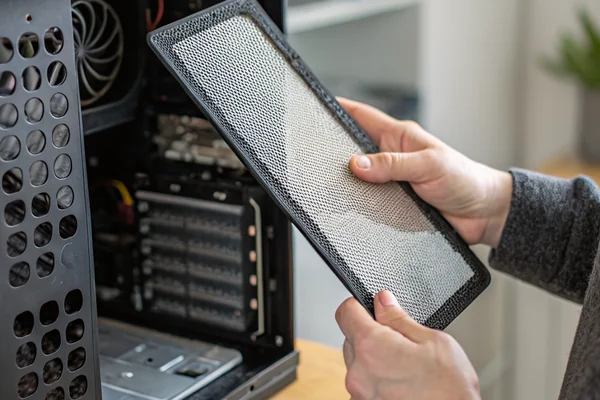
| Filter Mount Type | Ease of Removal | Typical Mesh Quality | Airflow Bypass Risk |
|---|---|---|---|
| Magnetic frame | High | Variable | Low-moderate |
| Fan-frame integrated | Low | Moderate | Very low |
| Panel slot (tray) | Moderate | Coarse to medium | Low |
| Aftermarket adhesive | Moderate | Medium-fine | Moderate |
Location matters independently of mount type. Bottom-intake filters sit closest to the floor where the highest particle concentration typically is, so they load faster. Front-panel filters face the room and catch ambient particles at a slower rate in most environments.
How Often Do Filters Need Cleaning, and What's the Right Method?
Cleaning frequency is the variable most people underestimate and the one with the largest practical impact.
Filters in typical indoor environments should be cleaned every 4–8 weeks, or whenever visible accumulation reaches more than a light coating -- waiting until a filter looks heavily clogged means weeks of degraded airflow that already raised chassis temperatures above what the filter strategy was intended to prevent.
Method Matters as Much as Frequency
The right cleaning method depends on filter construction. Mesh filters -- the most common type -- can be rinsed under running water, allowed to dry completely before reinstallation (wet mesh causes corrosion if reinstalled damp), and lightly brushed if rinsing alone doesn't dislodge embedded particles. Compressed air is effective for removing loose accumulation but can push particles deeper into fine mesh rather than dislodging them, so it's better used as a maintenance tap between deep cleans than as the primary cleaning method.
For environments with elevated dust, pet hair, or particulate (near carpeting, in workshops, in climates with high outdoor particulate), the 4–8 week baseline shortens considerably -- monthly or even bi-weekly inspection is more realistic. The practical test is simple: hold the filter up to a light source. If it's visibly darkened or if you can't see clearly through it, it needs cleaning before the next scheduled interval.
Some filter materials degrade with repeated wet cleaning -- foam filters in particular can lose structural integrity after repeated cycles and should be replaced rather than cleaned indefinitely. Mesh filters on rigid plastic or metal frames hold up to repeated cleaning without significant degradation.
When Does Skipping Filters Make More Sense Than Using Them?
Running filterless isn't neglect -- in some configurations it's the correct engineering choice.
Skipping filters makes sense when the chassis maintains intentional positive pressure, the environment has low ambient particulate, or the hardware is designed for periodic blowout rather than continuous protection -- in those cases, a filter may cost more airflow than the dust protection is worth for the specific deployment.
The Positive-Pressure Alternative
A chassis with more intake CFM than exhaust CFM maintains slight positive internal pressure, which means air exits through gaps and seams rather than entering through them. This substantially reduces dust ingestion through unfiltered paths without adding mesh resistance to the intake fans. Achieving it requires sizing intake fans to deliver meaningfully more airflow than exhaust fans -- not just marginally more -- and it works best in relatively sealed chassis with defined intake and exhaust paths rather than open-frame designs.
Environments with genuinely low particulate (air-conditioned server rooms, clean industrial enclosures, medical device installations) may find the airflow penalty of filters exceeds the protection benefit given how slowly dust accumulates in those conditions. Periodic maintenance blowouts on a scheduled basis can handle whatever does accumulate without the continuous airflow restriction of a filter.
High-airflow performance builds, where sustained maximum airflow matters more than dust management, sometimes deliberately omit filters and rely on active maintenance schedules. This is an informed tradeoff, not an oversight.
Does Filter Choice Affect Fan Selection at the Procurement Stage?
Filter strategy is a fan specification input, not something that gets resolved after fan selection is finalized.
Fans paired with filtered intakes need enough static pressure capability to deliver adequate airflow at the dirtiest expected filter condition, not just at a clean-filter baseline -- which typically means selecting a fan with a steeper P-Q curve than the raw CFM target alone would suggest, or accepting reduced airflow margin over the maintenance cycle.
Why This Belongs in the Initial Spec, Not the Afterthought
ANSI/AMCA Standard 2102 defines laboratory fan rating conditions that don't include filter resistance, meaning published CFM figures are free-air or low-restriction numbers. A fan rated at a given CFM in open conditions will deliver meaningfully less through a loaded intake filter.
For OEM or system integration procurement, specifying the filter resistance (even an estimated dirty-filter value) as an input to fan selection produces a better-matched result than selecting fans on raw CFM and then adding filters afterward. This is especially relevant for chassis designs that fix the filter mesh density and frame geometry before the fan is finalized -- the filter resistance is a known system input that should flow into the fan spec.
Custom or semi-custom fan sourcing for filtered applications typically calls for fans with moderate-to-steeper pitch angles (for pressure headroom), rather than the shallow-pitch high-CFM fans that optimize for open-air operation.
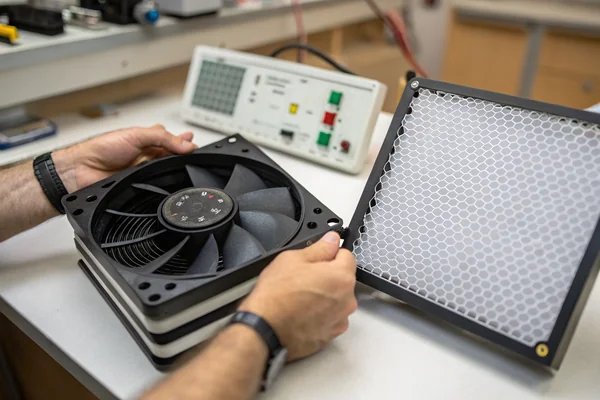
We supply PC case cooling fans from our Dongguan facility specifically matched to defined application conditions, including filtered-intake designs where the fan's static pressure curve needs to hold adequate airflow against real system resistance -- not just open-air CFM numbers. Every fan we produce is validated on our in-house CFM airflow test system and anechoic noise test chamber, and we can discuss P-Q curve requirements for your specific filter configuration directly during product selection.
FAQ
Will a filter make my fans louder?
A partially loaded filter increases the static pressure resistance the fan operates against, which typically increases fan speed (in PWM-controlled systems) to compensate -- so yes, a dirty filter can indirectly raise fan noise. A clean filter has a smaller effect, but the interaction is real.
Do bottom-mounted filters need to be cleaned more often than front-panel filters?
Generally yes -- bottom intakes pull from closer to the floor where airborne particle concentration is higher, so they accumulate dust faster than front-facing intakes at the same airflow rate. Plan for shorter cleaning intervals on bottom-mounted filters in most environments.
Can I add aftermarket filters to a case that didn't come with them?
Yes, adhesive-backed mesh filters are available and work reasonably well for this purpose, though coverage and bypass risk depend on how well the mesh conforms to the intake panel geometry. Magnetic-frame aftermarket filters are available for common 120mm and 140mm fan positions and tend to seal better.
Does filter mesh color affect performance?
No -- mesh color is an aesthetic property and has no meaningful effect on airflow resistance or filtration efficiency. Darker mesh is often chosen because it makes accumulated dust less visible between cleaning cycles, which if anything is a mild argument against it from a maintenance discipline standpoint.
Is foam or mesh better for a fan filter?
Mesh (metal or synthetic) is generally more durable and handles repeated wet cleaning better; foam provides finer filtration but degrades more quickly with repeated cleaning and can restrict airflow more aggressively as it loads. For most PC cooling applications, medium-density mesh is the more practical long-term choice.
Do filters affect intake fans and exhaust fans differently?
Filters are placed on intake paths, so they directly affect intake fans. Exhaust fans typically run unrestricted. The interaction matters for pressure balance: as intake filters load up, positive chassis pressure is harder to maintain, which indirectly changes the effective operating condition for all fans in the system.
How do I know if my filter is costing me significant airflow?
The simplest check: remove the filters temporarily and monitor CPU and GPU thermals at the same workload. If temperatures drop noticeably, the filters are adding enough resistance to matter -- which usually means they need cleaning rather than removal, but the test isolates whether the filter condition is a thermal factor.
Filters are a maintenance system, not a set-and-forget accessory -- choosing the right type and location matters, but cleaning frequency determines whether the strategy actually protects thermal performance over time. Herays engineers DC axial and PC case cooling fans at our Dongguan facility with over 20 years of production experience, certified to ISO 9001, ISO 14001, QC 080000, and IATF 16949. If your application has specific pressure or airflow requirements around filtered intakes, we're glad to discuss fan selection around your actual system resistance.
A pressure-flow (P-Q) curve is a graph showing the relationship between a fan's static pressure output and its delivered airflow volume, defining how the fan's performance changes as system resistance increases. It is the primary tool for matching a fan to a specific application's resistance conditions, and is why filter resistance is relevant to fan selection rather than a separate consideration. ↩
ANSI/AMCA Standard 210 defines laboratory methods for testing and rating fan aerodynamic performance, establishing the controlled conditions under which published CFM and static pressure figures are measured. Because these test conditions do not include filter resistance, published ratings represent best-case numbers that will not be achieved in filtered-intake installations at the dirtied end of a maintenance cycle. ↩

Liang
I've been working with DC fans for 30 years — long enough to have seen the industry evolve from basic sleeve bearing designs to today's high-efficiency, IP68-rated systems built for the harshest environments imaginable. I founded Herays because I believed manufacturers and engineers deserved a supplier who could talk technical from day one. Not just hand over a datasheet, but actually help you select the right fan for your thermal load, your enclosure, your certification requirements. Most of what I write here comes directly from problems I've solved on the factory floor or in customer applications — medical devices, laser equipment, industrial automation, you name it. If it involves moving air efficiently and reliably, I've probably spent time thinking about it. When I'm not obsessing over airflow curves, I'm usually helping a customer figure out why their cooling system isn't performing the way their simulation said it would.
View all posts by Liang