Choosing the wrong fan bearing can lead to premature product failure and dissatisfied customers. Understanding the trade-offs between cost, noise, and lifespan is essential for making the correct design decision.
The optimal bearing type depends on your application's primary design constraint. Sleeve bearings are ideal for low-cost projects, ball bearings are best for durability and long-term use, and Fluid Dynamic Bearings (FDB) offer the quietest operation for premium products. The final choice is always a trade-off between these factors.
In discussions with engineers and purchasing managers, the topic of fan bearings arises frequently. While it may seem like a minor detail, the bearing selection is one of the most critical decisions affecting your product's reliability. As the heart of the fan, the bearing influences everything from the final bill of materials to how long your product will last in the field. This article breaks down the key considerations to help you choose wisely.
We will focus on the three most common bearing types in DC axial fans, though specialized options like magnetic levitation bearings exist for specific high-end applications.
Table of Contents
The Critical Role of the Fan Bearing
Overlooking the fan bearing is a common but costly mistake. Because this single component is often the first point of failure1, its selection directly impacts your product's field reliability and your company's reputation.
The bearing directly dictates a fan's lifespan, noise level, cost, and acceptable mounting orientations. An incorrect choice can lead to early failure, excessive noise, or budget overruns, making it a critical design parameter, not just a line item on a spec sheet.
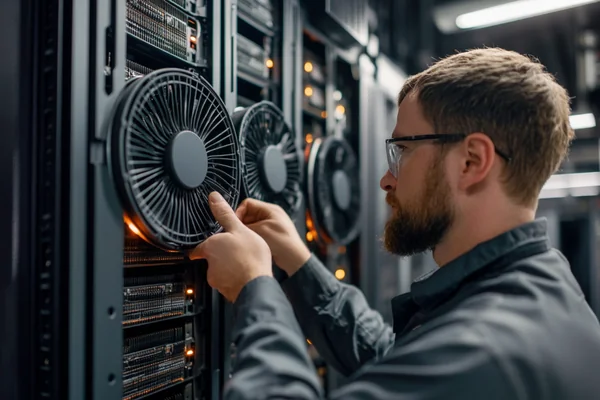
The bearing is the mechanical interface that supports the rotating shaft, reducing friction between the fan's stationary and moving parts. As a component under constant mechanical stress, it governs several key performance characteristics. Based on our experience helping customers specify fans, these are the factors most affected:
- Lifespan: A bearing's design, materials, and lubricant quality determine its operational life before failure.
- Noise: The amount of friction and the stability of the rotating assembly directly contribute to the fan's acoustic signature.
- Cost: More complex and durable bearings require higher-precision manufacturing processes, which increases the fan's unit cost.
- Failure Mode: How a bearing fails can be as important as when. Some types degrade gracefully by becoming louder, providing an audible warning, while others can seize abruptly and without notice.
Considering these factors frames the selection not just as a technical specification, but as a business decision that balances performance, cost, and risk.
| Factor | How the Bearing Impacts It |
|---|---|
| Lifespan (L10) | L10 life represents the number of operating hours that 90% of a group of identical bearings will complete or exceed under specified operating conditions.2 |
| Acoustic Noise | Directly related to friction and stability within the bearing mechanism. |
| Unit Cost | More precise and complex bearings are more expensive to manufacture. |
| Orientation | Some bearings are not suitable for horizontal or inverted mounting. |
Sleeve Bearings: The Cost-Effective Standard
For projects with tight budget constraints, a sleeve bearing fan is a common consideration. The concern is whether this low-cost option compromises product reliability and reputation.
Sleeve bearings are the most cost-effective choice3 and are very quiet at the start of their life. They are a practical solution for mass-market electronics and other applications where the fan is mounted vertically and extreme longevity is not the primary design driver.
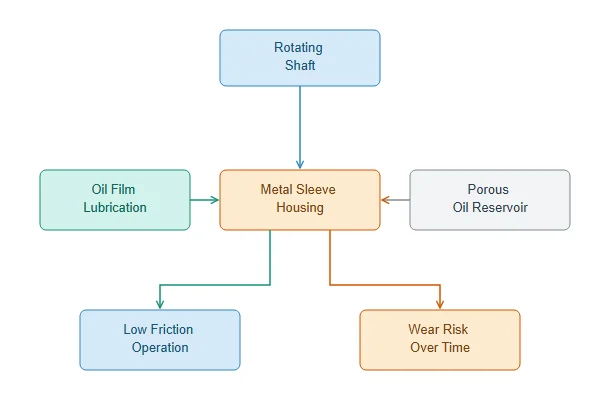
A sleeve bearing consists of a shaft rotating within a lubricated porous metal sleeve. An oil film between the two surfaces reduces friction. Their primary advantage is low manufacturing cost, making them prevalent in consumer electronics and other price-sensitive products. They are also characterized by very low noise levels during initial operation.
However, sleeve bearings have distinct limitations. The lubricant can evaporate or degrade over time, particularly at elevated temperatures. This process increases friction, causing the fan to become noisier and slower until it eventually seizes. They are also sensitive to mounting orientation; horizontal mounting causes uneven wear on the sleeve as the shaft rests on one side, leading to a shorter operational life. A key point we emphasize to clients is that sleeve bearings typically fail gracefully. They grow louder over time, providing an audible warning to the end-user, which can be preferable to a sudden, silent failure in some applications.
| Pros of Sleeve Bearings | Cons of Sleeve Bearings |
|---|---|
| Lowest unit cost | Shorter lifespan |
| Very quiet operation initially | Lubricant can dry out |
| Failure is often gradual (gets noisy) | Best for vertical mounting only |
Ball Bearings: The Benchmark for Durability
For products that must operate 24/7 in demanding environments, ball bearings are the default choice. The question is whether they introduce unnecessary cost and noise.
Ball bearings are the standard for long-term reliability.4 They tolerate high temperatures well and can be mounted in any orientation. This makes them the go-to choice for industrial equipment, servers, and any device that needs to run without interruption for years.
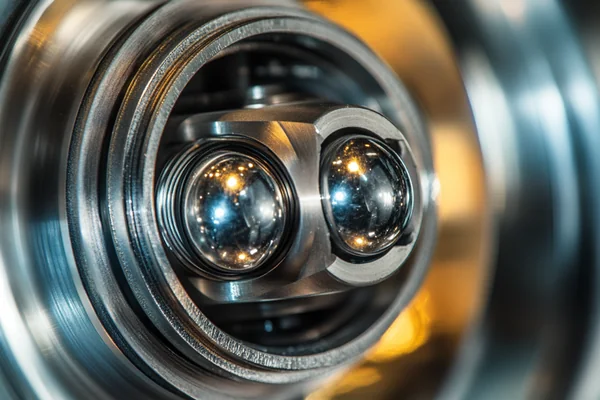
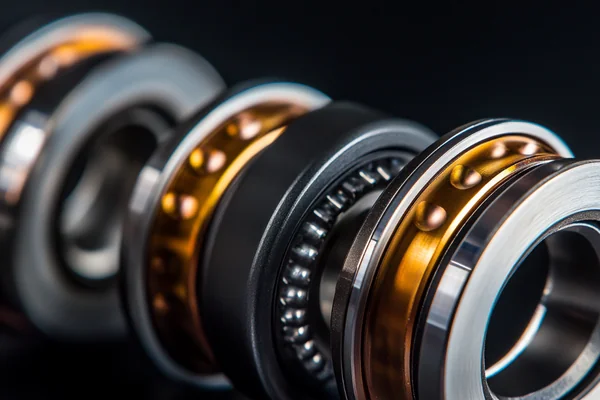
Inside a ball bearing fan, a set of small steel balls rolls between the moving and stationary parts (races). These rolling elements dramatically reduce friction, enabling the fan to run for extended periods with high rotational stability. Consequently, their L10 lifespan ratings are often double or triple those of sleeve bearings. A critical feature for many industrial customers building compact equipment is that they are not sensitive to mounting orientation5; they can be installed vertically, horizontally, or at any angle without degrading performance.
The trade-offs include a higher unit cost and a slightly higher noise level compared to a new sleeve or Fluid Dynamic Bearing. Furthermore, their failure mode is typically different. A ball bearing fan tends to operate within specification until it fails, which can be more abrupt. For a server in a monitored data center, where reliability is the absolute priority, this is an acceptable characteristic.
| Pros of Ball Bearings | Cons of Ball Bearings |
|---|---|
| Excellent long-term lifespan | Higher unit cost than sleeve |
| Can be mounted in any orientation | Slightly higher noise level |
| Performs well in high temperatures | Failure can be more abrupt |
Fluid Dynamic Bearings (FDB): Quiet Operation and Long Life
For applications demanding the quietest possible operation and a long lifespan, Fluid Dynamic Bearings (FDB) are a compelling option. However, their high cost raises questions about whether they offer a tangible benefit over a high-quality ball bearing.
Fluid Dynamic Bearings provide a lifespan comparable to ball bearings but with the low acoustic noise of sleeve bearings. They are an excellent choice for premium products like high-end PCs, audio/video equipment, and medical devices where low noise is a critical feature.
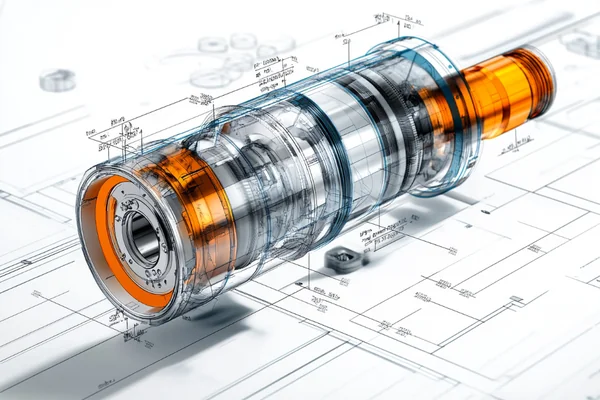
A Fluid Dynamic Bearing (FDB), also known as a hydrodynamic bearing, is an advanced design where the fan's shaft floats on a thin, stable layer of oil. This fluid layer is pressurized by the shaft's own rotation, creating a non-contact system that nearly eliminates friction. The result is extremely quiet operation and a long operational life, combining the key advantages of both sleeve and ball bearings. This makes them a strong fit for products where the user experience is paramount.
This performance comes at a premium cost. More importantly, the manufacturing quality of an FDB is critical. The seals that contain the lubricating fluid must be robust to prevent leakage. A poorly manufactured FDB can fail faster than a standard ball bearing, especially in environments with high heat or dust. When a customer is considering an FDB, we advise them to carefully evaluate the operating environment. For a clean, stable office or home setting, it is a fantastic choice. For a dusty factory floor or other contaminated space, a sealed ball bearing is often a more reliable solution.
| Pros of Fluid Dynamic Bearings | Cons of Fluid Dynamic Bearings |
|---|---|
| Extremely quiet operation | Highest unit cost |
| Lifespan comparable to ball bearings | Performance depends heavily on manufacturing quality |
| Excellent vibration and shock resistance6 | Seals can be a point of failure in harsh environments |
Making the Right Choice: A Decision Framework
Understanding the bearing types is the first step; selecting the right one for your product requires balancing cost, noise, and reliability.
Base your decision on your application's top priority. If minimizing cost is the primary driver, select a sleeve bearing. If you require maximum durability for 24/7 operation, choose a ball bearing. For the quietest possible performance in a premium product, specify a Fluid Dynamic Bearing.
The most effective way to decide is to identify the primary risk you need to mitigate. The main concern could be budget overruns, field failures, or negative customer reviews about noise. Your answer will point you toward the most appropriate bearing. As a fan supplier, this is the framework we use to guide customers to the right solution for their specific product. There is no single "best" bearing, only the best bearing for a given application.
Here is a simple guide based on common product categories:
| Application Example | Main Priority | Recommended Bearing | Why It's a Good Fit |
|---|---|---|---|
| Consumer Electronics | Low Cost | Sleeve Bearing | The budget is the primary constraint, and the product is not expected to run 24/7. A gradual, noisy failure is an acceptable end-of-life behavior. |
| Industrial Cabinet / Server | Reliability | Ball Bearing | Must run continuously for years, potentially in high heat. The ability to mount at any angle is often required. |
| High-End Gaming PC | Low Noise | Fluid Dynamic Bearing | Low acoustic noise is a key selling feature, and a premium user experience is expected. The operating environment is typically clean. |
| Medical Device | Quiet & Reliable | FDB or Ball Bearing | The choice depends on the device's function. FDB for quiet, patient-facing equipment. Ball bearing for internal, long-life components. |
Conclusion
Selecting the right fan bearing requires a clear understanding of the trade-offs between cost, lifespan, and noise. By aligning the bearing's characteristics with your product's specific requirements and operating environment, you can ensure you are specifying a reliable and effective cooling solution.
"Health Assessment of [Cooling Fan](https://herays.com/dc-axial-fan-noise-reduction-how-to-choose-a-quiet-cooling-fan/) Bearings Using Wavelet ...", https://pmc.ncbi.nlm.nih.gov/articles/PMC3574677/. A technical analysis or reliability study can show that the bearing system is a critical component for fan longevity and is frequently the limiting factor in its operational lifespan. ↩
"[PDF] Important Bearing Terminology: Bearing Life Basic Static Load ...", https://www.engineering.iastate.edu/~gkstarns/me325/bearings_2.pdf. Industry standards and engineering resources define L10 life as a statistical measure of reliability, representing the time at which 10% of a large population of components, such as bearings, are expected to have failed. ↩
"Cost analysis of composite fan blade manufacturing processes", https://ntrs.nasa.gov/citations/19800022892. Component supplier datasheets and engineering guides often confirm that sleeve bearings are the lowest-cost option due to their simpler construction and fewer precision parts compared to ball or fluid dynamic bearings. ↩
"Fan Bearing Types – Weighing the Pros and Cons | Same Sky®", https://www.sameskydevices.com/blog/fan-bearing-types-weighing-the-pros-and-cons?srsltid=AfmBOordJ5IJHwEGb6P2u86YJZ04gwurU-oukve_cdEzLgSi749RXG9Q. Industry application guides and engineering resources for high-reliability systems, such as those for telecommunications or industrial automation, specify ball bearings as the preferred choice for long-life cooling fans. ↩
"Design of bearing arrangements | Schaeffler medias", https://medias.schaeffler.us/en/knowledge-center/rolling-bearings/design-of-bearing-arrangements. Mechanical engineering resources explain that the point contact of the balls in a ball bearing assembly allows it to support both axial and radial loads effectively, making its performance and lifespan largely independent of mounting orientation. ↩
"Fluid bearing - Wikipedia", https://en.wikipedia.org/wiki/Fluid_bearing. Technical papers on bearing dynamics explain that the continuous fluid film in a hydrodynamic bearing provides significant damping properties, allowing it to absorb shock and vibration more effectively than the rolling elements in a ball bearing. ↩

Liang
I've been working with DC fans for 30 years — long enough to have seen the industry evolve from basic sleeve bearing designs to today's high-efficiency, IP68-rated systems built for the harshest environments imaginable. I founded Herays because I believed manufacturers and engineers deserved a supplier who could talk technical from day one. Not just hand over a datasheet, but actually help you select the right fan for your thermal load, your enclosure, your certification requirements. Most of what I write here comes directly from problems I've solved on the factory floor or in customer applications — medical devices, laser equipment, industrial automation, you name it. If it involves moving air efficiently and reliably, I've probably spent time thinking about it. When I'm not obsessing over airflow curves, I'm usually helping a customer figure out why their cooling system isn't performing the way their simulation said it would.
View all posts by Liang