RVs throw everything at a fan at once -- vibration from the road, wide temperature swings, dust, moisture, and a battery you can't afford to drain -- which is why a fan that works fine in a house doesn't always survive on the road.
- RV ventilation isn't just about comfort. It's what keeps mold from taking hold, clears cooking fumes, and keeps appliances like the fridge running properly.
- 12V is the standard for RVs because it runs directly off the house battery, without the extra complexity and losses of inverting for an AC fan.
- Roof vents want high CFM and a reversible motor for whole-van air exchange. Refrigerator vents care more about static pressure and heat tolerance.
- Noise rating matters more here than in most applications -- a 5-10 dBA difference is the gap between a restful night and constant irritation, and ball bearings tend to strike the best balance of longevity and quiet.
- I generally push RV builders toward IP55 or higher for anything exposed to moisture or road dust, and toward ball over sleeve bearings given the vibration and temperature swings involved.
I've been working with DC fans for 30 years, long enough to see them move out of computer cases and into just about every corner of modern life. One of the most challenging applications I've consulted on is for RVs and camper vans. The problems are unique: you're dealing with vibration from the road, extreme temperature swings, dust, moisture, and a constant battle to conserve battery power.
Over the years, I've helped countless DIY builders and specialty vehicle manufacturers select the right fans. The wrong choice doesn't just mean you're uncomfortable; it can lead to mold, damaged interiors, or even appliance failure. Getting it right comes down to understanding the specific job you're asking the fan to do.
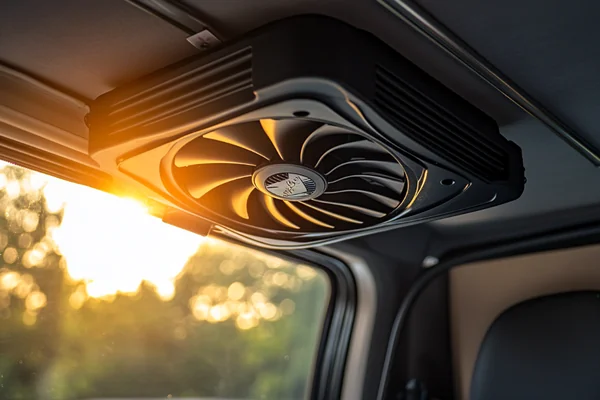
Table of Contents
What Are the Key Ventilation Needs in an RV or Camper Van?
When I talk to builders, the conversation often starts with "I need to cool my van." But the job is more complex than that. In an RV, you're managing a small, sealed environment. I see four primary jobs for fans:
- Moisture Control: Just breathing overnight can release a surprising amount of water vapor. Add cooking and the occasional shower, and you have a recipe for condensation, which quickly leads to mold and mildew. A good exhaust fan is your number one defense against this.
- Heat & Fume Exhaust: A van parked in the sun can get dangerously hot. A powerful roof fan creates airflow to pull that hot, stale air out. It's also essential for clearing out cooking smoke and odors quickly.
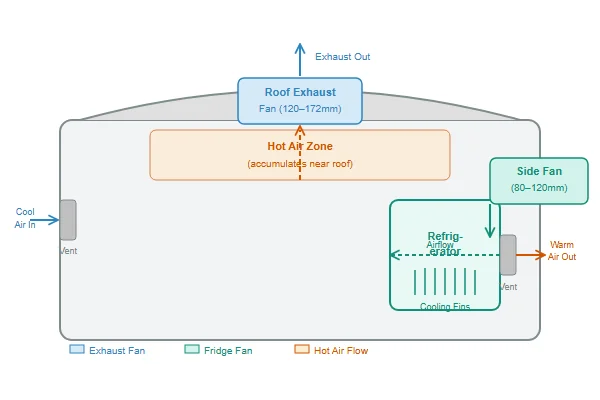
- Appliance Efficiency: This is the one most people overlook. The absorption refrigerators common in RVs don't have compressors; they rely on a heat-driven process that requires consistent airflow over their rear cooling fins to work properly. I've seen many "my fridge isn't working" complaints that were actually just poor ventilation. This is a detail covered in manufacturer engineering guides like Dometic's Refrigerator Vent Application Guide1. A small, well-placed fan can make a huge difference in fridge performance on a hot day.
- Air Circulation: Sometimes you just need to move air around inside the living space for comfort without opening a window.
Why Are 12V DC Fans the Standard for RVs?
Almost without exception, the answer is a 12V DC axial fan. The reason is simple: efficiency. Your RV's house electrical system runs on 12V DC from a battery bank.
Running a 12V fan directly from that system is the most direct and energy-efficient path. If you were to use a standard 120V or 230V AC fan from a house, you'd first have to use an inverter to change your 12V DC battery power into AC power. That conversion process wastes energy—often 10-15% of your precious battery capacity is lost as heat in the inverter. When you're off-grid, every amp-hour counts. 12V DC is simply the native language of your vehicle's power system.
For applications like RVs and marine equipment, we know that standard factory tests aren't enough. That's why we invested in our own in-house salt spray test systems and temperature cycling chambers. A fan in a van is exposed to road salt, constant vibration, humidity, and extreme temperatures from desert heat to mountain cold. We've seen too many fans fail prematurely because they were only designed and tested in ideal lab conditions. Our OEM partners for specialty vehicles rely on us because our ISO 9001 and IATF 16949 certified processes include testing that mimics these real-world conditions, ensuring a fan rated for 70,000 hours can actually deliver.
Should You Mount Your Fan on the Roof or a Wall?
The right location depends entirely on the job. I generally guide people to think in terms of "whole-space" vs. "spot" ventilation. The strategy of pushing air out versus pulling it in, what I call fan-out vs. fan-in airflow, is also a key decision.
- Roof-mounted fans are the champions of whole-space ventilation. Since heat rises, placing a fan at the highest point is the most effective way to exhaust hot, humid, or stale air from the entire cabin.
- Wall-mounted fans are for spot ventilation. This includes small fans for circulating air in a sleeping bunk, fans to improve refrigerator performance, or fans for venting a battery or electronics compartment.
Here's a quick breakdown I use to help people choose:
| Fan Location | Primary Function | Key Fan Requirement | Typical Size Range |
|---|---|---|---|
| Roof Vent | Whole-van exhaust, heat removal | High CFM, Reversible, IP Rated | 120mm - 172mm |
| Refrigerator Vent | Assist cooling fin airflow | High static pressure, High temp tolerance | 80mm - 120mm |
| General Circulation | Move air inside the living space | Low noise, Low power draw | 92mm - 140mm |
| Electronics Bay | Cool inverters, charge controllers | Compact size, Reliability | 40mm - 80mm |
How Do You Balance Airflow and Noise for Sleeping Areas?
This is one of the biggest complaints I hear: "My fan moves air, but it's too loud to sleep." A fan's noise level is measured in decibels (dBA), and it's a logarithmic scale—a 35 dBA fan is noticeably quieter than a 45 dBA fan. For any fan near a sleeping area, I consider noise to be as important as airflow.
Here's what I look at for achieving quiet operation:
- Bearing Type: This is the single biggest factor in a fan's long-term noise profile.
- Sleeve Bearings: They start very quiet but wear out, especially with the vibration in a vehicle. As they wear, they get noisy and can fail. I don't recommend them for continuous-duty RV applications.
- Ball Bearings: My usual recommendation. They have a slightly higher initial noise level than a brand-new sleeve bearing, but that noise level remains stable over a very long life. They are tough and handle vibration and temperature swings well. You can read more in my guide to fan bearing types.
- Fluid Dynamic Bearings (FDB): Excellent for quiet, long-life operation, but can be more expensive and are less common in rugged, IP-rated models.
- Speed Control: The best strategy for DC fan noise reduction is to run the fan at the lowest speed that gets the job done. Use a simple voltage or PWM speed controller to dial it down for quiet overnight running and crank it up for a quick cool-down during the day.
- Mounting: Don't bolt the fan directly to a large, flat panel of the van body, which can act like a speaker and amplify vibration. Use rubber grommets or a silicone gasket to isolate the fan and stop vibrations from turning into audible noise.
What Fan Specs Matter Most for RV Applications?
When you're looking at a datasheet, it's easy to get lost in the numbers. For an RV, I tell people to focus on these five things:
- IP Rating (Ingress Protection): If the fan is anywhere it might see rain, road spray, or even just heavy condensation, it needs to be a waterproof DC axial fan. An IP rating like IP55 means it's protected from dust and jets of water. For a roof fan, this isn't negotiable.
- Bearing Type: As I mentioned, ball bearings are the workhorse choice for reliability in a vehicle. Sleeve bearings just don't last under the combined stress of heat and vibration.
- CFM vs. Static Pressure: For an unobstructed roof vent, a high CFM (Cubic Feet per Minute) rating is great. But for pushing air through the tight fins of a refrigerator coil or a ducted system, you need to look at static pressure. That's the spec that tells you how well the fan can push against resistance.
- Operating Temperature Range: A fan mounted in a black roof dome or behind a hot refrigerator can easily see temperatures well above 50°C (122°F). Check the fan's maximum operating temperature to ensure it's rated for the job.
- Current Draw (Amps): When you're living off a battery, every bit of power matters. Compare the amp draw of different fans, and remember that running a fan at 50% speed can often use much less than 50% of the power.
Choosing the right fan isn't about finding the most powerful one; it's about matching the fan's engineering to the specific problem you're trying to solve in your vehicle.

FAQ
What's the best type of fan for an RV roof vent? For a main roof vent, I recommend a 12V DC axial fan with a high CFM rating, a durable ball bearing, a reversible motor (so you can choose intake or exhaust), and a solid IP rating (IP55 or higher) to protect it from weather.
Can I use a computer fan in my RV? You can, but I generally advise against it for critical applications. Most standard computer fans use low-cost sleeve bearings that wear out quickly with vehicle vibration, and they almost never have an IP rating to protect them from moisture or dust. They're built for a much cleaner, more stable environment.
How do I make my RV fan quieter? First, run it at a lower speed using a PWM or voltage controller. Second, ensure it has a quality ball bearing, as worn sleeve bearings are a major source of noise. Finally, mount the fan using rubber gaskets or grommets to isolate its vibration from the vehicle's body.
Do I really need a fan for my RV refrigerator? If you have an absorption-style fridge, my answer is an emphatic yes. In warm weather (anything over 80°F / 27°C), a small fan to assist airflow across the cooling coils can be the difference between a fridge that works and one that doesn't. It's one of the most effective and low-cost upgrades you can make.
What does an IP rating on a fan mean? IP stands for Ingress Protection. It's a two-digit code that rates how well the fan's motor and electronics are sealed. The first digit is for protection against solids (like dust), and the second is for protection against liquids (like water). For an RV fan exposed to the elements, higher numbers are always better.
"Refrigerator Vent Application Guide", https://www.rvupgradestore.com/v/vspfiles/assets/pdf/Ventguide.pdf. This guide from Dometic, a major RV appliance manufacturer, details the critical need for proper airflow and ventilation sizing for absorption refrigerator performance. ↩

Liang
I've been working with DC fans for 30 years — long enough to have seen the industry evolve from basic sleeve bearing designs to today's high-efficiency, IP68-rated systems built for the harshest environments imaginable. I founded Herays because I believed manufacturers and engineers deserved a supplier who could talk technical from day one. Not just hand over a datasheet, but actually help you select the right fan for your thermal load, your enclosure, your certification requirements. Most of what I write here comes directly from problems I've solved on the factory floor or in customer applications — medical devices, laser equipment, industrial automation, you name it. If it involves moving air efficiently and reliably, I've probably spent time thinking about it. When I'm not obsessing over airflow curves, I'm usually helping a customer figure out why their cooling system isn't performing the way their simulation said it would.
View all posts by Liang