Specifying the wrong fan type wastes budget, fails thermal targets, and forces a costly redesign. The difference between a centrifugal blower and an axial fan isn't just shape -- it's a fundamentally different airflow mechanism that determines which one solves your problem.
A centrifugal blower moves air perpendicular to its intake by accelerating it outward with a rotating impeller, delivering high static pressure suited to restrictive ducted paths. An axial fan moves air parallel to its rotating axis, delivering high airflow volume at low pressure -- the right choice for open-air or lightly restricted cooling.
- The core difference is directional: axial fans move air along the rotation axis, centrifugal blowers redirect air 90 degrees outward, making them fundamentally different tools for different airflow problems.
- Centrifugal blowers generate significantly more static pressure per unit size, which makes them the correct choice for any application with filters, ducts, tight enclosures, or significant back-pressure.
- Axial fans deliver more airflow volume at lower pressure and generally run quieter at equivalent speeds, suiting them to open-air, lightly restricted, or space-constrained applications.
- Form factor drives mounting decisions as much as performance does -- centrifugal blowers require inlet and outlet planning, while axial fans integrate as simple in-line or panel components.
- Most procurement errors in this category come from specifying based on size or cost rather than matching the fan type to the application's actual pressure-volume requirements.
Understanding where the performance difference actually comes from -- not just the headline numbers -- is what prevents specification mistakes that show up only after installation.
Table of Contents
How Do These Two Fan Types Actually Move Air Differently?
Pick the wrong type and the thermal model looks fine on paper but fails in the cabinet. The mechanism behind each type is the root cause of every downstream performance difference.
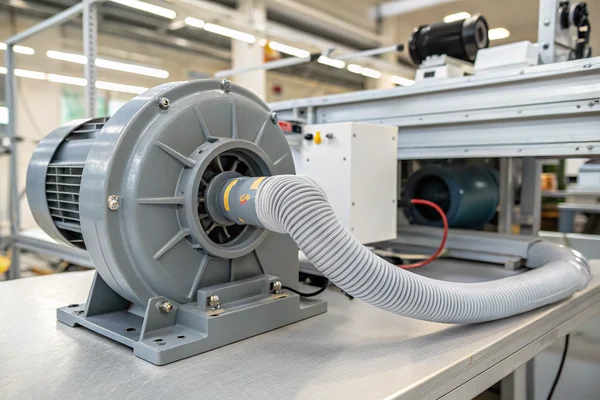
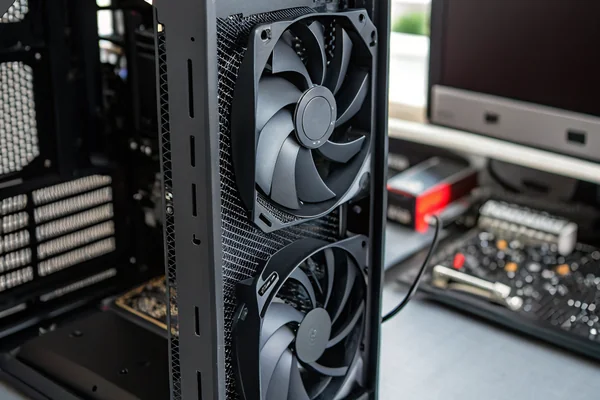
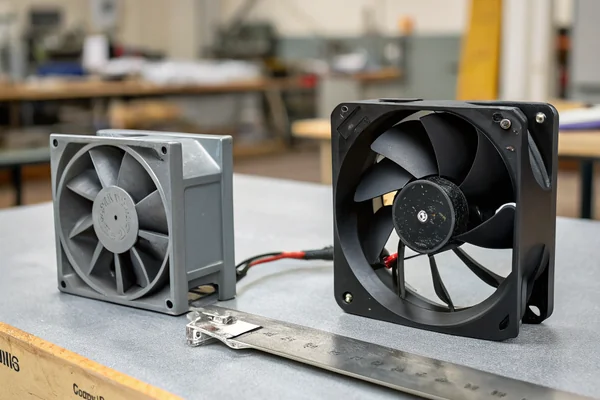
An axial fan1 draws air in and pushes it straight through along the axis of rotation, like a propeller. A centrifugal blower draws air in axially at the impeller eye and flings it radially outward through a volute casing, exiting at 90 degrees to the inlet -- a fundamentally different fluid path that produces fundamentally different pressure-volume characteristics.
Why the Fluid Path Shapes Everything Downstream
The direction of airflow isn't an aesthetic distinction -- it changes how each device handles resistance. An axial fan's straight-through path is efficient when air flows freely, but performance degrades sharply as system resistance increases because there's no mechanical mechanism to build pressure against a back-pressure load. The centrifugal blower's impeller, spinning inside a volute, converts rotational velocity into pressure energy by the same principle a centrifuge uses to separate dense materials -- it actively builds pressure as a byproduct of redirecting the airflow, which is why its performance curve holds up under load in a way an axial fan's does not.
This distinction matters immediately in any real system design: every filter, every elbow fitting, every length of duct, and every narrow enclosure adds system resistance. The fan type that handles that resistance correctly isn't a preference -- it's a constraint.
| Characteristic | Axial Fan | Centrifugal Blower |
|---|---|---|
| Airflow direction | Parallel to axis | 90° from inlet to outlet |
| Pressure generation mechanism | Blade pitch / propeller action | Centrifugal acceleration in volute |
| Performance under back-pressure | Degrades sharply | Maintains relatively well |
| Typical form factor | Thin, square or round frame | Bulkier, requires inlet/outlet planning |
Which Type Generates More Static Pressure, and Why Does That Gap Matter?
Choosing an axial fan for a high-resistance application doesn't just reduce performance -- it can produce near-zero airflow while the fan appears to be running normally.
Centrifugal blowers generate substantially more static pressure2 than axial fans of comparable size, often by a factor of several times at equivalent speeds, because the volute casing converts centrifugal velocity into pressure continuously throughout the airflow path rather than relying on blade pitch alone.
Reading the P-Q Curve Before You Commit
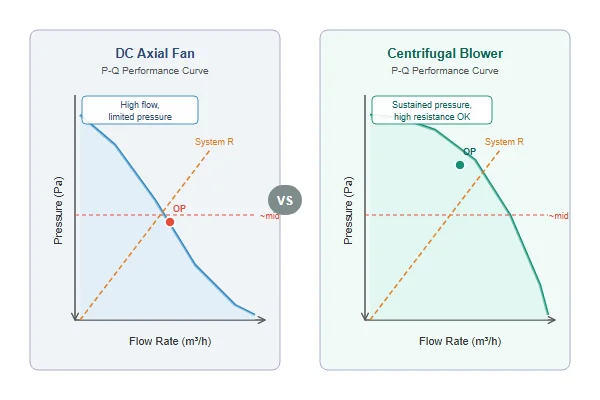
The ANSI/AMCA Standard 210 laboratory test method exists precisely to characterize how a fan's static pressure output changes across its airflow range -- the pressure-volume (P-Q) curve. For a given fan type, this curve tells you whether the device can actually deliver usable airflow into your system's resistance, not just into free air.
An axial fan's P-Q curve typically drops steeply as system resistance climbs: it performs well at low resistance, but its static pressure ceiling is limited. A centrifugal blower's curve is flatter and extends to much higher pressure values, which is why it remains usable across a wider range of restrictive conditions. For applications involving HEPA-class filtration, tightly packed server enclosures, long duct runs, or medical device internal channels, the pressure gap between the two types isn't marginal -- it's the difference between adequate cooling and a thermally failed system.
If the application's estimated system resistance sits above roughly the midpoint of an axial fan's pressure curve, a centrifugal blower should be the default starting point rather than a secondary consideration.
What Are the Real Noise and Efficiency Tradeoffs Between the Two Types?
Neither type is categorically quieter or more efficient -- the honest answer depends on what the application is actually asking each device to do.
Axial fans tend to run quieter and more efficiently than centrifugal blowers when delivering high airflow at low resistance, because the straight-through flow path minimizes turbulence losses. Centrifugal blowers are more efficient when operating against significant back-pressure, where an axial fan working beyond its pressure capability becomes both noisy and thermally inefficient.
Why Comparing Noise Numbers Out of Context Misleads
A centrifugal blower running at its design point in a ducted application will often be quieter in practice than an axial fan straining against back-pressure beyond its capability -- even if the blower's datasheet noise figure looks higher in free-air testing. This is because an axial fan operating near its stall point generates significant turbulence and blade-tip noise, and motor current increases as the fan works harder against a load it wasn't designed for.
Efficiency follows the same logic. Matching the fan type to the application's actual resistance point keeps the device operating near its best efficiency point on the P-Q curve. Running either type far from its design point wastes power, generates heat in the motor, and shortens operating life -- none of which shows up in a datasheet comparison done at free-air conditions.
The practical guidance: specify noise and efficiency at the application's actual operating point on the P-Q curve, not at the free-air or maximum-pressure extremes.
How Do Form Factor and Mounting Requirements Differ Between the Two?
Physical integration constraints eliminate one option before performance specs even enter the discussion in many designs.
Axial fans integrate as simple in-line or panel components requiring only a square or round cutout and clearance for straight-through airflow. Centrifugal blowers require separate, planned inlet and outlet paths oriented 90 degrees apart, making them fundamentally different enclosure design problems -- not just different components in the same mounting hole.
Why Inlet and Outlet Planning Isn't Optional for Centrifugal Blowers
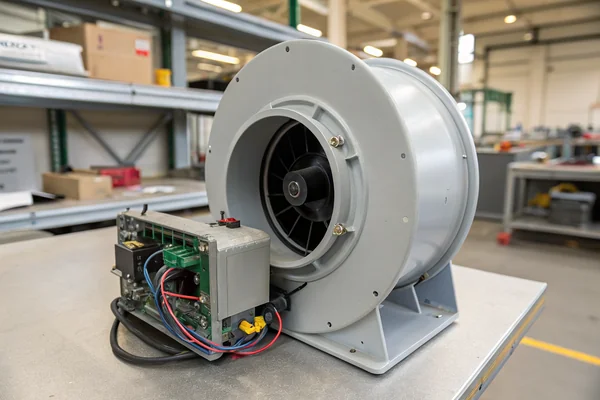
A centrifugal blower's 90-degree inlet-to-outlet geometry means the enclosure design must accommodate a specific inlet location and a separate, directed outlet path -- typically a duct stub or formed channel. Ignoring this and recirculating the outlet air back near the inlet defeats the device's pressure capability entirely. This makes centrifugal blowers a better fit for products where the enclosure was designed around the blower from the start, or where a dedicated duct path already exists, rather than as drop-in replacements in layouts designed for axial fans.
Axial fans, by contrast, are more forgiving of imperfect installation geometry: a panel cutout with reasonable blade-tip clearance and no major obstructions to the straight-through flow path is usually sufficient. This installation simplicity is a real engineering advantage in cost-constrained or space-constrained designs where adding duct structure isn't practical.
Which Type Should You Actually Choose? A Practical Decision Framework
Most specification errors in this category come from skipping the system resistance estimate and selecting by size, price, or familiarity instead.
Choose a centrifugal blower when system resistance is significant -- filters, ducts, tight enclosures, high-density components -- and choose an axial fan when the airflow path is open or lightly restricted and moving a large volume of air quietly is the priority. When in doubt, estimate the application's system resistance curve and check where it intersects each fan type's P-Q curve before committing.
The Three Questions That Determine the Answer
First, what is the estimated system resistance at your target airflow? If it's high enough that an axial fan's pressure ceiling becomes the binding constraint, the decision is already made. Second, what are the physical constraints -- is there room for a blower's inlet-outlet geometry, or does the design require a simple in-line component? Third, is the application noise-sensitive enough that operating near each device's design point matters more than headline noise figures?
Working through these three questions in order typically resolves the choice before any other spec comparison is needed. A useful secondary check: if the application has a filter in the airflow path that will load up with particulates over time, increasing system resistance as it ages, a centrifugal blower's flatter pressure curve provides more operational margin as filter condition degrades -- something an axial fan's steep pressure drop-off doesn't accommodate well.
What Does This Choice Mean for Long-Term Reliability and Failure Modes?
Fan type selection affects not just day-one performance but long-term reliability in ways that often don't show up until field returns arrive.
An axial fan running in a higher-resistance application than it was designed for draws more current, heats its motor bearings faster, and is more likely to stall under transient load spikes -- shortening its service life in ways that aren't visible on a datasheet. A centrifugal blower operating near its pressure design point runs its motor at a more sustainable load, extending bearing and winding life under those same conditions.
Why Thermal and Mechanical Stress Compounds Over Time
Motor bearing life is directly affected by continuous operating current, which rises when either fan type is working against resistance beyond its design intent. For an axial fan in a high-resistance application, this means the motor runs hotter than its rated conditions anticipated, accelerating bearing wear whether the bearings are sleeve, ball, or fluid dynamic type. The motor winding insulation also degrades faster at elevated temperatures, compressing the fan's MTBF below the datasheet value in ways that don't show up during initial qualification testing done at the rated free-air condition.
Centrifugal blowers carry their own failure mode: inlet obstruction, which reduces airflow into the impeller eye, can cause internal recirculation that adds mechanical load and noise before eventually causing thermal shutdown. Keeping the inlet clear and planning for inlet filter maintenance schedules is a more important reliability task for blowers than for most axial fan installations.
Matching fan type to application isn't just a performance question -- it's a reliability and total cost of ownership question that compounds over the product's deployed life.
How Should You Approach Sourcing and Supplier Conversations for These Two Types?
Procurement conversations that skip application context produce datasheets that look acceptable but fans that underperform in the field.
When sourcing either fan type, give the supplier the application's system resistance estimate and target airflow operating point rather than just requesting a CFM or pressure spec -- the intersection of the fan's P-Q curve with the application's system curve is what determines real-world performance, and a supplier who can validate that intersection is more useful than one who only sends a datasheet.
What to Ask a Supplier That a Datasheet Won't Tell You
A standard fan datasheet gives free-air CFM, maximum static pressure, and a noise figure typically measured at free-air or a single operating point. What it doesn't give is how the fan behaves at your specific system resistance -- which requires either reading the full P-Q curve carefully or asking the supplier to confirm the operating point directly. For custom or semi-custom work, asking about the specific blade geometry, pitch angle, and impeller design for the target application moves the conversation from catalog selection to application engineering, which is where real performance and reliability differences are made.
For DC high-speed vortex blower applications specifically, confirming that the supplier tests to a recognized standard -- ANSI/AMCA Standard 210 methodology or equivalent -- gives confidence that the published P-Q curve reflects a real, repeatable measurement rather than a best-case bench number.
We manufacture both DC axial fans and DC high-speed vortex blower fans from our Dongguan facility, and we validate performance on our in-house CFM airflow test system and anechoic noise test chamber as part of our ISO 9001 and IATF 16949 quality process. When you bring us an application with a known system resistance and airflow target, we can confirm the operating point against our measured P-Q curves rather than free-air specs, and we can discuss which fan type and blade geometry actually fits your specific pressure-volume requirement.
FAQ
Can I replace an axial fan with a centrifugal blower in an existing product design?
Not without design changes to the enclosure. A centrifugal blower requires a separate, directed outlet path oriented 90 degrees from its inlet, which means the enclosure and airflow architecture typically need to be redesigned around the blower rather than just swapping it into the existing axial fan mounting location.
Is a centrifugal blower always the higher-pressure option, regardless of size?
Generally yes within the same size class, but a large axial fan can produce more absolute static pressure than a small centrifugal blower. The comparison is most useful when evaluating devices of similar overall size or power budget for a given application.
What does "stall" mean for an axial fan, and how do I know if my application risks it?
Fan stall occurs when system resistance is high enough that airflow through the fan drops to the point where the blades lose lift, causing turbulent recirculation and a dramatic drop in both airflow and efficiency. If your application's system resistance curve intersects the fan's P-Q curve near its maximum pressure point, stall risk is real and a centrifugal blower should be evaluated instead.
Do centrifugal blowers require more maintenance than axial fans?
Inlet obstruction is a more critical maintenance concern for centrifugal blowers than for most axial fans, because restricted inlet airflow causes internal recirculation that adds load and heat. Both types benefit from periodic bearing inspection in long-service applications, though the intervals depend on the operating environment and bearing type.
How important is blade material for reliability in either fan type?
Material affects blade rigidity and resistance to thermal cycling, chemical exposure, and mechanical fatigue. In centrifugal blowers the impeller operates under higher centrifugal stress than axial fan blades, making material selection more consequential -- a blower impeller designed for a cooler operating temperature may deform or fail faster if installed near a heat source the original spec didn't account for.
Is it possible to test my actual system resistance before finalizing the fan type?
Yes -- building a representative duct or enclosure mockup and measuring the static pressure required to achieve target airflow through it gives a real system resistance data point that can be overlaid on candidate fans' P-Q curves. This is more reliable than estimating resistance from first principles, especially for complex enclosure geometries.
Does the DC power supply type affect which fan is more appropriate?
Power supply architecture affects available current and voltage stability, which matters for motor starting torque -- particularly relevant for centrifugal blowers, which can have higher inertial starting loads than axial fans of similar power ratings. Confirming motor starting current requirements against the supply's transient current capacity is worth doing for either type before finalizing the design.
The centrifugal blower versus axial fan decision comes down to one core question: what does the application's actual system resistance demand? At Herays, our Dongguan facility has engineered and validated DC axial fans and DC high-speed vortex blowers for over 20 years under ISO 9001, ISO 14001, QC 080000, and IATF 16949 certification. If your application has a specific pressure, airflow, or enclosure constraint, we're glad to work through the operating point with you.
An axial fan is a fan type in which the airflow moves parallel to the shaft around which the blades rotate. In this context, understanding the axial flow path is what explains why the device handles low-resistance applications well but loses performance sharply as system back-pressure increases. ↩
Static pressure in a fan or blower context is the pressure difference the device can generate between its inlet and outlet against a resistance load, measured with no net velocity component. It is the key parameter that determines whether a fan can drive airflow through a real system with ducts, filters, or restricted enclosures, as opposed to just moving air into free space. ↩

Liang
I've been working with DC fans for 30 years — long enough to have seen the industry evolve from basic sleeve bearing designs to today's high-efficiency, IP68-rated systems built for the harshest environments imaginable. I founded Herays because I believed manufacturers and engineers deserved a supplier who could talk technical from day one. Not just hand over a datasheet, but actually help you select the right fan for your thermal load, your enclosure, your certification requirements. Most of what I write here comes directly from problems I've solved on the factory floor or in customer applications — medical devices, laser equipment, industrial automation, you name it. If it involves moving air efficiently and reliably, I've probably spent time thinking about it. When I'm not obsessing over airflow curves, I'm usually helping a customer figure out why their cooling system isn't performing the way their simulation said it would.
View all posts by Liang