DC blowers fail in harsh environments not because the motor burns out -- but because moisture, dust, or contaminated air gets in through a gap no one accounted for during sourcing.
IP-rated DC blowers carry a two-digit Ingress Protection1 rating that directly tells you how well the unit resists solid particle and liquid ingress -- selecting the right rating for your environment is one of the most consequential sourcing decisions you'll make for any application where contamination is a real operating condition.
- IP ratings use a standardized two-digit code -- the first digit rates solid particle protection (0-6), the second rates liquid protection (0-9K) -- giving engineers a direct, comparable spec across manufacturers.
- Blowers face a fundamentally different sealing challenge than axial fans because their high-pressure internal airpath creates pressure differentials that actively drive contaminants inward if sealing is inadequate.
- Common industrial blower ratings range from IP44 (splash-resistant general duty) through IP65 (dust-tight, low-pressure water jets) to IP67/IP68 for submersion-capable applications.
- Sealing methods -- labyrinth seals, lip seals, conformal coatings, sealed bearings -- each carry their own thermal and mechanical tradeoffs that affect long-term reliability as much as the rating itself.
- Overstating the required IP rating costs money and may actually hurt thermal performance; understating it causes premature failures in the field.
Getting IP rating selection right for DC blowers requires understanding not just the rating system itself, but why blowers are harder to seal than axial fans, and what the sealing method behind the rating actually means for long-term reliability.
Table of Contents
Why Do Blowers Need Environmental Protection More Urgently Than Axial Fans?
Most engineers think of ingress protection as a nice-to-have -- until a blower fails in a humid cabinet and shuts down an entire production line.
DC blowers need environmental protection more urgently than axial fans because their centrifugal design creates internal pressure differentials that actively pull contaminants inward through any gap -- unlike axial fans, which move air parallel to the shaft and present a less aggressive ingress pathway to dust and moisture.
The Centrifugal Pressure Problem
An axial fan moves air roughly parallel to its shaft axis. A DC blower draws air in through an inlet, accelerates it centrifugally through a scroll housing, and discharges it at high pressure through a narrow outlet. That internal pressure differential -- positive inside the scroll, negative at the inlet -- creates a physical driving force that pulls surrounding air, moisture vapor, and particulate through any unsealed gap in the housing or bearing cavity. This means a blower operating in a humid or dusty environment will actively ingest contamination unless the sealing is deliberate and sufficient for the actual conditions.
Axial fans are not immune to ingress, but because they don't generate the same internal pressure differentials, passive ingress from ambient humidity or settling dust is the more typical failure mode rather than active pressure-driven ingress. The engineering consequence is that sealing requirements for blowers are more demanding per unit of environmental harshness, and the penalty for underrating is more sudden -- contamination reaches bearings and motor windings faster when the machine is actively pulling it in.
How Does the IP Rating System Actually Work for Blower Selection?
The IP code looks straightforward but the digit interactions matter in ways that trip up engineers who only look at the summary number.
The IP rating system uses a two-digit code where the first digit (0-6) rates protection against solid particle ingress and the second digit (0-9K) rates protection against liquid ingress -- both digits must match your application's actual environmental conditions, not just the more obvious one.
Reading the Two Digits Together
| First Digit | Solid Protection | Second Digit | Liquid Protection |
|---|---|---|---|
| 0 | No protection | 0 | No protection |
| 1 | >50mm objects | 1 | Vertical drips |
| 2 | >12.5mm objects | 2 | Drips at 15° tilt |
| 4 | >1mm wires | 4 | Splash from any direction |
| 5 | Dust-protected (limited) | 5 | Low-pressure water jets |
| 6 | Dust-tight (complete) | 6 | High-pressure water jets |
| — | — | 7 | Immersion up to 1m/30 min |
| — | — | 8 | Continuous immersion (depth per manufacturer spec) |
| — | — | 9K | High-pressure, high-temperature wash-down |
A common mistake is prioritizing the liquid digit while underspecifying the solid digit -- or vice versa. A food processing application might face high-pressure wash-down (liquid digit 6 or 9K) but also fine flour or sugar dust (solid digit 6 required), and selecting IP65 when IP69K is actually needed for the wash-down cycle will cause a field failure that looks like a liquid failure but was a spec mismatch. Both digits need to be evaluated against the actual environmental profile independently, then combined into the full rating required.
It's also worth noting what IP ratings do not cover: corrosion resistance, condensation from internal temperature cycling, and oil mist ingress are not addressed by the standard IP code. Applications with any of these additional factors may need supplemental environmental specs beyond the IP rating alone.
What IP Ratings Are Actually Specified for Industrial DC Blowers?
Not every IP rating in the standard exists in practice for DC blowers -- the market clusters around a handful of ratings that match the most common industrial deployment environments.
Industrial DC blowers are most commonly specified at IP44, IP54, IP55, IP65, and IP67 -- with IP44 covering general splash protection for indoor industrial environments, IP65 covering outdoor and dusty wash-down environments, and IP67 applicable where temporary immersion or heavy condensation is a realistic condition.
Why the Market Clusters at These Specific Ratings
IP44 (splash-proof, 1mm particle protection) covers a wide range of indoor industrial applications -- motor control panels, HVAC equipment, general manufacturing environments -- where occasional splash and airborne particulate are present but neither is extreme. It's the most cost-accessible IP tier and often sufficient where the blower is mounted inside a partially enclosed cabinet that provides a first layer of environmental protection.
IP54 and IP55 step up to dust-protected (limited ingress allowed, but not enough to impair function) with splash or jet resistance. These ratings are common in outdoor equipment, transportation cooling, and light industrial applications where the blower is more directly exposed to the environment.
IP65 is the first fully dust-tight rating (no ingress permitted) with resistance to low-pressure directed water jets from any direction. This is the practical standard for food and beverage equipment, outdoor electronics enclosures, and automotive applications where wash-down is routine and dust accumulation on motor windings is not acceptable.
IP67 adds immersion capability and is relevant where condensation, flooding, or submersion events are plausible -- marine equipment, outdoor utility enclosures, certain agricultural machinery.
IP69K, requiring resistance to high-temperature, high-pressure wash-down jets, is a specialty rating that adds significant sealing complexity and cost, typically reserved for direct food contact equipment and heavy industrial wash-down environments.
What Sealing Methods Do Manufacturers Actually Use -- and Do They All Work the Same Way?
The IP rating on the label tells you the test result -- it doesn't tell you how the seal was achieved or how long it will hold.
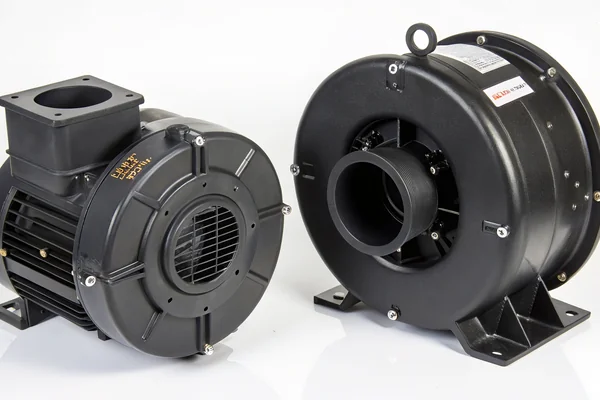
Manufacturers achieve IP ratings through combinations of labyrinth seals, elastomeric lip seals, conformal coatings on PCBs, sealed bearings, and overmolded housing joints -- and the method chosen affects not just initial protection but thermal performance and long-term seal integrity in ways the IP number alone doesn't reveal.
Why Sealing Method Is as Important as the Rating Itself
Labyrinth seals -- geometric channels that create a tortuous path for contaminants -- are common in higher-speed blowers because they add no friction, generate no heat, and don't degrade with shaft rotation. However, they're path-based rather than material-based, meaning they can be compromised if the blower is submerged or if contamination is fine enough to navigate the labyrinth geometry. They're well matched to IP54-IP65 applications but are rarely sufficient alone for IP67 or IP69K.
Lip seals (elastomeric contact seals running against the shaft) provide more positive sealing for liquid ingress and are necessary at IP67 and above, but they introduce friction, generate heat, and wear over time -- which means seal integrity at end of bearing life is lower than at installation, and thermal design needs to account for the added heat source near the bearing cavity.
Conformal coating on PCBs and motor windings addresses a different failure mode: moisture permeation through the housing over time, condensation from thermal cycling, and electrical creepage in humid conditions. Conformal coating doesn't contribute to the IP rating directly, but it provides meaningful additional protection for the electronics even after other seals begin to age.
Housing joint sealing -- whether by gasket, O-ring, or overmolding -- determines whether the housing itself is the weak point. A well-rated blower with a poorly seated housing gasket will fail its IP rating in practice regardless of what the label says, which is why procurement should ask not just for the IP rating certificate but for the sealing method documentation and, where the application is critical, third-party IP test reports rather than self-certification.
Which Applications Actually Drive IP-Rated Blower Specifications in Practice?
Knowing the rating system is one thing -- knowing which real-world applications actually justify higher IP tiers helps calibrate selection decisions and avoid over-engineering.
IP-rated DC blowers are most commonly required in food and beverage processing, outdoor telecommunications enclosures, medical equipment, automotive and EV battery thermal management, and marine electronics -- environments where contamination isn't an edge case but a continuous operating condition.
Why Each Application Has Its Own IP Logic
Food and beverage processing typically requires IP65 minimum, often IP69K, because wash-down with hot pressurized water is a scheduled, routine cleaning step rather than an accidental event. The failure mode isn't gradual -- a blower that allows water ingress during a cleaning cycle will fail immediately or produce contaminated product.
Outdoor telecommunications enclosures operate over years of weather exposure, including condensation cycles that can be more damaging than direct rain. IP65 is the minimum practical rating here, with conformal coating on electronics strongly recommended as a supplement, because thermal cycling creates internal condensation pressure that standard IP testing doesn't specifically address.
Automotive and EV battery thermal management brings a different challenge: fine metallic particulate from manufacturing environments and the requirement to survive high-pressure washing during vehicle production. IP54-IP65 is the typical range for in-vehicle blower applications, with specific automotive environmental standards (like IATF 16949 process requirements) governing validation.
Medical equipment presents unique challenges because cleaning agents -- alcohol, bleach-based disinfectants -- are chemically aggressive in ways that pure water resistance ratings don't capture. Housing material compatibility with cleaning agents is a separate evaluation from the IP rating itself.
Does Specifying a Higher IP Rating Always Cost More, and by How Much?
The cost relationship between IP rating and price is real but nonlinear -- and choosing the wrong direction is more expensive than the premium itself.
Higher IP ratings cost more because they require additional sealing components, tighter manufacturing tolerances, and longer validation testing -- but the cost step from IP44 to IP65 is modest compared to the cost of a premature field failure, while the step from IP65 to IP67/IP68 carries a more significant price and lead-time premium.
Where the Real Cost Jumps Are
The cost increase from an unrated or IP44 blower to IP54 or IP65 is typically modest for a well-designed product -- it reflects gasket material, housing mold tolerances, sealed bearing grade, and PCB conformal coating rather than a fundamental redesign. For many standard industrial applications, this premium is easily justified against the replacement and downtime cost of a single field failure.
The more significant cost jumps occur at IP67 and above, where lip seals or equivalent positive shaft sealing become necessary, housing joints require O-ring sealing or overmolding rather than simple gaskets, and immersion testing adds to validation time and cost. IP69K adds high-temperature, high-pressure wash-down testing that requires even more robust sealing and housing material selection, reflecting a genuine engineering complexity step rather than just more of the same.
A common sourcing mistake is over-specifying IP rating for cost reasons that run in the wrong direction -- assuming the highest available rating is always the safest choice. A higher IP rating with poorly matched sealing methods for the actual environment, or with thermal design that can't dissipate the heat generated by friction seals, may fail earlier than a correctly specified lower rating. The right spec is the one that matches the actual environment, not the highest number available.
Our Dongguan facility has produced DC High-Speed Vortex Blower Fans for over 20 years across environmental ratings demanded by automotive, industrial, and outdoor applications. IP-rated variants from our blower lines are validated using our in-house salt spray test system and temperature cycling test system -- the same equipment used for IATF 16949 qualification -- so environmental protection is confirmed against real aging stressors, not just initial ingress testing. We can discuss the specific sealing method and validation data behind any blower we supply for your application's IP requirements.
What Installation Decisions Can Undermine a Correctly Specified IP-Rated Blower?
Selecting the right IP rating for the blower itself only solves half the problem if installation practice introduces new ingress paths.
A correctly rated blower can be rendered ineffective by improperly sealed cable entries, unprotected mounting hardware penetrations, or condensation from thermal cycling that bypasses the housing seal -- IP rating selection and installation design must be treated as a system problem, not two separate decisions.
Why the Installed System Rating Is Always the Weakest Link
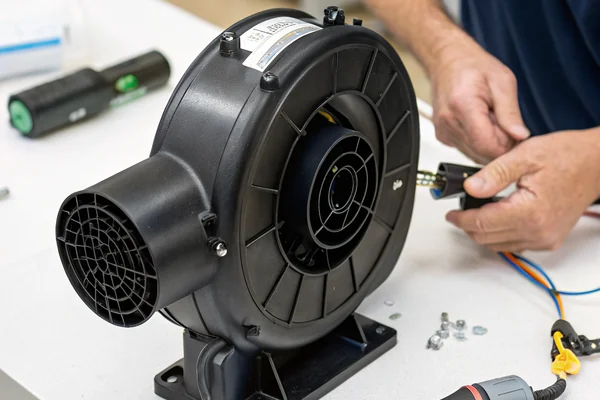
The IP rating of a blower applies to the unit as tested and supplied -- it does not automatically extend to the cable entry point, the mounting screws that penetrate the housing, or the mating connector interface. Each of these is a potential ingress point that requires its own sealing approach: cable glands rated to at least the system IP level, sealed fastener penetrations, and connectors with IP-matched mating seals.
Condensation from thermal cycling is a particularly common field failure mode that doesn't show up during initial IP testing. A blower that cycles between cold startup and operating temperature creates pressure differentials inside the housing that can draw in humid air during cooldown -- which then condenses against the cold interior surfaces. Sealed housings with no pressure equalization mechanism can accumulate internal moisture over time even when the external sealing is intact. Some IP-rated designs address this with membrane-type pressure equalization valves that allow pressure equalization while blocking liquid ingress.
Mounting orientation also matters. Many IP ratings are tested in specific orientations, and a blower certified for vertical inlet mounting may not maintain its rating if installed horizontally or inverted -- a detail worth confirming with the supplier before finalizing the installation design.
FAQ
What does the "X" placeholder mean in an IP rating like IPX5?
If one digit is replaced by X in a published IP rating, it means that digit was not tested or rated -- not that it meets the highest level. An IPX5 blower has been tested for low-pressure water jet resistance but has no stated rating for solid particle ingress and should not be assumed dust-protected.
Can a DC blower be field-modified to achieve a higher IP rating?
Not reliably. IP ratings are assigned to a specific design as manufactured and tested. Adding aftermarket sealant or gaskets in the field may provide some protection but cannot be relied upon to meet the original IP standard -- and may interfere with thermal performance or void the supplier's warranty.
Does IP rating affect a blower's airflow or static pressure performance?
Sealing adds components -- lip seals, tighter housing tolerances -- that can slightly reduce effective airflow and add friction heat near the bearing. For most applications the effect is minor, but for performance-critical applications it's worth requesting P-Q curve data on the sealed production variant rather than assuming it matches the unrated model.
How is IP rating tested, and should I ask for test certificates?
IP testing follows IEC 60529, which specifies water jet pressure, flow rate, duration, and angle for each liquid digit, and particle size and exposure conditions for each solid digit. For critical applications, requesting third-party test certificates (rather than self-certified compliance) is reasonable procurement practice.
Is IP rating the same as NEMA rating?
No. NEMA enclosure ratings (common in North American specifications) and IEC IP ratings are related but not directly equivalent. NEMA ratings typically address additional factors like corrosion and oil resistance that IP does not, so a conversion table can be used as a rough guide but the two systems should not be treated as interchangeable in specifications.
How often do IP-rated seals need to be inspected or replaced?
Lip seals and elastomeric gaskets age, compress, and can lose sealing performance over time -- particularly in high-temperature environments that accelerate elastomer degradation. For critical applications, seal inspection intervals should be part of the maintenance schedule rather than treated as lifetime-rated components.
Does salt spray resistance require a separate rating from IP?
Yes. The IP code does not address salt spray or corrosion resistance. Applications in marine or coastal environments need to specify corrosion resistance separately -- typically through salt spray test hours (per IEC 60068-2-11 or equivalent) -- in addition to the IP rating.
IP rating selection for DC blowers is a system-level decision, not a label check -- the right rating, the right sealing method, and the right installation practice all have to align with the actual operating environment.
At Herays, our Dongguan facility has engineered and validated IP-rated DC blower fans for over 20 years, with in-house salt spray testing and temperature cycling validation conducted under ISO 9001 and IATF 16949 certification. If your application has a specific environmental protection requirement, we're glad to discuss the sealing design and test data behind getting it right.
Ingress Protection (IP) rating is a two-digit classification defined in IEC 60529 that quantifies a product's resistance to solid particle and liquid ingress -- the first digit covers solids (0-6), the second covers liquids (0-9K). In blower selection, it is the primary standardized spec for communicating environmental durability across suppliers and designs. ↩

Liang
I've been working with DC fans for 30 years — long enough to have seen the industry evolve from basic sleeve bearing designs to today's high-efficiency, IP68-rated systems built for the harshest environments imaginable. I founded Herays because I believed manufacturers and engineers deserved a supplier who could talk technical from day one. Not just hand over a datasheet, but actually help you select the right fan for your thermal load, your enclosure, your certification requirements. Most of what I write here comes directly from problems I've solved on the factory floor or in customer applications — medical devices, laser equipment, industrial automation, you name it. If it involves moving air efficiently and reliably, I've probably spent time thinking about it. When I'm not obsessing over airflow curves, I'm usually helping a customer figure out why their cooling system isn't performing the way their simulation said it would.
View all posts by Liang