Air cushion machines run for hours at a stretch, and an undersized blower shows up as slow inflation, weak seals, or a motor that burns out months ahead of schedule.
A DC blower for air cushion packaging machines needs to deliver steady, moderate-pressure airflow continuously for extended duty cycles, sized to match the specific film width and inflation speed of the machine -- undersizing shows up as incomplete inflation or seal failures, while oversizing wastes power and adds unnecessary noise.
- Air cushion machines need continuous, moderate-pressure airflow rather than the high-volume low-pressure output a standard cooling fan provides, which is why they use centrifugal blowers, not axial fans.
- Duty cycle matters more here than in most blower applications -- these machines often run for full shifts with minimal rest, making thermal and bearing durability a primary selection criterion.
- Blower sizing depends on film width, target inflation speed, and desired cushion firmness together, not any single spec in isolation.
- A blower that's undersized for the application typically fails quietly at first -- soft or inconsistent cushions -- before showing more obvious symptoms like overheating or early failure.
- Reliable sourcing for this application means confirming duty-cycle-rated bearings and thermal performance data, not just a peak pressure and flow spec on a datasheet.
Understanding why these machines specifically need a blower, not a fan, is the starting point for getting the sizing and sourcing decisions right.
Table of Contents
How Do Air Cushion Packaging Machines Actually Work?
The mechanism behind air cushion inflation determines exactly what kind of airflow the machine needs.
Air cushion machines pull flat plastic film through a sealing and inflation station, where a blower forces air into sealed pockets formed by heat-sealed film, creating the inflated cushions used for shipping protection -- the process depends on sustained internal pressure to hold the pockets' shape as they're sealed and cut.
Why This Process Demands Pressure, Not Just Volume
Unlike open-air cooling, where a fan simply needs to move a large volume of air past a surface, air cushion inflation requires the blower to push air against the resistance of the film pocket and the sealing mechanism itself. The pocket has to reach adequate internal pressure before the seal closes, or the finished cushion arrives soft and doesn't provide real cushioning. This resistance -- however modest compared to industrial ducted systems -- is enough that a low-pressure axial fan generally can't maintain consistent inflation, which is why these machines are built around centrifugal blowers from the start.
| Machine Stage | Airflow Requirement |
|---|---|
| Film feed | None (mechanical only) |
| Sealing station | Heat, not airflow |
| Inflation | Continuous moderate-pressure airflow |
| Cut and dispense | None (mechanical only) |
What Pressure and Flow Specs Does the Blower Actually Need to Hit?
Getting this spec wrong is the single most common reason a retrofit blower underperforms the original.
Air cushion machine blowers typically need moderate static pressure -- enough to overcome film and seal resistance -- paired with steady CFM matched to the machine's target inflation rate, and both numbers should be evaluated at the blower's actual continuous operating point, not its free-air maximum.
Why Free-Air Specs Don't Tell the Real Story
A blower's datasheet maximum CFM is measured with no resistance at all, which has little relevance to how it performs pushing against a sealed, partially-resistant film pocket. What matters is the blower's output at the pressure point the machine's inflation station actually presents -- reading the blower's full P-Q curve, rather than a single headline number, is the only reliable way to confirm it can sustain adequate inflation rate under the machine's real operating resistance. Machine manufacturers or integrators can usually provide the target pressure and flow operating point for a specific model; without that, matching a replacement blower to the original unit's rated spec sheet is the safer starting point.
How Much Does Duty Cycle Actually Matter for This Application?
Packaging lines rarely give a blower the rest periods that reduce thermal and mechanical stress in other applications.
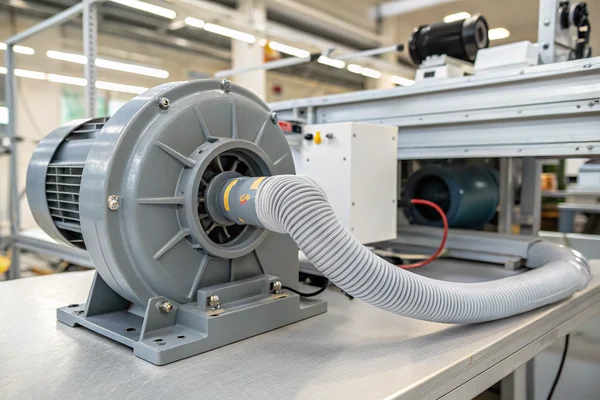
Air cushion machines commonly run continuously for full shifts with minimal downtime, which makes duty-cycle-rated bearings and sustained thermal performance more important selection criteria than they'd be in an intermittent-use application -- a blower rated for continuous duty at its actual operating point is essential, not optional.
Why Intermittent-Rated Blowers Fail Early Here
A blower spec'd or tested only for intermittent operation may handle short bursts fine but accumulate heat over a full shift of continuous running, gradually degrading bearing lubrication and motor winding insulation faster than its datasheet MTBF would suggest. This is a common mismatch when a lower-cost blower intended for lighter-duty applications gets substituted into a packaging line running near-continuously -- it may work acceptably for weeks before failing well ahead of expectations. Confirming a blower's rated duty cycle explicitly covers continuous operation, not just peak performance, is worth doing before committing to a supplier for this application.
How Do You Size a Blower for Different Machine Capacities?
Machine throughput requirements vary enough that a one-size-fits-all blower rarely fits every model in a product line.
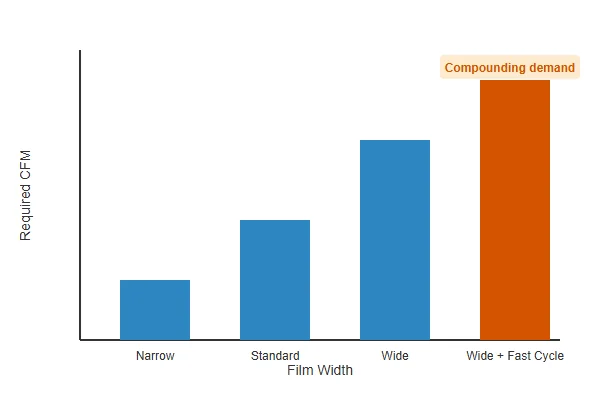
Blower sizing should scale with film width and target inflation speed together -- wider film and faster inflation rates both increase the airflow and pressure demand, so a blower sized correctly for a narrow, slower machine will typically underperform if scaled up to a wider or faster model without resizing.
Why Scaling Isn't Linear
Increasing film width increases the volume of air needed to fill each cushion pocket, while increasing inflation speed compresses the time available to deliver that volume -- both push airflow requirements up, and they compound rather than simply add. A machine redesigned for a wider film or faster cycle time using the same blower as a narrower, slower predecessor is a common source of underperformance, since the original blower was sized for meaningfully lower total airflow demand. Confirming target throughput -- cushions per minute at the intended film width -- with the machine's actual specification, rather than assuming the previous blower will scale, avoids this mismatch.
What Should You Actually Look for When Sourcing a Blower for This Application?
Sourcing conversations that focus only on peak spec numbers tend to miss the criteria that actually predict field reliability.
When sourcing a blower for air cushion packaging equipment, prioritize suppliers who can confirm continuous-duty bearing ratings, provide a full P-Q curve rather than a single spec point, and have direct experience with packaging or similar continuous-airflow industrial applications -- not just a datasheet that meets the peak numbers.
Questions Worth Asking Before Committing to a Supplier
Ask specifically whether the blower's rated lifespan and MTBF figures were measured under continuous operation representative of a packaging line, not intermittent test conditions. Ask for the full P-Q curve rather than accepting a single maximum CFM and pressure figure, since that curve is what determines actual performance at the machine's real operating point. And ask whether the supplier has supplied blowers into similar continuous-duty packaging or industrial equipment before -- direct application experience often surfaces sizing and reliability considerations a generic catalog conversation won't.
Does Motor Type Affect Blower Reliability in This Application Specifically?
Brushless motor design has a direct bearing on how well a blower tolerates the continuous-duty demands of packaging equipment.
Brushless DC (BLDC) blower motors generally outperform brushed alternatives in continuous-duty packaging applications, since they avoid brush wear entirely and typically pair with better bearing options -- ball or fluid dynamic bearings -- that hold up better under the sustained running hours this application demands.
Why Brush Wear Is a Bigger Problem Here Than It Sounds
Brushed DC motors rely on physical brush contacts that wear down through friction every hour the motor runs, and a packaging line running continuously for full shifts accumulates that wear far faster than an intermittent-use device would. Brushless motors eliminate this wear mechanism entirely by using electronic commutation instead of physical brush contact, which is a large part of why BLDC blowers dominate continuous-duty industrial applications like packaging equipment despite typically costing more upfront than brushed alternatives.
We manufacture DC high-speed vortex blower fans from our Dongguan facility specifically engineered for continuous-duty industrial applications like packaging equipment, validated on our in-house CFM airflow test system under sustained operating conditions rather than just peak free-air testing. Every unit we ship carries ISO 9001 and IATF 16949 certification, and we can work with you directly on the pressure and flow operating point specific to your machine's film width and inflation speed.
FAQ
Can a standard axial cooling fan be used instead of a blower for air cushion inflation?
Generally no -- axial fans move high volumes of air at low pressure, while inflation against sealed film pockets requires the higher static pressure a centrifugal blower provides. Substituting an axial fan typically results in weak or incomplete inflation.
How do I know if my current blower is undersized for a machine upgrade?
Watch for softer or less consistent cushions after a machine speed or film width change. If inflation was reliable before the change and degraded afterward without any other modification, blower sizing is a likely cause worth checking against the new throughput target.
What's a reasonable expected lifespan for a continuous-duty packaging blower?
This varies by bearing type and duty cycle, but a properly sized and duty-cycle-rated blower with ball or fluid dynamic bearings should be evaluated against its datasheet MTBF specifically measured under continuous operation, not intermittent test conditions -- ask the supplier for that distinction directly.
Does ambient temperature in the packaging facility affect blower selection?
Yes -- a facility running warmer ambient temperatures reduces a blower's thermal headroom under continuous duty, which can matter for bearing life and motor winding temperature over a full shift. Confirming the blower's rated operating temperature range against your facility's conditions is worth doing for continuous-duty applications.
Is noise a significant factor in blower selection for packaging equipment?
It can be, particularly in shared warehouse or fulfillment environments where multiple machines run simultaneously. Blower noise at the actual operating point (not free-air) is the relevant figure to compare between candidate units.
Can one blower model serve multiple machine sizes in a product line?
Only if the airflow and pressure demand across those models is similar enough to fall within the same blower's effective operating range. Significantly different film widths or inflation speeds across a product line usually require different blower sizing for each.
Getting blower selection right for an air cushion packaging machine comes down to matching continuous-duty performance -- not just peak specs -- to the machine's actual film width and inflation speed. At Herays, our Dongguan facility has engineered DC brushless blowers for continuous industrial duty for over 20 years under ISO 9001 and IATF 16949 certification. If you're sizing a blower for a specific packaging machine, we're glad to work through the pressure and flow operating point with you directly.

Liang
I've been working with DC fans for 30 years — long enough to have seen the industry evolve from basic sleeve bearing designs to today's high-efficiency, IP68-rated systems built for the harshest environments imaginable. I founded Herays because I believed manufacturers and engineers deserved a supplier who could talk technical from day one. Not just hand over a datasheet, but actually help you select the right fan for your thermal load, your enclosure, your certification requirements. Most of what I write here comes directly from problems I've solved on the factory floor or in customer applications — medical devices, laser equipment, industrial automation, you name it. If it involves moving air efficiently and reliably, I've probably spent time thinking about it. When I'm not obsessing over airflow curves, I'm usually helping a customer figure out why their cooling system isn't performing the way their simulation said it would.
View all posts by Liang