

Fuel cells don't just need air moved -- they need a precisely metered, humidity-tolerant, contamination-free supply of oxygen delivered continuously, which is a fundamentally different engineering problem than general cooling.
Fuel cell systems require blowers capable of precise, stable cathode air delivery matched to the stack's actual oxygen demand, tolerant of the humid internal environment fuel cells operate in, and free of internal contamination sources that could damage sensitive membrane components -- requirements that go well beyond general-purpose industrial or cooling blower specifications.
- Cathode air supply directly feeds the electrochemical reaction inside a fuel cell stack, making blower precision and reliability a functional requirement, not just an efficiency consideration.
- Fuel cell internal environments run humid, which requires blower components rated for sustained humidity exposure rather than standard dry-environment electronics specifications.
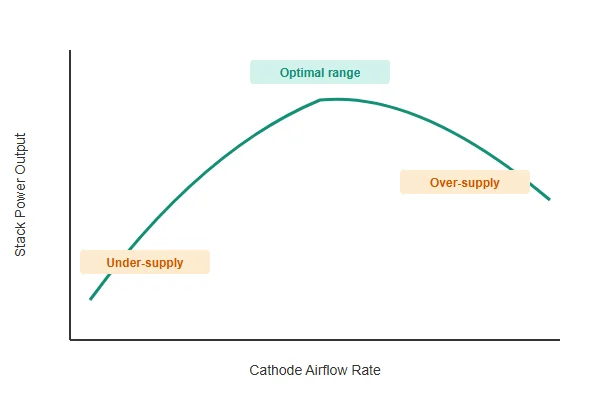
- Precision flow control matters because both under-supply and over-supply of cathode air can reduce fuel cell efficiency or, in some cases, damage the membrane electrode assembly.
- Contamination control is critical since fuel cell membranes are sensitive to particulates and certain chemical contaminants that a standard blower's internal materials might introduce.
- Sourcing a fuel cell blower typically requires closer supplier collaboration than a general blower purchase, given the tight integration between blower performance and stack operation.
Understanding what makes fuel cell cathode air supply different from general cooling airflow clarifies why blower selection here deserves more engineering attention than a catalog spec comparison alone provides.
Table of Contents
What Role Does the Blower Actually Play in Fuel Cell Operation?
The blower's job in a fuel cell system goes well beyond thermal management -- it directly supplies a reactant.
In a PEM (proton exchange membrane) or similar fuel cell system, the blower supplies oxygen-containing air to the cathode side of the stack, where it participates directly in the electrochemical reaction that generates electricity -- this makes the blower a functional component of the power generation process itself, not just a supporting cooling accessory.
Why This Changes the Reliability Conversation Entirely
A cooling fan failure in most electronics causes gradual thermal degradation or, eventually, thermal shutdown -- a serious but generally survivable event. A cathode air blower failure in a fuel cell system directly interrupts the electrochemical reaction supplying power, meaning blower reliability in this application ties directly to the fuel cell system's core function rather than being a secondary protective measure. This elevates blower selection and reliability validation to a similar priority level as the fuel cell stack itself, not a component to be sourced as an afterthought.
Why Does Humidity Resistance Matter So Much for Fuel Cell Blowers?
Fuel cell internal environments present a genuinely different humidity challenge than most blower applications.
PEM fuel cells require humidified membranes to function properly, meaning the cathode air path -- and the blower supplying it -- operates in a consistently humid environment, requiring motor windings, bearings, and internal materials rated for sustained humidity exposure rather than the standard dry-environment specifications common to most industrial or electronics-cooling blowers.
Why Standard Humidity Ratings Often Fall Short Here
A blower rated for occasional or intermittent humidity exposure -- common in general industrial IP ratings -- may not hold up under the sustained, continuous humidity a fuel cell cathode air path presents. Corrosion of internal metal components, degradation of standard motor winding insulation under constant moisture exposure, and condensation-related electrical issues are all accelerated failure modes when a blower not genuinely rated for sustained humidity is deployed in this application. Confirming a blower's rated humidity tolerance is for continuous, not intermittent, exposure is an important distinction specific to this application.
How Precise Does Airflow Control Actually Need to Be?
Both insufficient and excessive cathode airflow create real problems for fuel cell efficiency and health.
Fuel cell cathode air supply needs to closely match the stack's actual real-time oxygen demand -- under-supply starves the reaction and reduces power output, while over-supply can dry out the membrane or waste parasitic power on the blower itself, making precise, responsive flow control a genuine functional requirement rather than an efficiency nicety.
Why This Requires Closed-Loop Control, Not Fixed Speed
Because fuel cell load (and therefore oxygen demand) varies with the electrical load the system is serving, a fixed-speed blower can't track this changing demand accurately -- fuel cell systems generally pair the blower with closed-loop control that adjusts airflow based on load demand and stack feedback, requiring a blower with precise, responsive speed control rather than a simple on/off or fixed-speed design. This is functionally similar to the precision control requirements seen in medical ventilator applications, though the underlying process being served is entirely different.
Why Does Contamination Control Matter So Much for This Application?
Fuel cell membranes are sensitive to contaminants in a way that makes blower material selection a real engineering consideration.
Fuel cell membrane electrode assemblies can be damaged or degraded by certain particulate and chemical contaminants, meaning the blower's internal materials, lubricants, and any particulates it might introduce into the airflow path need to be compatible with the fuel cell's contamination sensitivity -- a standard blower's internal materials, chosen for cost or general performance, aren't automatically safe for this application.
Why Material Compatibility Requires Direct Supplier Discussion
Unlike general cooling applications where a blower's internal lubricants and materials are largely irrelevant to what it's cooling, a fuel cell cathode air blower's materials are in the direct path of air feeding a chemically sensitive membrane. This means confirming specific lubricant chemistry, internal material outgassing characteristics, and particulate generation is a legitimate and necessary part of blower selection for this application -- a conversation that generally requires direct engineering discussion with the blower supplier rather than relying on a general catalog spec sheet.
How Should You Approach Sourcing a Blower for a Fuel Cell System?
This application benefits from closer supplier collaboration than most general blower purchases.
When sourcing a blower for a fuel cell system, share your stack's actual oxygen demand profile across its operating range, humidity and contamination sensitivity requirements, and control system integration needs with the supplier directly -- this application's tight coupling between blower performance and stack function generally makes close engineering collaboration more valuable than a catalog-spec comparison alone.
Why This Application Rewards Early, Detailed Supplier Engagement
Because cathode air supply directly affects fuel cell performance and membrane health, a blower that's a close-but-imperfect match can produce measurable performance degradation that a similarly imperfect match in a general cooling application might not. Engaging a supplier early with detailed operating requirements -- rather than treating blower selection as a late-stage catalog purchase -- gives more opportunity to identify and address any material compatibility or control integration issues before they become problems in a built system.
We manufacture DC high-speed vortex blower fans validated on our in-house CFM airflow test system and temperature cycling equipment at our Dongguan facility, and we work directly with engineering teams on humidity tolerance, material compatibility, and precision flow control requirements for demanding applications like fuel cell cathode air supply. With over 20 years of production experience under ISO 9001 and IATF 16949 certification, we're glad to discuss the specific requirements your fuel cell system presents.

What Does Blower Redundancy Look Like in Fuel Cell System Design?
Given the blower's direct role in power generation, some fuel cell system designs build in redundancy rather than relying on a single unit.
Some fuel cell systems, particularly those in critical or continuous-power applications, incorporate redundant blower configurations or monitoring systems that can detect degraded cathode air supply before it causes a system fault -- a design-level response to the reality that no single component, however well-engineered, can be assumed failure-proof in a power-critical application.
Why Redundancy Decisions Depend on Application Criticality
Not every fuel cell application justifies the added cost and complexity of a redundant blower system -- a consumer-facing backup power unit may accept single-blower risk with monitoring and graceful shutdown, while a critical infrastructure or continuous-uptime application may require full redundancy. This is a system-level design decision that depends on the specific application's tolerance for an unplanned power interruption, and it's worth discussing with your blower supplier early, since redundant configurations affect airflow path design and control system architecture from the start.
FAQ
Can a standard industrial blower be adapted for fuel cell use with minor modifications?
Sometimes, if its base materials and humidity tolerance are close to what's needed, but this requires careful evaluation of material compatibility and sustained humidity rating rather than assuming a standard industrial blower is a safe starting point.
Does fuel cell blower sizing scale linearly with stack power rating?
Not necessarily linearly, since airflow demand depends on the stack's specific oxygen utilization characteristics and operating point, which is why working from the stack manufacturer's actual demand curve is more reliable than a simple power-based estimate.
How does altitude affect fuel cell cathode air blower requirements?
Reduced air density at altitude means a blower may need to move a greater volume of air to deliver the same mass of oxygen, similar to the altitude derating effect seen in general cooling fan applications -- worth accounting for if the system operates at elevated locations.
Is redundancy common in fuel cell cathode air blower design?
In some critical or continuous-power applications, yes -- given the blower's direct role in power generation, redundant blower configurations or backup systems are sometimes incorporated into system-level reliability design, similar to the redundancy considerations in other life-critical airflow applications.
What testing should a fuel cell blower undergo before deployment?
Beyond standard performance testing, humidity cycling and material compatibility validation specific to the fuel cell's operating environment are worth confirming, since standard industrial blower testing may not fully capture these fuel-cell-specific requirements.
Does blower noise matter in fuel cell system design?
It can, particularly for fuel cell systems used in noise-sensitive environments like backup power for offices or residential settings, though functional performance (precise flow control, reliability) typically takes priority over acoustic considerations in this application.
Cathode air blower selection for fuel cell systems sits at the intersection of precision control, humidity tolerance, and material compatibility -- a genuinely different engineering problem than general cooling. At Herays, our Dongguan facility has engineered DC brushless blowers for demanding applications for over 20 years under ISO 9001 and IATF 16949 certification. If you're specifying a blower for a fuel cell or similar precision-critical application, we're glad to work through the requirements with you directly.

Liang
I've been working with DC fans for 30 years — long enough to have seen the industry evolve from basic sleeve bearing designs to today's high-efficiency, IP68-rated systems built for the harshest environments imaginable. I founded Herays because I believed manufacturers and engineers deserved a supplier who could talk technical from day one. Not just hand over a datasheet, but actually help you select the right fan for your thermal load, your enclosure, your certification requirements. Most of what I write here comes directly from problems I've solved on the factory floor or in customer applications — medical devices, laser equipment, industrial automation, you name it. If it involves moving air efficiently and reliably, I've probably spent time thinking about it. When I'm not obsessing over airflow curves, I'm usually helping a customer figure out why their cooling system isn't performing the way their simulation said it would.
View all posts by Liang

