

RGB ecosystem marketing promises seamless lighting sync across your whole build, but the reality involves a specific technical standard that either matches across brands or doesn't -- and knowing which is which saves a lot of frustrated troubleshooting.
ARGB is a standardized 5V, 3-pin addressable RGB protocol that most major motherboard and fan brands have adopted, which means ARGB fans from different brands can often be mixed and synced together on a compatible motherboard header -- the real compatibility question is usually about software ecosystem integration, not the underlying electrical standard.
- ARGB refers to a specific 5V, 3-pin addressable lighting standard, distinct from older 12V RGB, and most major brands have converged on this same electrical standard.
- Because the electrical standard is shared, ARGB fans from different brands are often physically and electrically compatible when connected to the same type of header.
- The real cross-brand friction usually comes from software -- each brand's RGB control software may not recognize or fully control another brand's ARGB devices without extra configuration.
- Third-party controllers and hubs can bridge the software gap, offering unified control across brands that individual manufacturer software doesn't natively support.
- Motherboard ARGB header count and compatibility should be confirmed before assuming you can connect fans from multiple brands directly to your board.
Understanding where the real cross-brand compatibility boundary actually sits -- hardware standard versus software ecosystem -- clarifies what to expect before building a mixed-brand RGB setup.
Table of Contents
What Is ARGB, and Why Does It Matter for Cross-Brand Compatibility?
Understanding what ARGB actually is -- as opposed to older RGB lighting -- is the foundation for understanding cross-brand compatibility.
ARGB (Addressable RGB) is a lighting standard where each individual LED in a strip or fan ring can be controlled independently for effects like color chasing or rainbow patterns, using a 5V, 3-pin electrical interface -- this is different from older, non-addressable 12V RGB, where the entire strip changes color together as a single unit.
Why the Distinction From Older RGB Matters Practically
Because ARGB and older 12V RGB use different voltages and pin counts, they're not interchangeable, and connecting the wrong type to a mismatched header risks damaging the LEDs. The good news for cross-brand compatibility specifically is that ARGB, unlike the more fragmented earlier RGB landscape, has converged on a shared 5V 3-pin standard across most major manufacturers, which is the technical foundation that makes cross-brand ARGB compatibility realistic in the first place.
How Does the ARGB 5V 3-Pin Standard Actually Work?
Understanding the electrical specifics clarifies why this standard enables broader compatibility than older RGB implementations.
The ARGB standard uses a 5V power line, a ground line, and a single data line that carries digital signals addressing each LED individually in sequence -- this data-based addressing method, standardized across most major brands, is what allows a single header to control complex per-LED lighting effects and what makes cross-brand hardware compatibility technically feasible.
Why Digital Addressing Enables the Cross-Brand Compatibility ARGB Offers
Because the data line carries a standardized digital signal rather than a brand-proprietary protocol, a motherboard's ARGB header can generally drive ARGB fans from any manufacturer that implements the same standard correctly, since the header is just sending standard addressing signals rather than a brand-specific handshake. This is a meaningfully different situation than the software layer, where brand-specific control applications may not recognize devices outside their own ecosystem even though the underlying hardware signal is compatible.
Does Your Motherboard's ARGB Header Actually Support Fans From Any Brand?
Header compatibility is a hardware question separate from the software ecosystem question, worth confirming explicitly.
Most modern motherboards with a dedicated ARGB header (labeled variably as ARGB, AURA SYNC ARGB, or similar depending on brand) will physically and electrically drive ARGB-standard fans from any manufacturer, since the header follows the shared electrical standard -- confirming your specific motherboard has an ARGB header (not just RGB) and checking its rated maximum LED count is the practical hardware compatibility check.
Why LED Count Limits Matter More Than Brand Matching at the Hardware Level
Each ARGB header has a maximum number of LEDs it can reliably power and address, which becomes a practical constraint when daisy-chaining multiple ARGB fans regardless of brand -- exceeding this limit can cause dim, flickering, or unreliable lighting even with fully standard-compliant hardware from a single brand, let alone mixed brands. Checking your motherboard's documented maximum ARGB LED count per header against your planned fan count and per-fan LED count is a more relevant hardware check than worrying about brand matching for headers.
How Do Third-Party Controllers and Hubs Solve the Software Compatibility Gap?
When brand-specific software falls short of true cross-brand control, dedicated third-party hardware often fills the gap.
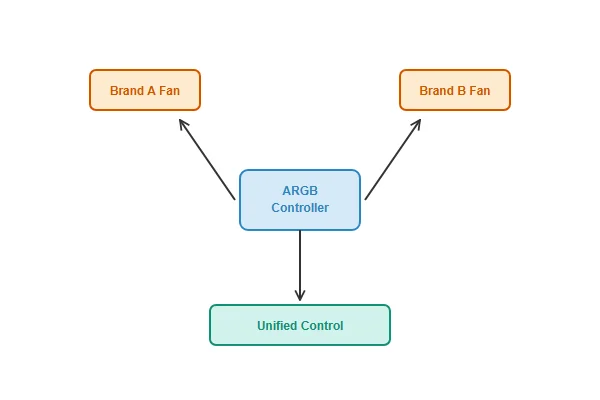
Third-party ARGB controllers and hubs provide unified control across brands by acting as an intermediary that speaks the standard ARGB protocol to your fans while offering its own control software or physical buttons, bypassing the need for each fan brand's proprietary software to recognize devices from other manufacturers.
Why This Approach Often Works Better Than Chasing Native Software Support
Rather than hoping a specific motherboard brand's software will add support for another manufacturer's fans, a dedicated third-party ARGB controller sidesteps brand software entirely by controlling the standard protocol directly, which is particularly useful for builds intentionally mixing fans, RAM, and other RGB components from several different brands. This approach trades a small amount of additional hardware cost and setup complexity for reliable, brand-agnostic control that doesn't depend on any single manufacturer's software roadmap.
What Should You Actually Check Before Mixing ARGB Fans From Different Brands?
A short practical checklist reduces the risk of ending up with a partially working mixed-brand setup.
Before mixing ARGB fans across brands, confirm each fan explicitly states 5V/3-pin ARGB compatibility (not older 12V RGB), check your motherboard's ARGB header LED count limit against your total planned LED count, and decide upfront whether you'll rely on motherboard software or a third-party controller for unified control across brands.
Why Deciding the Control Approach Upfront Avoids Mid-Build Frustration
Discovering partway through a build that your motherboard's software won't control a second brand's fans, after already committing to that hardware combination, is a common and avoidable frustration. Deciding whether to rely on native motherboard software (which may have brand limitations) or a third-party controller (which adds cost but offers more reliable cross-brand control) before purchasing components, rather than after, avoids this mid-build compatibility surprise.
Our PC case cooling fan line includes ARGB-compatible models built to the standard 5V 3-pin specification for broad compatibility with motherboard headers and third-party controllers, validated on our in-house testing equipment at our Dongguan facility. With over 20 years of production experience under ISO 9001 certification, we can support OEM and volume buyers with ARGB-standard fan specifications for mixed-ecosystem builds.
How Should OEM Product Manufacturers Approach ARGB Standardization?
For manufacturers building fans or components intended for the broader RGB ecosystem, standard compliance is a genuine market access decision.
OEM manufacturers building ARGB-compatible products should implement the standard 5V 3-pin electrical specification precisely and test compatibility against major motherboard brands' headers directly, since deviations from the standard -- even small ones -- can create the exact cross-brand compatibility friction that undermines the product's usefulness in mixed-ecosystem builds.
Why Precise Standard Compliance Is a Market Access Requirement, Not a Nice-to-Have
A product that implements ARGB "close enough" but with minor protocol deviations may work with some motherboard headers and fail unpredictably with others, creating exactly the kind of inconsistent compatibility that damages a product's reputation in a market where cross-brand mixing is a common and expected use case. Testing against multiple major motherboard brands' actual ARGB headers during development, not just validating against a single reference implementation, is what actually confirms real-world cross-brand compatibility before a product ships.

FAQ
Can I tell if a fan is ARGB or older RGB just by looking at the connector?
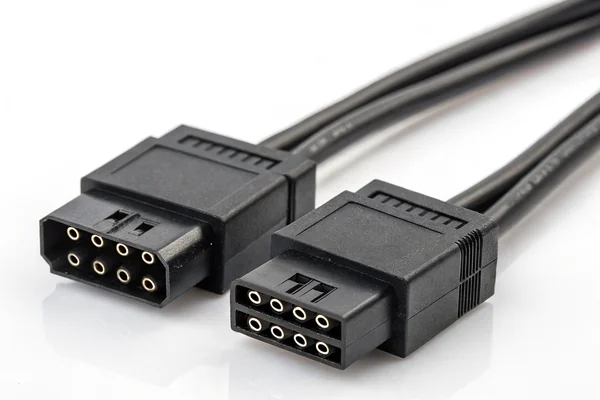
The pin count is a strong indicator -- 3-pin generally indicates ARGB (5V), while 4-pin generally indicates older RGB (12V) -- but confirming the manufacturer's explicit spec sheet is more reliable than visual inspection alone.
Do all motherboards have both an ARGB and a regular RGB header?
No -- many boards include only one type, or in some budget cases neither, so checking your specific motherboard's documented header types before planning an RGB build is important.
Will connecting too many ARGB fans to one header cause damage, or just dim lighting?
Typically this causes dim, flickering, or unreliable lighting rather than hardware damage, though it's still worth staying within the header's rated LED count for reliable operation.
Is there a performance cost to running ARGB lighting versus non-RGB fans?
No meaningful airflow or noise performance cost comes from the RGB hardware itself -- ARGB lighting circuitry doesn't affect the fan's core cooling performance in any significant way.
Can I daisy-chain fans from different brands in the same ARGB chain?
Often yes, if all units follow the standard ARGB protocol correctly, though testing the specific combination is worth doing since implementation quality can vary slightly between manufacturers even within the shared standard.
Do third-party ARGB controllers require their own separate power connection?
Many do require a separate SATA or Molex power connection in addition to the ARGB signal connections, since they're powering and controlling multiple devices beyond what a single motherboard header alone could supply.
ARGB's shared electrical standard makes cross-brand fan compatibility more realistic than the RGB landscape once was, though software ecosystem integration remains the practical friction point worth planning around. At Herays, our Dongguan facility manufactures ARGB-standard case cooling fans built for broad compatibility, backed by over 20 years of experience under ISO 9001 certification. If you're specifying ARGB fans for a mixed-ecosystem product or build, we're glad to confirm compatibility details.

Liang
I've been working with DC fans for 30 years — long enough to have seen the industry evolve from basic sleeve bearing designs to today's high-efficiency, IP68-rated systems built for the harshest environments imaginable. I founded Herays because I believed manufacturers and engineers deserved a supplier who could talk technical from day one. Not just hand over a datasheet, but actually help you select the right fan for your thermal load, your enclosure, your certification requirements. Most of what I write here comes directly from problems I've solved on the factory floor or in customer applications — medical devices, laser equipment, industrial automation, you name it. If it involves moving air efficiently and reliably, I've probably spent time thinking about it. When I'm not obsessing over airflow curves, I'm usually helping a customer figure out why their cooling system isn't performing the way their simulation said it would.
View all posts by Liang

