Nearly every liquid cooling setup uses standard axial fans on its radiator without a second thought, but there's a specific scenario where that default choice stops making sense.
Standard axial fans remain the right default for the vast majority of radiator applications, since typical radiator fin density falls within axial fans' effective static pressure range -- a blower only becomes worth considering for unusually dense, thick, or restrictive radiator configurations that exceed what axial fans can push air through effectively.
- Radiators add real static pressure resistance through their fin density, which is why radiator-rated fans (higher static pressure axial fans) exist as a distinct category from general case fans.
- Blowers generate more static pressure than even radiator-optimized axial fans, but this advantage matters only when radiator restriction genuinely exceeds what axial fans can handle effectively.
- Most consumer and even many enthusiast radiator configurations fall within the effective range of quality static-pressure-focused axial fans, not requiring blower-level pressure capability.
- Noise comparison generally favors axial fans at equivalent radiator-appropriate pressure, since blowers optimized for higher pressure typically trade away some of the acoustic efficiency axial fans achieve in their optimized range.
- A blower becomes worth considering specifically for extremely dense fin-per-inch radiators, very thick radiator stacks, or restrictive custom loop configurations that push beyond typical radiator resistance.
Understanding where the actual crossover point sits between standard axial fans and blowers for radiator applications clarifies why this remains a niche consideration rather than a common recommendation.
Table of Contents
What Role Do Fans Actually Play in Liquid Cooling Systems?
Understanding the fan's specific job in a liquid cooling loop clarifies why radiator airflow characteristics matter as much as they do.
In a liquid cooling loop, fans mounted on the radiator reject the heat the coolant has absorbed from components by pushing or pulling air through the radiator's dense fin array -- the fan's job is specifically to move air through this restrictive fin structure effectively, not just to move air generally around the case.
Why Radiator Airflow Is a More Specific Job Than General Case Cooling
Unlike a general case fan moving air relatively freely through open space, a radiator fan has to push air through a dense array of thin metal fins designed to maximize heat transfer surface area, which inherently creates more airflow resistance than an open case fan position. This is precisely why radiator fan selection has historically been treated somewhat differently from general case fan selection, with static pressure capability weighted more heavily.
Is a Blower Actually Better Than a Fan for Most Radiator Applications?
Despite blowers' higher raw pressure capability, they aren't automatically the better choice for typical radiator use.
For most radiator applications, a quality static-pressure-optimized axial fan outperforms a blower on the combination of pressure capability, airflow volume, and noise, since typical radiator fin density falls within axial fans' effective operating range -- blowers become advantageous only when radiator restriction genuinely exceeds that range.
Why Axial Fans Remain the Practical Default Despite Blowers' Pressure Advantage
Radiator-optimized axial fans are specifically engineered with blade designs that boost static pressure performance compared to general-purpose axial fans, closing much of the gap with blowers for typical radiator restriction levels while maintaining better airflow volume and generally better noise characteristics at that operating point. This is why the liquid cooling market has converged heavily on axial fans, even radiator-optimized ones, as the standard choice, with blowers remaining a specialized option rather than a common recommendation.
What Static Pressure Does a Typical Radiator Actually Require?
Understanding realistic radiator resistance levels clarifies where standard axial fans remain adequate and where the picture might change.
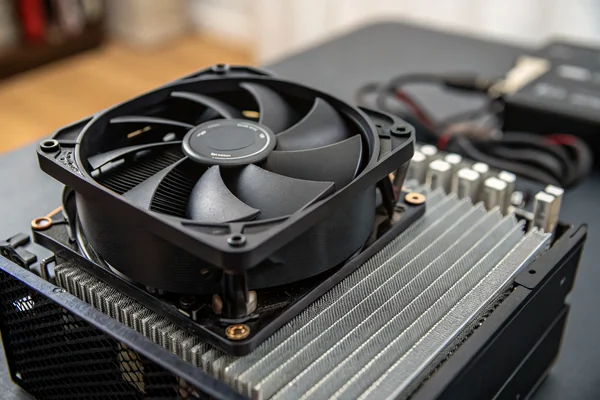
Typical consumer and enthusiast radiators -- including most 240mm, 280mm, and 360mm configurations at standard thickness -- present static pressure resistance well within the effective range of quality radiator-optimized axial fans, meaning the vast majority of liquid cooling builds don't approach the resistance level where blower-level pressure becomes necessary.
Why Most Builds Never Actually Reach the Blower-Relevant Threshold
Radiator resistance scales with fin density (fins per inch) and thickness, and while these do vary across the market, most commercially available radiators are designed with fin density and thickness combinations that remain compatible with standard high-static-pressure axial fans, since radiator manufacturers generally design around what the broader fan market can effectively drive. This is part of why blower recommendations for radiator cooling remain rare in mainstream builds -- the products on the market are largely designed to work well with axial fans already.
How Does Noise Actually Compare Between Fans and Blowers on a Radiator?
Acoustic performance is a genuine, measurable factor in this comparison, generally favoring axial fans at typical radiator operating points.
At the static pressure levels typical radiators actually present, quality radiator-optimized axial fans generally achieve better noise performance than blowers, since blowers optimized for higher pressure capability than most radiators actually require trade away some of the acoustic efficiency axial fans achieve within their designed operating range.
Why "Overqualified" Pressure Capability Doesn't Improve Noise
A blower capable of significantly more static pressure than a given radiator actually requires isn't operating at its own optimal efficiency point for that application, which can mean giving up some acoustic advantage without gaining a meaningful performance benefit in return. This is part of why simply defaulting to "more pressure capability is always better" doesn't hold up as a noise-optimized strategy -- matching fan or blower capability to the radiator's actual resistance, not maximizing pressure capability beyond what's needed, produces the best combined performance and noise outcome.

When Does a Blower Actually Make Sense for a Liquid Cooling Setup?
Identifying the specific scenarios where blowers genuinely earn consideration helps avoid both over- and under-specifying for radiator applications.
A blower becomes worth considering for extremely high fin-per-inch radiators designed for maximum surface area over airflow ease, unusually thick radiator stacks (well beyond standard single or dual-radiator thickness), or restrictive custom loop configurations combining multiple radiators and other flow restrictions in series -- scenarios that genuinely push beyond typical radiator resistance.
Why These Scenarios Represent Genuine Edge Cases, Not a Common Recommendation
Extreme fin density radiators, unusually thick stacks, and highly restrictive custom loop configurations are deliberate choices made by builders specifically prioritizing maximum heat transfer surface area or exotic loop designs over airflow ease, representing a genuinely different design intent than typical liquid cooling builds. For builders in this specific situation, evaluating blower options against their radiator's actual documented resistance becomes worthwhile; for the much larger population of standard liquid cooling builds, this remains a non-issue.
We manufacture both static-pressure-optimized DC axial fans and DC high-speed vortex blowers, validated on our in-house CFM airflow and anechoic noise testing equipment at our Dongguan facility to confirm real performance at specific radiator resistance points. With over 20 years of production experience under ISO 9001 certification, we can help evaluate whether your specific radiator configuration falls within standard axial fan range or genuinely warrants blower-level pressure capability.
How Should You Approach Testing Fan Versus Blower Performance on Your Actual Radiator?
For genuinely borderline cases, direct comparative testing settles the question more reliably than general guidance alone.
Test fan versus blower performance on your actual radiator by measuring coolant temperature delta under sustained full load with each option installed, at matched noise levels where possible, rather than comparing peak specifications alone -- real thermal performance under your specific loop's actual flow rate and heat load is what ultimately matters, not datasheet numbers in isolation.
Why Matched-Noise Testing Gives the Fairest Comparison
Comparing a fan and a blower at their respective maximum speeds doesn't reveal which option actually performs better for a noise-conscious build, since one might achieve similar thermal results at a meaningfully lower speed and noise level than the other. Testing both options at a matched noise level -- adjusting each to produce comparable dB(A) output, then comparing resulting coolant temperatures -- gives a fairer, more practically useful comparison for builders who care about both cooling and acoustic performance together.

FAQ
How do I find my specific radiator's fin density and resistance specification?
Check the radiator manufacturer's product specification, which typically states fins-per-inch (FPI) and thickness -- comparing this against your candidate fan's rated static pressure at your target airflow gives a reasonable compatibility estimate.
Do push-pull fan configurations change whether a blower is worth considering?
Push-pull configurations (fans on both sides of the radiator) generally improve airflow through restrictive radiators using standard axial fans, often addressing moderate restriction concerns without needing to move to blower-level pressure capability.
Are there blower products specifically marketed for radiator use?
Blower options specifically marketed for radiator cooling are less common than the axial fan market, given how niche this application actually is -- most available blowers are general-purpose industrial or electronics cooling products rather than radiator-specific designs.
Does radiator material (copper vs aluminum) affect fan or blower selection?
Radiator material affects heat transfer efficiency rather than airflow resistance, so it doesn't directly change fan or blower static pressure requirements, though it can affect overall cooling performance independent of the fan/blower choice.
Can mixing axial fans and blowers on the same custom loop cause problems?
This isn't common practice and would require careful airflow and mounting consideration, since the two device types have different form factors and airflow characteristics -- most builds stick to one type consistently across the loop.
Is it worth testing both fan types on my specific radiator before committing?
For genuinely borderline cases -- unusually dense or thick radiators where the standard axial fan answer isn't clearly adequate -- direct comparative testing on your actual radiator configuration is more reliable than relying on general guidance alone.
Standard axial fans remain the right default for the vast majority of water cooling radiator applications, with blowers reserved for genuinely unusual, high-restriction configurations. At Herays, our Dongguan facility manufactures both fan types validated for real performance at specific resistance points, backed by over 20 years of experience under ISO 9001 certification. If you're evaluating fan or blower options for an unusual radiator configuration, we're glad to help work through the comparison.

Liang
I've been working with DC fans for 30 years — long enough to have seen the industry evolve from basic sleeve bearing designs to today's high-efficiency, IP68-rated systems built for the harshest environments imaginable. I founded Herays because I believed manufacturers and engineers deserved a supplier who could talk technical from day one. Not just hand over a datasheet, but actually help you select the right fan for your thermal load, your enclosure, your certification requirements. Most of what I write here comes directly from problems I've solved on the factory floor or in customer applications — medical devices, laser equipment, industrial automation, you name it. If it involves moving air efficiently and reliably, I've probably spent time thinking about it. When I'm not obsessing over airflow curves, I'm usually helping a customer figure out why their cooling system isn't performing the way their simulation said it would.
View all posts by Liang