

Choosing custom too early wastes budget and lead time on a spec you didn't need; choosing standard too late means redesigning around a fan that never quite fit.
Standard off-the-shelf fans win on cost, lead time, and low minimum order quantities for designs that fit common form factors, while OEM/custom fans make sense when your application has size, performance, connector, or branding requirements standard products can't meet -- the decision comes down to how much your design actually deviates from catalog specs.
- Standard fans typically ship faster and require no minimum order quantity, making them the default choice for prototyping, low volume, or designs that fit common specifications.
- OEM makes sense specifically when your application has a genuine mismatch with standard products -- unusual dimensions, connector requirements, performance specs, or branding needs.
- MOQ and lead time for custom fans vary significantly by how much tooling or engineering change is actually required, not just by order quantity alone.
- Cost comparison between standard and custom isn't just unit price -- it needs to account for tooling amortization, engineering time, and the cost of a standard fan that doesn't quite fit versus one that does.
- Working effectively with a manufacturer on OEM starts with a clear, specific requirements document, not an open-ended request to "make something similar" to an existing product.
Getting this decision right early avoids both the cost of unnecessary customization and the redesign cost of a standard fan that turns out not to fit.
Table of Contents
What Are the Real Advantages of Sticking With Standard Fans?
Standard products carry advantages that go beyond simply being easier to buy.
Standard off-the-shelf fans offer faster lead times, no minimum order quantity in most cases, established reliability data from wide deployment, and lower unit cost since tooling and engineering costs are already amortized across many customers -- advantages that matter most for prototyping, low-volume runs, or designs that genuinely fit common specifications.
Why "Good Enough" Standard Products Often Beat Custom
A standard fan that meets 90% of your requirements, purchased off a catalog with no MOQ and short lead time, frequently outperforms a "perfect" custom fan on total project economics once you account for tooling cost, engineering time, and the schedule risk of a longer custom lead time. Standard products also benefit from field data across a wide installed base, giving you access to real-world reliability information that a brand-new custom design simply hasn't accumulated yet. The core question worth asking honestly is whether your remaining 10% gap actually matters for your application, or whether it's a preference rather than a genuine requirement.
| Factor | Standard Fan | Custom/OEM Fan |
|---|---|---|
| Lead time | Days to weeks | Weeks to months |
| MOQ | Often none | Usually required |
| Unit cost | Lower (amortized tooling) | Higher (unless high volume) |
| Fit to unique specs | Limited to catalog options | Matches exact requirement |
| Reliability data | Established, wide deployment | Limited to your own testing |
When Does Going OEM Actually Make Sense?
Custom fans earn their added cost and lead time specifically when standard products create a real constraint on your design.
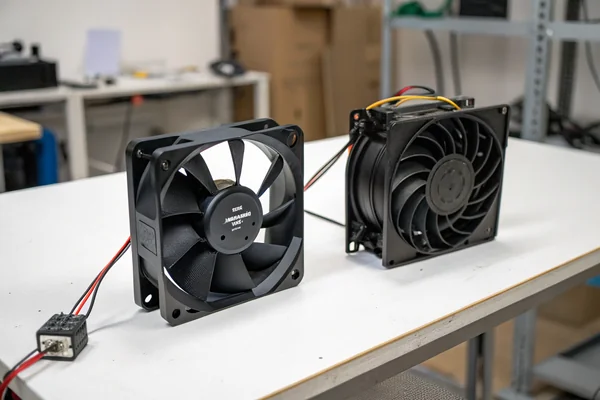
OEM/custom fans make sense when your application has unusual physical dimensions, connector or cable requirements standard products don't offer, performance specs (pressure, flow, noise) outside standard product ranges, or branding and appearance requirements for a consumer-facing product -- genuine design constraints, not general preference for something "better."
Distinguishing a Real Constraint From a Preference
A genuine constraint is something your design literally cannot accommodate without deviation -- a non-standard mounting hole pattern forced by an existing enclosure, a connector type your control board requires, a noise spec tighter than any catalog fan meets. A preference is wanting a fan that's marginally quieter or slightly more efficient when a standard option already meets your actual requirement. Being honest about which category your requirement falls into prevents committing to OEM lead times and MOQs for a benefit that doesn't actually justify the tradeoff.
How Do MOQ and Lead Times Actually Work for Custom Fans?
These two factors vary more than most buyers expect, and understanding why helps set realistic project timelines.
MOQ and lead time for custom fans depend heavily on how much actual change is required -- a simple connector or cable modification to an existing standard product typically has a much lower MOQ and shorter lead time than a fully custom frame requiring new injection mold tooling, which can take months and require significantly higher order quantities to justify.
Why Not All "Custom" Requests Are Equal
Manufacturers can often accommodate minor modifications -- a different connector, custom cable length, specific label or branding -- to an existing standard product line with minimal tooling change and correspondingly modest MOQ increases. A genuinely new frame size or blade design, by contrast, typically requires new injection molds, which represents real upfront tooling cost that needs to be amortized across a meaningful order volume, driving both MOQ and lead time up substantially. Discussing your specific requirement with a manufacturer early often reveals it falls into the lower-complexity category even when it initially sounds like a major customization.
How Should You Actually Compare Cost Between Standard and Custom Options?
A unit-price-only comparison misses the factors that actually determine which option is cheaper for your specific project.
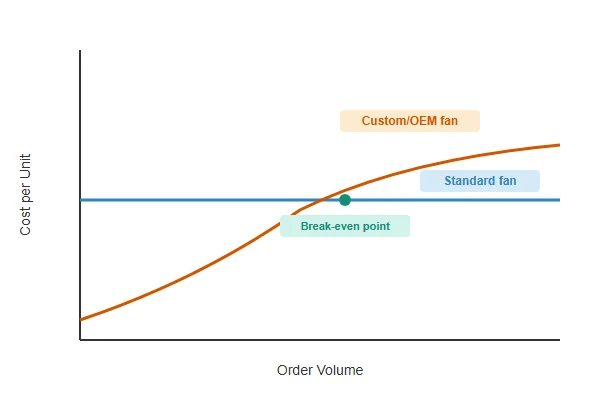
A fair cost comparison between standard and custom fans includes unit price, any tooling or NRE (non-recurring engineering) charges amortized across your expected volume, and the cost of design compromises or redesign work required if a standard fan doesn't quite fit -- at sufficient volume, custom can become cost-competitive or even cheaper per unit than a standard fan requiring workarounds.
Where the Break-Even Point Usually Falls
Tooling and NRE costs are fixed regardless of volume, meaning the per-unit cost impact of custom tooling shrinks as order volume grows -- at low volumes, standard products almost always win on pure economics, while at sufficiently high volumes, a custom fan optimized precisely for your application can become cost-competitive once amortized tooling is factored in. The volume threshold where this crossover happens varies by how much tooling is actually required, which is why getting a specific quote comparing both paths for your actual expected volume is more useful than a general rule of thumb.
What Does Working Effectively With a Manufacturer on OEM Actually Look Like?
The quality of your requirements document has an outsized effect on how smoothly an OEM engagement goes.
Working effectively with a manufacturer on OEM starts with a specific, documented requirement set -- exact dimensions, performance targets, connector and cable specs, environmental conditions, and target volume -- rather than an open-ended request to modify an existing product, since specificity upfront reduces the number of engineering iteration cycles needed to converge on a final design.
Why Vague Requirements Cost More Time Than They Save
A request like "something similar to your standard 92mm fan but a bit quieter" requires the manufacturer to guess at acceptable tolerances, triggering multiple rounds of samples and feedback before converging on a spec that actually works. A request specifying the exact target dB(A) at a defined operating point, alongside dimensional and connector requirements, lets the manufacturer propose a workable design in fewer iterations. Investing time upfront in a clear specification document is one of the most effective ways to compress overall OEM development timelines.
We support both paths from our Dongguan facility -- standard catalog DC axial, case, and blower fans available with short lead times, and OEM/custom development for connector, dimensional, performance, or branding requirements standard products can't meet. Our engineering team works directly from your specification document to minimize iteration cycles, backed by over 20 years of production experience and in-house testing equipment under ISO 9001 and IATF 16949 certification.

What Risks Come With Choosing the Wrong Sourcing Path?
Picking the wrong path doesn't just cost money -- it can cost schedule and design flexibility at the worst possible moment.
Choosing standard when a genuine constraint required custom typically surfaces as a late-stage redesign around a fan that doesn't quite fit, while choosing custom when standard would have worked wastes tooling cost and lead time on a benefit the project didn't actually need -- both mistakes are avoidable by being honest about the requirement before committing.
Why the Standard-When-You-Needed-Custom Mistake Is More Common
Teams under schedule pressure often default to whatever standard fan is fastest to source, assuming minor spec gaps can be worked around later -- a workaround that sometimes turns into a full enclosure redesign once the mismatch becomes apparent during integration testing. This late discovery is far more expensive than the incremental cost of qualifying a custom fan earlier would have been, which is why an honest requirements review at the start of sourcing, not after a standard part has already been designed around, is the cheaper path in the long run.
FAQ
Can I start with a standard fan and move to custom later if requirements change?
Often yes, particularly for prototyping and early testing, though switching later means requalifying the new custom part in your design -- worth planning for if there's a real chance requirements will tighten as the project matures.
Is there a minimum volume below which OEM never makes sense?
There's no universal threshold since it depends on how much tooling change is required, but very low volumes (prototype or small pilot runs) rarely justify new tooling costs unless the standard product genuinely can't meet a hard requirement.
How much do connector or cable modifications typically add to lead time versus a fully standard product?
This varies by manufacturer and specific modification, but simple changes like connector type or cable length often add relatively modest lead time compared to a fully custom frame, since they usually don't require new injection tooling.
Do OEM fans require different quality validation than standard products?
Custom fans should go through the same or more rigorous qualification testing as standard products, particularly since they lack the wide field deployment history a standard product has accumulated -- don't skip validation just because it's a new custom design.
Can I request OEM branding (my company's logo) on an otherwise standard fan?
Yes, this is one of the more common and lower-complexity OEM requests, typically requiring minimal tooling change since it usually only affects labeling rather than the fan's physical or performance specifications.
What information should I have ready before contacting a manufacturer about OEM?
Target dimensions, performance specs (airflow, pressure, noise), connector and cable requirements, environmental operating conditions, expected annual volume, and target unit cost -- having these ready significantly speeds up the initial quoting and feasibility conversation.
The standard-versus-OEM decision comes down to being honest about which of your requirements are genuine constraints versus preferences, then matching the sourcing path to that reality. At Herays, our Dongguan facility supports both standard catalog fans and OEM development, backed by over 20 years of production experience under ISO 9001 and IATF 16949 certification. If you're weighing standard versus custom for a specific application, we're glad to work through the tradeoffs with you directly.

Liang
I've been working with DC fans for 30 years — long enough to have seen the industry evolve from basic sleeve bearing designs to today's high-efficiency, IP68-rated systems built for the harshest environments imaginable. I founded Herays because I believed manufacturers and engineers deserved a supplier who could talk technical from day one. Not just hand over a datasheet, but actually help you select the right fan for your thermal load, your enclosure, your certification requirements. Most of what I write here comes directly from problems I've solved on the factory floor or in customer applications — medical devices, laser equipment, industrial automation, you name it. If it involves moving air efficiently and reliably, I've probably spent time thinking about it. When I'm not obsessing over airflow curves, I'm usually helping a customer figure out why their cooling system isn't performing the way their simulation said it would.
View all posts by Liang

