Most cooling fans move air just fine -- until precise pressure, whisper-quiet noise, and 50,000-hour lifetimes all become mandatory at once. For CPAP machines and bedside medical devices, those requirements aren't optional.
DC blower fans are the standard choice for CPAP and medical devices because they generate the controlled static pressure needed for therapeutic air delivery, run quietly enough for overnight bedside use, and can sustain the precision and reliability that patient safety and regulatory approval demand -- where standard axial fans fall short on all three counts.
- Blower fans generate sufficient static pressure to deliver therapeutic airflow through tubing and masks; axial fans cannot build the pressure needed for this kind of restrictive airflow path.
- Noise requirements for bedside medical devices are among the most demanding in any fan application, with CPAP machines typically targeting operating noise well below conversational speech levels.
- Therapeutic airflow delivery requires tight, consistent pressure control across a range of flow rates -- a level of precision that rules out most general-purpose fan designs.
- Regulatory pathways for Class II medical devices introduce documentation, traceability, and quality system requirements that directly affect which fan suppliers are viable.
- Wearable and bedside medical equipment imposes physical constraints -- weight, volume, vibration, EMI -- that shape fan selection as much as pure airflow performance does.
Understanding why blower fans specifically are the right tool here, and what medical device engineers actually have to specify to source one correctly, is worth working through carefully before a design gets locked in.
Table of Contents
Why Do CPAP Machines Use Blower Fans Instead of Axial Fans?
The pressure requirement alone rules out axial fans for most CPAP applications.
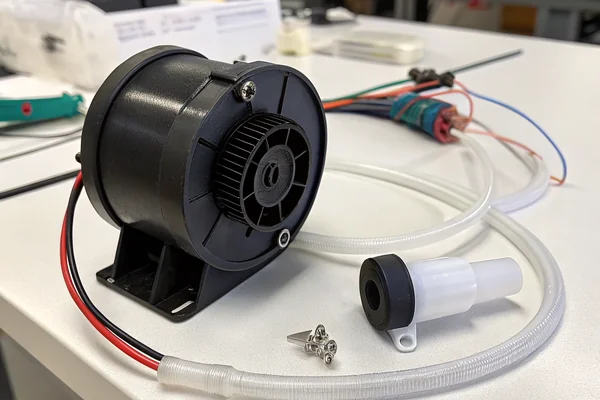
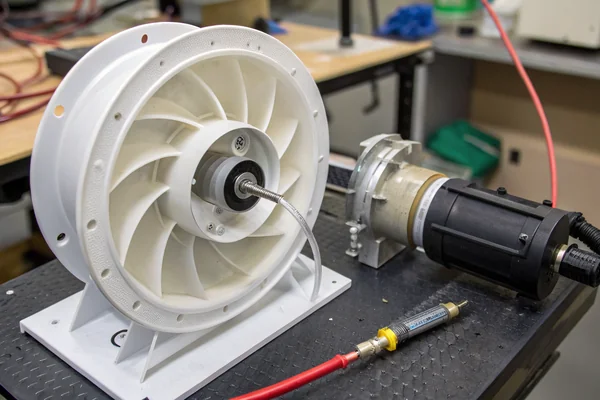
CPAP machines rely on centrifugal blower fans1 rather than axial fans because delivering therapeutic airflow through a tube and mask creates significant backpressure that axial fans cannot overcome -- blowers generate the static pressure required, while axial fans stall or drop flow sharply under that load.
Why Axial Fans Stall Under Therapeutic Load
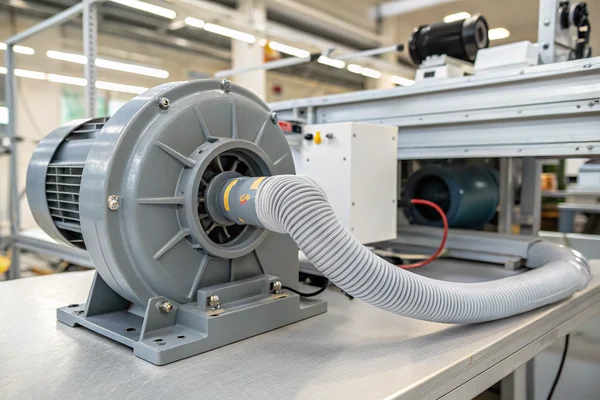
An axial fan moves air parallel to its rotational axis and is optimized for open-air, low-resistance applications. The moment a mask, tubing, and patient breathing resistance enter the picture, the system impedance climbs sharply, and an axial fan's pressure-flow curve drops off quickly -- in many cases, airflow collapses well before the therapeutic pressure target is reached. A centrifugal blower, by contrast, accelerates air radially outward through an impeller, converting rotational energy into both velocity and pressure far more effectively under load. This is the same underlying reason centrifugal blowers appear in industrial ductwork and HVAC systems where axial fans are impractical -- the pressure-generating mechanism is simply different.
For CPAP specifically, therapeutic pressures typically range from around 4 to 20 cm H₂O depending on the patient's prescription, which sounds modest but represents a level of backpressure that immediately exposes the limitations of an axial design. The blower's ability to hold that pressure while maintaining consistent flow -- not just at one operating point but across a dynamic range as a patient's breathing changes -- is what makes it the right architecture for the application.
What Noise Levels Do Bedside Medical Devices Actually Need to Hit?
Fan noise in a CPAP device isn't a comfort preference -- it directly affects clinical compliance.
Bedside medical devices like CPAP machines target operating noise in the low-to-mid 20s dBA range during normal therapeutic operation, because quieter devices see measurably higher patient compliance rates -- a fan that sounds acceptable in a lab can still generate enough noise at the bedside to disrupt sleep and drive patients to abandon therapy.
Why the Bedside Environment Sets an Exceptionally Tight Target
Background noise in a quiet bedroom at night typically sits around 30 dBA or below. A device that operates at 35 dBA in that environment is perceptible, and for a CPAP patient already sensitive to the presence of the machine, any noticeable fan noise can affect sleep quality and long-term adherence to therapy. This is a different noise constraint than, say, a server room fan where elevated ambient noise makes strict dBA limits less critical.
Fan noise in a blower design comes from multiple sources: impeller blade-pass tone (a function of blade count and rotational speed), turbulence noise from air moving through the volute and outlet, bearing noise, and motor electrical noise. Each has to be addressed in the design, not just raw blade pitch the way a simpler axial fan design might handle noise. High-speed blowers in particular generate characteristic high-frequency tones that can be harder to attenuate than broadband noise, which is why noise engineering for medical blowers often involves careful impeller geometry, housing resonance tuning, and sometimes acoustic isolation mounting -- not just running the motor slower.
The practical consequence for engineers sourcing a blower for a CPAP or similar device is that dBA figures need to be measured in a meaningful acoustic environment, ideally an anechoic chamber, at the actual operating point in the target application -- not at free-air maximum speed in an open room.
How Does a Blower Fan Maintain Precise Airflow Control for Therapeutic Delivery?
Delivering a prescribed therapeutic pressure consistently, across breathing cycles, requires more than just high RPM.
Precision therapeutic airflow delivery requires a blower fan with a well-characterized pressure-flow (P-Q) curve2, a stable motor control system, and tight manufacturing consistency -- because the control algorithm in the CPAP device uses the fan's predictable response to modulate pressure dynamically as breathing resistance changes throughout the night.
Why P-Q Curve Consistency Matters More Than Peak Specs
A CPAP device's control electronics don't run the blower at a fixed speed -- they continuously adjust motor drive to maintain a target pressure despite constantly changing resistance from inhalation and exhalation cycles. This closed-loop control depends on the fan behaving predictably: if the P-Q curve shifts significantly from unit to unit, or drifts over the device's operating life, the pressure control algorithm has to compensate for fan variation rather than just patient physiology. Tight manufacturing consistency in impeller geometry and motor characteristics isn't a quality-management nicety in this application -- it's a functional requirement.
This is also why engineers should be skeptical of a blower spec that looks good in free-air testing but has a poorly documented P-Q curve under load. The only operationally meaningful way to characterize a blower for a CPAP-type application is with the actual system impedance accounted for -- ideally tested to ANSI/AMCA Standard 210 methodology to get a properly certified performance characterization.
| Operating Parameter | Why It Matters for CPAP | Consequence of Drift |
|---|---|---|
| P-Q curve consistency | Control algorithm baseline | Pressure target errors |
| Motor speed response | Breathing cycle tracking | Inhalation/exhalation mismatch |
| Long-term RPM stability | Sustained therapeutic delivery | Pressure creep over years of use |
| Unit-to-unit repeatability | Production-scale device behavior | Recall risk, clinical inconsistency |
What Reliability and Regulatory Requirements Apply to Medical Blower Fans?
Fan reliability in a medical device isn't just a longevity preference -- it's a regulatory documentation requirement.
Medical device blower fans typically need to meet 50,000+ hour bearing life expectations and survive the full qualification process required for Class II medical device components, including traceability documentation, change-control requirements, and supplier quality audits -- factors that rule out fan suppliers without a formal quality management system.
Why the Regulatory Context Changes the Supplier Relationship
A CPAP machine that fails therapeutically while a patient is asleep is a serious adverse event, which is why regulatory bodies classify these devices at a level that requires documented design verification and supplier controls. This means a fan supplier for a medical application isn't just selling a component -- they're a supplier of record in a controlled bill of materials, subject to the device manufacturer's supplier qualification process and potentially their quality management system audit.
Practically, this means engineers need to confirm that a fan supplier operates under ISO 9001 or equivalent certification, can provide traceability to component lots, follows a change-control process that notifies customers before modifying materials or production processes, and has testing documentation supporting the reliability claims on their datasheets. Fan suppliers who lack these systems create compliance risk for the device manufacturer, regardless of how well the fan performs in bench testing.
Bearing selection is closely tied to reliability targets in this context. Long-life bearing systems -- fluid dynamic or ball bearing designs -- are typically required to meet the 50,000-hour expectations that match device operational lifespans. Sleeve bearings, while cost-effective in consumer applications, rarely satisfy the life documentation requirements for a regulated medical device component.
What Physical Design Constraints Are Unique to Bedside and Wearable Medical Equipment?
The packaging constraints on medical blower fans are more demanding than most industrial applications.
Bedside and wearable medical devices impose tight limits on fan volume, weight, vibration transmission, and EMI -- because space is constrained, vibration transmits directly to the patient or sleep environment, and EMI can interfere with the device's own sensors -- making physical integration as technically demanding as airflow performance.
Why Every Gram and Every Micron of Vibration Gets Scrutinized
A home CPAP machine sits on a bedside table six inches from a sleeping patient's head. Its fan creates mechanical vibration that, if inadequately isolated, transmits through the housing as tactile noise -- a low-frequency hum that's often more disruptive than the acoustic noise from the airstream. This means blower mounting design, anti-vibration gasket selection, and dynamic balance specification all matter to the final product experience in ways they typically don't in a server chassis or industrial enclosure.
Wearable medical devices add weight and volume to the constraint list directly. A blower for a portable oxygen concentrator or travel CPAP has to deliver the same therapeutic performance in a fraction of the space and mass budget of a desktop unit, which drives designs toward higher-speed, smaller-diameter impellers -- with the attendant engineering tradeoffs of higher-frequency noise and tighter tolerance requirements on balancing.
EMI is a less-discussed but real constraint. Medical devices frequently include sensor circuits that are sensitive to electromagnetic interference, and a DC motor in a blower runs in close proximity to these circuits. This makes motor drive design, shielding, and PCB layout relevant to fan selection in ways engineers sourcing fans for industrial applications rarely have to consider.
| Constraint | Source | Design Implication |
|---|---|---|
| Volume/weight | Bedside/portable form factor | Smaller, higher-speed impellers |
| Vibration | Patient proximity, sleep quality | Dynamic balance spec, isolation mounts |
| EMI | On-board sensor circuits | Motor shielding, drive design |
| Thermal | Enclosed housing | Thermal management of motor and electronics |
How Should Engineers Approach Sourcing a Blower Fan for a Medical Device Project?
Sourcing a medical blower fan involves more upfront specification work than a standard industrial fan procurement.
Medical blower fan sourcing requires specifying therapeutic pressure range, flow rate, noise budget, bearing life target, form factor, and quality system requirements simultaneously -- treating any one of these as an afterthought typically means either a re-spec cycle or a compliance gap that surfaces during device verification testing.
Why Getting All Requirements on the Table Early Matters
Fan design for a medical application involves interdependencies that make late-stage changes expensive. The impeller geometry that achieves a given P-Q curve at acceptable noise levels sets constraints on the housing design, which constrains the mounting interface, which interacts with the vibration isolation approach -- and all of it gets locked into a controlled bill of materials once the design enters verification. Discovering that the selected blower's noise spec was measured in different conditions than the actual application, or that the supplier doesn't support the required change-notification process, is far more painful to resolve after device design freeze than before.
The questions worth asking a prospective blower supplier upfront include: Can they provide a certified P-Q curve measured under the actual system impedance or a representative equivalent? What bearing type and rated life does the design use? Is the product manufactured under a documented quality system, and is that system subject to external audit? What is the change-control process if the impeller material or bearing source changes? Does the supplier have anechoic chamber test capability, or are noise figures measured in ambient conditions?
Working through these questions before committing to a blower design avoids the scenario where a component that performed acceptably in prototype turns out to be unqualifiable for production.
Does Fan Lifetime Actually Vary Significantly Between Blower Models That Look Similar on Paper?
Two blowers with similar published specs can diverge substantially in real operating life, and the reasons are mostly invisible on a datasheet.
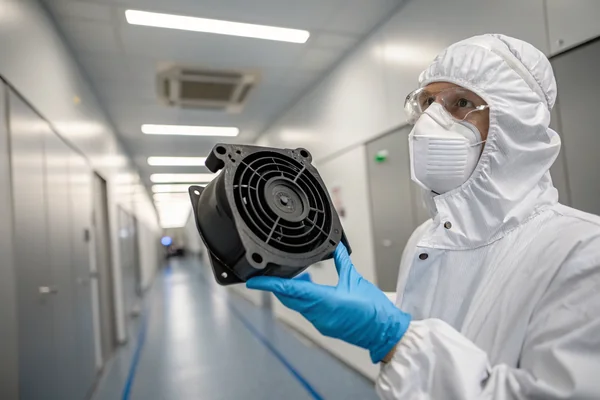
Bearing type, dynamic balance quality, and operating temperature significantly affect real-world blower lifetime -- two fans with similar published RPM and airflow specs but different bearing systems and balance tolerances can see lifetime differences of 2x or more in demanding continuous-duty medical applications.
Why Datasheet Lifetime Claims Need to Be Interrogated
Published MTBF or bearing life figures on fan datasheets are often calculated from manufacturers' own models rather than empirically derived from fleet data. The underlying assumptions -- ambient temperature, orientation, duty cycle, applied load -- may not match a given medical application at all. A blower mounted vertically in an enclosure running at 35°C for 8 hours a night performs very differently from the 25°C horizontal bench test behind the rated figure.
Dynamic balance quality matters more at the high speeds medical blowers typically run than it does in lower-speed axial fan applications. An imbalance that's negligible at 3,000 RPM creates substantially more bearing stress at 15,000 to 30,000 RPM -- the operating range of compact high-speed medical blowers -- and that bearing stress accumulates directly into shortened life. This is why blower suppliers with automated dynamic balance test and correction equipment in their production process, rather than statistical sampling only, provide better lifetime consistency.
Temperature cycling is a useful accelerated life test for medical device qualification specifically because medical devices experience ambient temperature variation across shipping, storage, and operating conditions that can stress motor and bearing materials in ways steady-state testing misses.
Our DC High-Speed Vortex Blower Fan line is manufactured at our Dongguan facility using automated dynamic balance test and correction equipment on every unit, and all acoustic specifications are validated in our in-house anechoic noise test chamber -- both directly relevant to the noise and balance consistency requirements of bedside medical applications. Our quality system operates under ISO 9001 certification, supporting the documentation and traceability requirements medical device OEMs need from component suppliers.
FAQ
Can a standard DC axial fan be used in a CPAP machine if it moves enough CFM?
No -- CFM at free-air conditions doesn't translate to performance under the backpressure of a mask and tubing. An axial fan that meets a CFM target in open air will typically stall or drop flow sharply once system impedance is applied. The architecture has to be a blower.
What bearing type is most common in medical-grade blower fans?
Ball bearings and fluid dynamic bearings are the standard choices for medical applications requiring long life and documented reliability. Sleeve bearings are generally not used where 50,000-hour life documentation is required.
How is noise measured for CPAP blower qualification?
Properly, in an anechoic chamber at the specific operating point under representative system load -- not in ambient lab conditions at free-air speed. The measurement conditions matter as much as the number, and engineers should confirm how a supplier's stated dBA figure was obtained.
Does operating orientation affect blower fan lifetime?
Yes, particularly for sleeve bearings, but also for ball bearings at high speed. Suppliers should be asked whether their rated life applies to the specific mounting orientation of the target application, not just a default horizontal bench position.
What does change control mean for a fan supplier in a medical device context?
It means the supplier is required to notify the device manufacturer before changing any material, component source, or production process that could affect the fan's performance or reliability -- so the device manufacturer can evaluate whether re-qualification testing is needed. Suppliers without this process create compliance risk for the device OEM.
How tight does unit-to-unit P-Q curve consistency typically need to be for CPAP blowers?
Tight enough that the device's pressure control algorithm can assume a consistent baseline fan response. Specific tolerances depend on the control system design, but typical medical device specifications are far tighter than consumer or industrial fan procurement tolerances, which is a key reason to confirm the supplier's production testing approach.
Is EMI certification required for the fan itself in a medical device?
Typically, the finished medical device carries the EMI certification, but the fan's motor and drive characteristics contribute to the system's EMI profile. Suppliers should be able to provide motor drive design details relevant to EMI evaluation during device-level testing.
CPAP and bedside medical devices demand a combination of pressure, precision, noise, and reliability that makes fan selection one of the more consequential engineering decisions in the entire design. At Herays, our Dongguan facility has over 20 years of production and R&D experience in DC blower and axial fan design, operating under ISO 9001 and IATF 16949 quality systems with in-house anechoic and dynamic balance testing. If your medical device application has specific pressure, noise, or qualification requirements, we're glad to work through the tradeoffs with you.
Centrifugal fan is a fan architecture where air enters axially and is discharged radially through an impeller and volute, generating higher static pressure than axial designs at a given flow rate. In restrictive airflow paths like CPAP tubing and masks, this pressure-generating mechanism is essential to maintaining therapeutic delivery. ↩
Pressure-flow (P-Q) curve is the graph relating a fan's static pressure output to its volumetric airflow across its operating range, tested to laboratory standards. For CPAP applications, a certified and consistent P-Q curve is the foundation of the pressure control algorithm's ability to track a patient's breathing accurately. ↩

Liang
I've been working with DC fans for 30 years — long enough to have seen the industry evolve from basic sleeve bearing designs to today's high-efficiency, IP68-rated systems built for the harshest environments imaginable. I founded Herays because I believed manufacturers and engineers deserved a supplier who could talk technical from day one. Not just hand over a datasheet, but actually help you select the right fan for your thermal load, your enclosure, your certification requirements. Most of what I write here comes directly from problems I've solved on the factory floor or in customer applications — medical devices, laser equipment, industrial automation, you name it. If it involves moving air efficiently and reliably, I've probably spent time thinking about it. When I'm not obsessing over airflow curves, I'm usually helping a customer figure out why their cooling system isn't performing the way their simulation said it would.
View all posts by Liang