Cramming desktop-class processing power into a device that fits in two hands creates a thermal problem that laptop and desktop designers never have to solve -- there's simply nowhere for the heat to go.
Handheld gaming consoles and portable game systems increasingly rely on slim centrifugal blowers rather than open axial fans, because their thin chassis and tightly packed internals demand a cooling solution that can move meaningful air through a very shallow, restrictive space while staying acceptably quiet against a user's hands and ears.
- Handheld gaming devices face unusually severe thermal constraints -- high processing power in an extremely thin, hand-held chassis with limited airflow paths.
- Slim centrifugal blowers are generally favored over open axial fans for handhelds because they can generate airflow within a much shallower physical profile.
- Noise sensitivity is higher than typical PC cooling since the device sits close to the user's hands and ears during active use.
- Thermal throttling is a deliberate design tradeoff manufacturers accept rather than running blowers loud enough to fully prevent it.
- Aftermarket cooling upgrades exist for popular handhelds, but effectiveness varies significantly by device and modification approach.
Understanding why handhelds need a fundamentally different cooling approach than laptops or desktops clarifies what's actually happening inside these devices during demanding gameplay.
Table of Contents
What Makes Thermal Management in Portable Gaming Devices So Especially Difficult?
Understanding the specific constraints handheld designers face explains why this is a genuinely harder problem than laptop cooling.
Handheld gaming devices combine relatively powerful processors with an extremely thin chassis (often under 20mm thick), minimal internal volume for heatsinks or airflow channels, and battery-powered operation that limits how much power can be dedicated to cooling -- all while needing to stay comfortable to hold during extended use.
Why Handhelds Face a Harder Version of the Laptop Thermal Problem
Laptops already represent a compromise between performance and thermal headroom compared to desktops, and handhelds compress that same challenge into an even smaller, thinner form factor with less battery capacity to spare on cooling -- the chassis has to be thin enough to hold comfortably, which directly limits how large a heatsink or fan can physically be. This is why handheld thermal design is often considered more constrained than laptop thermal design, not simply a smaller version of the same problem.
Why Do Handhelds Use Slim Blower Designs Instead of Standard Axial Fans?
The centrifugal blower's specific geometry advantage explains this common design choice.
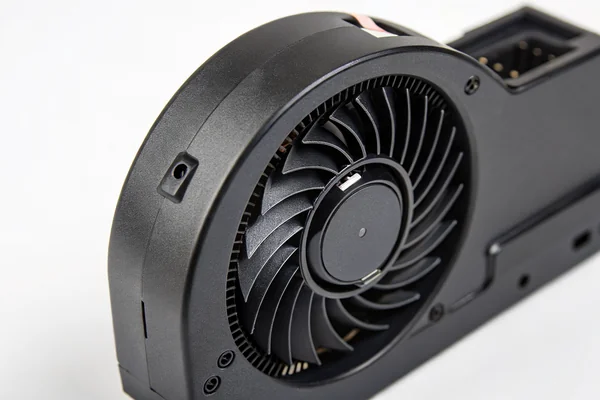
Slim centrifugal blowers draw air in axially through a thin opening and expel it radially through a narrow slot, allowing them to generate meaningful airflow within a chassis profile far shallower than an axial fan of comparable output would require -- this geometry fits the thin, flat shape of a handheld far better than a traditional fan.
Why Blower Geometry Specifically Solves the Thickness Constraint
An axial fan's airflow output scales closely with its blade diameter, meaning generating adequate airflow in a thin chassis would require an axial fan with a large diameter that simply doesn't fit -- a centrifugal blower instead achieves airflow through impeller rotation speed and blade design within a much shallower housing. This geometric advantage is the core reason blowers, not axial fans, dominate handheld gaming device cooling despite blowers generally being less efficient per watt than comparable axial fans in unrestricted applications.
How Much Does Noise Sensitivity Actually Constrain Handheld Cooling Design?
Noise tolerance in handheld devices differs meaningfully from desktop or even laptop expectations.
A handheld device sits close to the user's hands and ears during active gameplay, making blower noise more noticeable and more disruptive than equivalent noise from a desktop tower or even a laptop on a desk -- this pushes handheld cooling design toward more conservative fan curves than raw thermal capacity alone would suggest.
Why Proximity Changes the Acceptable Noise Threshold
The perceived loudness and annoyance of a given noise level increases significantly with proximity to the listener, meaning a blower noise level that would be barely noticeable in a desktop case several feet away becomes distinctly noticeable when the device is held inches from your ears. This is why handheld manufacturers often tune fan curves more conservatively than pure thermal performance would dictate, accepting somewhat higher temperatures in exchange for noise levels that don't disrupt the gameplay experience.
Is Thermal Throttling in Handhelds a Cooling Failure or a Deliberate Design Choice?
This distinction matters for understanding what handheld manufacturers are actually optimizing for.
Thermal throttling in handheld gaming devices is generally a deliberate, engineered tradeoff -- manufacturers calibrate the blower's noise level and speed curve to stay within an acceptable acoustic range, accepting that sustained maximum-load gameplay will trigger some throttling rather than running the blower loud enough to fully prevent it.
Why Manufacturers Accept Some Throttling Rather Than Maximizing Cooling
Given the noise sensitivity of close-proximity handheld use and the battery life cost of running a blower at maximum speed continuously, manufacturers generally calibrate for a noise and battery life target first, then accept that the most demanding games or sustained sessions will trigger some thermal throttling as a consequence. This is why throttling in a handheld shouldn't automatically be read as a cooling system failure -- it's frequently the expected result of a deliberate acoustic and battery life design decision.
Do Aftermarket Cooling Upgrades for Handhelds Actually Deliver Meaningful Improvement?
For users seeking better sustained performance, aftermarket options are a common but variable-outcome path.
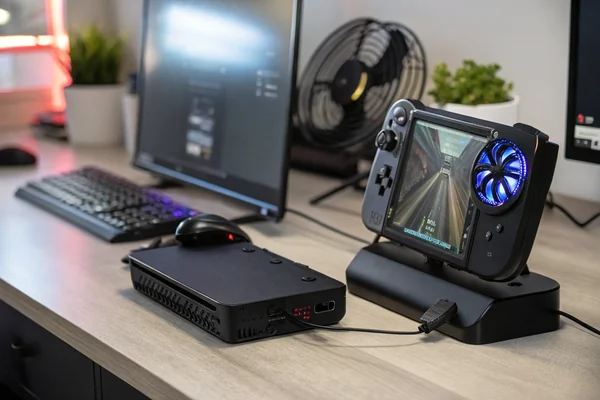
Aftermarket cooling upgrades for popular handheld devices -- ranging from replacement blowers with higher airflow to external cooling docks -- can provide a measurable thermal improvement, but effectiveness varies significantly by device design and the specific modification, and some upgrades trade increased noise for the performance gain.
Why Aftermarket Results Vary So Much Between Devices and Modifications
A handheld's thermal ceiling is set by the combination of its heatsink design, chassis material, and available airflow path, meaning a blower upgrade alone may deliver a modest improvement if the heatsink or airflow path is the actual bottleneck rather than the blower itself. External cooling docks that add a larger, quieter fan outside the handheld's chassis constraints tend to deliver more consistent improvement than internal blower swaps, since they aren't limited by the device's original thin-chassis airflow geometry.
What Should Product Designers Actually Prioritize When Specifying a Handheld Cooling Blower?
Bringing these constraints together into practical specification guidance for designers.
Prioritize a blower with the airflow-to-thickness ratio your chassis design actually requires, validated noise output at your target acoustic ceiling (not just maximum-speed dBA), and confirmed compatibility with your specific internal airflow path and heatsink design before committing to a specific model.
Why Airflow-to-Thickness Ratio Matters More Than Raw CFM for This Application
A blower's raw CFM rating in isolation doesn't tell you whether it can actually deliver that airflow within your specific chassis thickness constraint -- the airflow-to-thickness ratio, tested in a representative or actual chassis mockup, is a far more meaningful comparison point for handheld applications than comparing CFM specs across blowers of different physical depths. This is why validating a candidate blower in an actual or representative thin-chassis mockup, rather than trusting datasheet CFM alone, matters more for handheld cooling than for less space-constrained applications.
Our DC blower fan line includes ultra-slim centrifugal models engineered for space-constrained handheld and portable electronics, manufactured at our Dongguan facility under ISO 9001 certification. With over 20 years of production experience, we work with handheld device manufacturers to balance airflow, thickness, and acoustic requirements for genuinely thin-chassis cooling applications.
How Much of a Handheld's Battery Budget Does Cooling Actually Consume?
Battery life is a competing priority that directly constrains how aggressively a blower can run.
A handheld's blower draws power continuously during active cooling, competing directly with the processor and display for a fixed battery capacity -- running the blower at higher speeds to chase lower temperatures directly reduces gameplay time per charge, making this a genuine tradeoff rather than a free performance lever.
Why Blower Power Draw Is a Meaningful Line Item in a Tight Power Budget
Unlike a desktop or plugged-in laptop where fan power draw is a rounding error against the wall outlet, a handheld's blower power consumption is a measurable percentage of a small battery capacity shared with the processor, display, and wireless radios. This is why manufacturers tune blower speed curves against a battery life target as much as a thermal target, and why an aftermarket blower upgrade that improves cooling but draws meaningfully more power can shorten battery life even while lowering temperatures.
FAQ
Why don't handhelds just use bigger heatsinks instead of blowers to avoid noise entirely?
Passive cooling alone generally can't dissipate the heat output of modern handheld processors under sustained load within the chassis's thin, limited-surface-area constraints, making active airflow from a blower necessary for anything beyond light workloads.
Does blower noise in handhelds vary significantly between brands and models?
Yes, considerably -- blower quality, blade design, and fan curve tuning all affect perceived noise at a given cooling output, making this a meaningful differentiator between handheld models rather than a uniform characteristic across the category.
Can software alone fix handheld thermal throttling without hardware changes?
Software can optimize fan curves and power limits to better balance performance and noise, but it can't overcome the underlying physical airflow and heatsink constraints of the chassis -- meaningful throttling reduction generally requires a hardware change.
Is a louder blower always a sign of better cooling capacity in a handheld?
Not necessarily -- noise level depends on blade design and motor characteristics as well as raw airflow output, so a louder blower doesn't automatically mean it's moving more air or cooling more effectively than a quieter alternative.
Do external cooling docks eliminate the need for good internal blower design?
No -- docks help specifically during docked or desk use, but the device still needs adequate internal cooling for genuinely portable, undocked gameplay, which remains the primary use case for most handheld devices.
How often should a handheld's internal blower and vents be cleaned?
Dust accumulation in the thin vents and blower intake can meaningfully reduce airflow over time, so periodic cleaning (following manufacturer guidance) is worth doing, particularly for devices used in dusty environments or showing rising temperatures during normal use.
Cooling a handheld gaming device well comes down to solving a genuinely harder airflow-in-a-thin-space problem than laptops or desktops face, which is why slim centrifugal blowers dominate this category. At Herays, our Dongguan facility manufactures ultra-slim blower fans for space-constrained portable electronics, backed by over 20 years of production experience under ISO 9001 certification. If you're designing cooling for a handheld or portable device, we're glad to help match blower specifications to your chassis and acoustic constraints.

Liang
I've been working with DC fans for 30 years — long enough to have seen the industry evolve from basic sleeve bearing designs to today's high-efficiency, IP68-rated systems built for the harshest environments imaginable. I founded Herays because I believed manufacturers and engineers deserved a supplier who could talk technical from day one. Not just hand over a datasheet, but actually help you select the right fan for your thermal load, your enclosure, your certification requirements. Most of what I write here comes directly from problems I've solved on the factory floor or in customer applications — medical devices, laser equipment, industrial automation, you name it. If it involves moving air efficiently and reliably, I've probably spent time thinking about it. When I'm not obsessing over airflow curves, I'm usually helping a customer figure out why their cooling system isn't performing the way their simulation said it would.
View all posts by Liang