Choosing a DC fan seems simple, but the specs can be confusing. You see CFM and static pressure ratings and wonder which one is more important for keeping your electronics cool.
To choose the right fan, don't prioritize one spec over the other. Instead, focus on your system's airflow resistance. High-CFM fans are for open, unobstructed spaces, while high-static-pressure fans are for tight, restricted areas with obstacles like heatsinks or filters.
As a fan supplier, this is one of the most common questions I get from engineers and PC builders. Everyone wants a simple answer, but picking the wrong fan can lead to overheating, loud noise, or even system failure1. It's a critical choice. The truth is, looking at CFM and static pressure as a simple "versus" battle is the wrong way to think about it. To make the right decision, you need to understand what these numbers really mean and, more importantly, how they relate to your specific design. Let's break it down so you can choose with confidence.
Table of Contents
What Does CFM Measure?
You need to move air, so you look for a fan with a big CFM number. But if that fan goes into a tight case with lots of components, it might not work as you expect.
CFM stands for Cubic Feet per Minute2. It measures the volume of air a fan can move per minute in an open environment with zero resistance. It represents the fan's absolute maximum airflow potential under ideal, unrealistic conditions3.
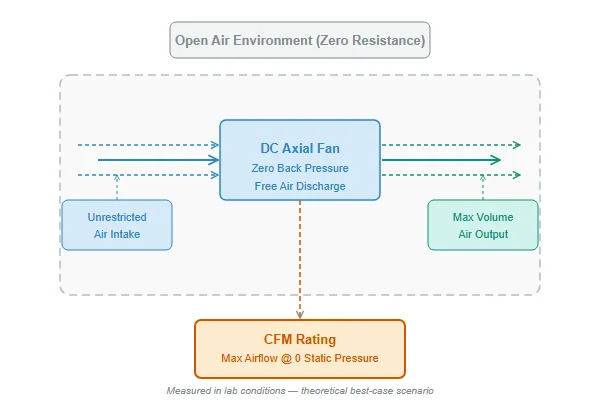
Think of the max CFM rating on a datasheet as a theoretical best-case scenario. It's measured in a lab with no case, no filters, and no heatsinks in the way. It’s like a car’s top speed tested on a perfectly flat, empty track. In the real world, you never get that top speed because of traffic, hills, and wind resistance. The same is true for fans. The moment you put that fan into a device, the actual airflow will be lower than the max CFM rating4. However, CFM is still a great starting point for understanding a fan’s general capability, especially for applications where the air has a clear path to travel.
Common Applications Based on Airflow
| Application | Airflow Resistance | Primary Need |
|---|---|---|
| Case Ventilation | Low | Move large volumes of air out. |
| Electronics Enclosure | Low to Medium | Circulate air to prevent hotspots. |
| Room Ventilation | Very Low | General air exchange. |
Understanding this helps you see that CFM is just one part of the story. It tells you the fan's potential, but not what it will actually deliver inside your product.
What is Static Pressure?
The term "static pressure" sounds technical, so it's easy to gloss over. But ignoring it is a common mistake that leads to poor cooling, especially in compact designs.
Static pressure is the force a fan can generate to push air against resistance. It's the fan’s pushing power, measured when airflow is completely blocked5. This spec tells you how well a fan can overcome obstacles like filters, heatsinks, and narrow channels.
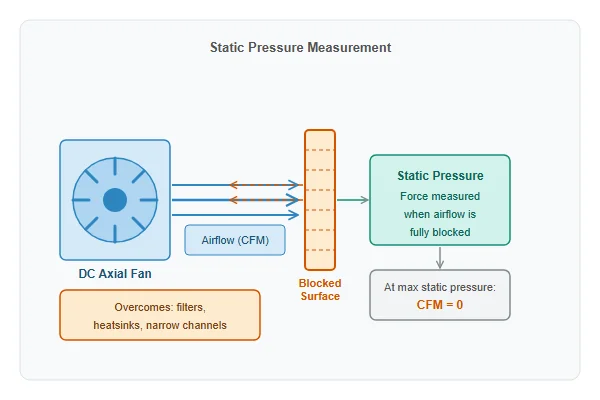
Let's go back to the car analogy. If CFM is the top speed, then static pressure is the engine's torque. It’s the raw power to get a heavy load moving from a standstill or up a steep hill. A fan with high static pressure is designed to maintain airflow even when things get in the way. The max static pressure value is also a theoretical number, measured when the fan outlet is completely sealed (meaning zero airflow). In your device, you'll never have a completely sealed situation, but this number gives you a clear idea of the fan's ability to handle resistance. If your design has tight spaces or dense components, this is a spec you absolutely cannot ignore.
Common Sources of Airflow Resistance
| Component/Feature | Resistance Level | Why it Matters |
|---|---|---|
| Dust Filter | Medium to High | Clogs over time, increasing resistance. |
| Heatsink Fins | High | Densely packed fins block airflow. |
| Radiator | High | Similar to a heatsink; needs pressure. |
| Narrow Channels | High | Air has to be forced through a tight space. |
| Open Case | Low | Air moves freely with few obstacles. |
Recognizing these sources of resistance in your own design is the first step to choosing the right type of fan.
When Should You Choose High-CFM Fans?
You’ve found a fan with a huge CFM rating and it seems like a perfect fit. But putting it in the wrong system is a waste of money and can lead to more noise.
Choose a high-CFM fan when your system has low airflow resistance and your main goal is to move a large volume of air. These are ideal for general case ventilation or cooling open enclosures where air has a clear path.
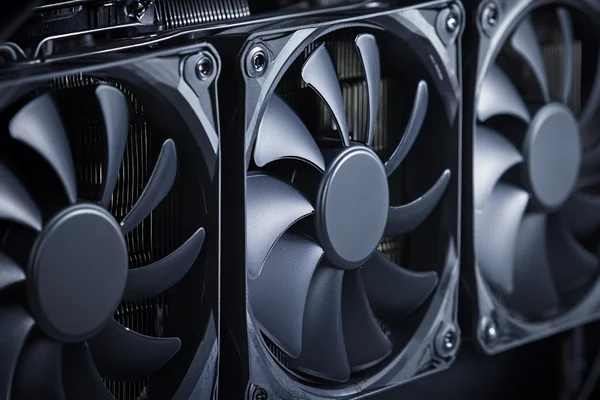
In my experience, customers often select high-CFM fans for applications that are essentially empty boxes. Think of a large desktop PC case with plenty of internal space, a server room that needs general air circulation, or an electronics cabinet where components are spread out. In these low-impedance systems, there are few obstacles to block the air. The primary goal is simply to exchange the hot air inside with cool air from the outside as quickly as possible. A high-CFM fan excels here because its blades are designed to scoop and move large amounts of air efficiently when there's nothing pushing back. Using a high-pressure fan in this scenario would be overkill. It would likely be louder, more expensive, and less efficient at moving air in an open space.
When Should You Choose High-Static-Pressure Fans?
Your compact device is getting hot, and the fan inside is spinning fast but not cooling it down. You can feel the heat, but not the airflow. This is a classic symptom of a mismatch.
Choose a high-static-pressure fan when your system has high airflow resistance. These fans are essential for forcing air through dense heatsinks, radiators, dust filters, and narrow, winding paths where pushing power is critical.
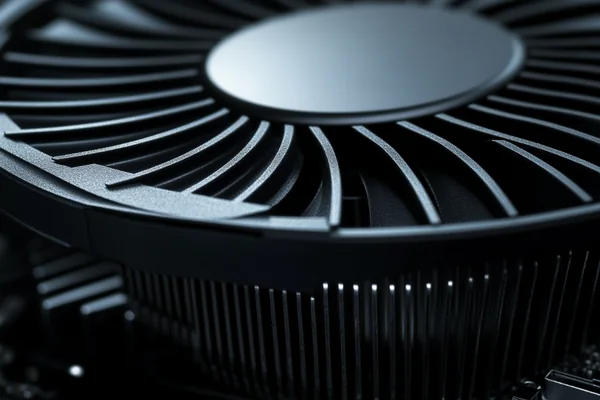
This is a situation I see all the time with product engineers working on compact electronics, 3D printers, or high-performance PCs. High-impedance systems are everywhere. A CPU cooler with tightly packed fins is a perfect example. A high-CFM fan would just spin in front of it, unable to push air deep into the fin stack. The air would stall, and the CPU would overheat.6 You need a fan designed for pressure to force air through those fins. The same applies to water-cooling radiators, devices with protective dust filters, or any embedded system where air has to navigate a tight, complex path to reach a hot component. In these cases, the fan’s ability to overcome backpressure is far more important than its free-air CFM rating.
How Do You Balance CFM & Static Pressure for Real Designs?
You now understand CFM and static pressure, but you're still looking at two maximums on a datasheet. These numbers are misleading because your fan will never achieve either of them.
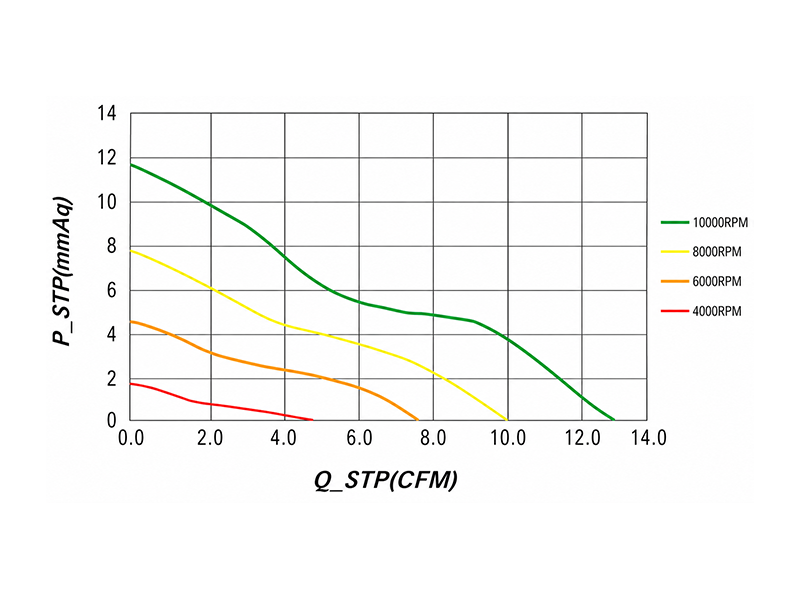
The secret is the P-Q (Pressure vs. Airflow) curve7 found in the fan's datasheet. This graph shows the fan's actual performance, revealing how much airflow (CFM) it delivers at different levels of resistance (static pressure).
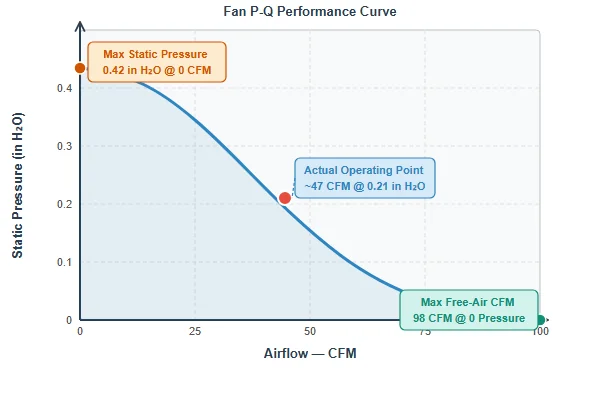
Stop thinking of CFM and static pressure as two separate choices. They are two ends of a single performance curve. On the far left of the P-Q curve is max static pressure (at zero airflow). On the far right is max CFM (at zero pressure). Your fan will operate somewhere in the middle. The key is to estimate your system's resistance, often called "system impedance8." A high-impedance system (like a dense heatsink)9 will intersect the fan's P-Q curve closer to the high-pressure, low-airflow side. A low-impedance system (like an open case) will intersect it closer to the high-airflow, low-pressure side. This intersection point is your true operating point10—the actual CFM you will get in your device. As a supplier, this is how we help engineers make the right choice. We don't just sell them a fan; we help them match their system's needs to the right point on that curve.
Conclusion
Stop asking if you need more CFM or static pressure. Instead, analyze your system's airflow resistance and use the fan's P-Q curve to find the perfect match for your design.
"Electric fan use in heat waves: Turn on or turn off? - PMC - NIH", https://pmc.ncbi.nlm.nih.gov/articles/PMC5079223/. A source can provide analysis or [case studies](https://herays.com/case_study/) demonstrating how a mismatch between a fan's capabilities and a system's airflow resistance can lead to thermal throttling, acoustic noise, and reduced component lifespan or failure. ↩
"Actual cubic feet per minute - Wikipedia", https://en.wikipedia.org/wiki/Actual_cubic_feet_per_minute. A source from an engineering standards body, such as the Air Movement and Control Association (AMCA), can provide a formal definition of Cubic Feet per Minute (CFM) and the standard conditions under which it is measured. ↩
"[PDF] Test Procedure for Fans and Blowers - Department of Energy", https://energy.gov/sites/default/files/2023-07/fans-tp-fr-correction.pdf. A source can describe the 'free air' or 'zero static pressure' test conditions used to determine a fan's maximum CFM rating, clarifying that these laboratory conditions do not include the system impedance present in any real-world enclosure. ↩
"[DOC] Fan Configuration and Airflow Impedance", https://www.sjsu.edu/people/nicole.okamoto/courses/me_146/Fan%20Configuration%20and%20Airflow%20Impedance%20Lab%20Manual%20Part%201%20%20ME146.doc. An engineering guide or educational resource can explain that any physical obstruction in an enclosure creates system impedance (backpressure), which causes the fan's actual operating airflow to be lower than its maximum free-air CFM rating. ↩
"[PDF] Measure and Interpret Static Pressures - Energy Star", https://www.energystar.gov/sites/default/files/specs/National%20Comfort%20Institute%20-%20Measure%20and%20Interpret%20Static%20Pressures.pdf. A source on fan testing standards, such as those from AMCA International, can confirm that a fan's maximum static pressure (or 'shut-off pressure') is determined by measuring the pressure at the fan's outlet under a zero-flow condition, where the outlet is completely sealed. ↩
"[PDF] Rotating Stall Initiation and Suppression in a Centrifugal Fan", https://docs.lib.purdue.edu/cgi/viewcontent.cgi?article=2038&context=icec. A source can explain the aerodynamic phenomenon of fan stall, which occurs when the system's backpressure exceeds the fan's pressure-generating capability, causing airflow to separate from the blades, leading to a drastic reduction in flow rate and cooling performance. ↩
"[Axial fan](https://herays.com/dc-axial-fan-sizes-guide-25mm-to-172mm/) design - Wikipedia", https://en.wikipedia.org/wiki/Axial_fan_design. An engineering resource can define the P-Q (Pressure-Quantity) or fan performance curve, explaining that it is a graph that illustrates the inverse relationship between the airflow (CFM) a fan delivers and the static pressure it operates against. ↩
"[DOC] Fan Configuration and Airflow Impedance", https://www.sjsu.edu/people/nicole.okamoto/courses/me_146/Fan%20Configuration%20and%20Airflow%20Impedance%20Lab%20Manual%20Part%201%20%20ME146.doc. A source can define 'system impedance' or the 'system resistance curve,' explaining that it represents the pressure drop required to achieve a certain airflow rate through a given system, and that this value typically increases with the square of the airflow. ↩
"2.4 Colour coding and standard resistor values - The Open University", https://www.open.edu/openlearn/science-maths-technology/an-introduction-electronics/content-section-2.4. A source can provide data or analysis showing that components with densely packed fins, such as CPU heatsinks and radiators, present a high resistance to airflow, thereby creating a high-impedance system with a steep system resistance curve. ↩
"An Engineer's Guide to Understanding Fan Curves - Q-PAC", https://www.q-pac.com/resources/engineers-guide-to-understanding-fan-curves. An engineering guide on thermal management can confirm that the actual performance of a fan within a specific application—its 'operating point'—is found at the intersection of the fan's P-Q performance curve and the system's impedance curve. ↩

Liang
I've been working with DC fans for 30 years — long enough to have seen the industry evolve from basic sleeve bearing designs to today's high-efficiency, IP68-rated systems built for the harshest environments imaginable. I founded Herays because I believed manufacturers and engineers deserved a supplier who could talk technical from day one. Not just hand over a datasheet, but actually help you select the right fan for your thermal load, your enclosure, your certification requirements. Most of what I write here comes directly from problems I've solved on the factory floor or in customer applications — medical devices, laser equipment, industrial automation, you name it. If it involves moving air efficiently and reliably, I've probably spent time thinking about it. When I'm not obsessing over airflow curves, I'm usually helping a customer figure out why their cooling system isn't performing the way their simulation said it would.
View all posts by Liang