If you've ever tried to cool a Raspberry Pi or a compact piece of low-voltage electronics, you've probably hit this exact wall: finding a fan that actually runs -- and reliably starts -- on 5V or 3.3V isn't as simple as it looks on a datasheet.
- When people say "low voltage" in this business they usually mean 5V or 3.3V -- the rails you actually find on logic boards, not a smaller version of a 12V fan.
- Don't just swap in a 5V fan and call it 3.3V-compatible. The driver IC inside has to be built for that lower threshold, or it won't start reliably.
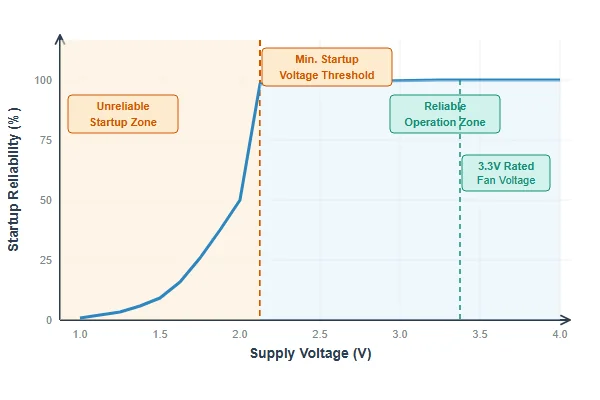
- I've seen this fail more than once: a 5V fan spins fine on the bench at 3.3V, then stalls in the field under load or in cold weather. Startup voltage, not the nameplate voltage, is what actually predicts reliability.
- Efficiency also takes a hit down here -- the driver's own power draw eats a bigger share of the budget, and hitting target RPM often means pulling more current than you'd expect.
I've been in the DC fan business for a long time, and one of the most common points of confusion I see comes up when engineers need to cool a device that only has a 5V or 3.3V power rail available. The assumption is that a fan is a fan, and you can just find a smaller voltage version. In reality, once you drop below the standard 12V, the physics and electronics inside the motor change in ways that can catch you by surprise.
From what I’ve seen working with designers of medical devices and compact electronics, many of the reliability issues I'm asked to troubleshoot trace back to a misunderstanding of how a brushless DC motor behaves at the edge of its operating window. A fan that works on your test bench might not start up in the field, and the reason is almost always tied to the voltage.
Table of Contents
Where Are Low-Voltage DC Fans Actually Used?
While 12V and 24V fans dominate industrial and server applications, the need for 5V and 3.3V cooling solutions comes directly from the world of embedded and consumer electronics. The projects I've helped with in this space usually involve:
- USB-Powered Devices: Since the USB standard provides a 5V rail, any device that needs active cooling and plugs into a USB port needs a 5V fan.
- Single-Board Computers (SBCs): Boards like the Raspberry Pi and its competitors have 5V and 3.3V GPIO pins, making these fan voltages a natural fit for processor cooling hats and cases.
- Handheld and Portable Electronics: Battery-powered devices, from portable medical scanners to high-performance handheld gaming consoles, often run on logic levels where 3.3V or 5V is the most convenient power source for a small fan.
- Network and Telecom Equipment: Small form-factor routers, switches, and media converters often use internal 5V rails for their main logic and can tap into that for cooling a specific hot-running chip.
- LED Lighting: Compact, high-intensity LED drivers can generate a lot of heat in a small space, and a small 5V fan is often the only option that fits.
In all these cases, the fan is not the primary component; it's an accessory to a system whose core voltage levels are already fixed.
What Are the Challenges of Designing with 3.3V Fans?
This is where the real engineering problems start. A 3.3V fan isn't just a 5V fan with a different label. A standard brushless DC motor1 relies on a driver IC to switch the electromagnets in the correct sequence. Most commodity driver ICs are designed for a minimum operating voltage of 4V or higher. If you supply less than that, the IC's internal logic simply won't turn on.
To build a true 3.3V fan, a manufacturer has to source a specialized, more expensive driver IC that is guaranteed to operate at this lower voltage.
Here are the issues I see when a design relies on a fan not truly specified for 3.3V operation:
- Startup Failure: The fan may not have enough torque to overcome the initial static friction (stiction) of the bearing and start spinning.
- Voltage Sag: The initial current draw during startup can cause the supply voltage to dip slightly. If it dips below the driver IC's minimum threshold, the fan will fail to start and may enter a "chatter" state.
- Reduced Performance: Even if it starts, the fan will run at a much lower RPM, delivering significantly less airflow and static pressure than its 5V rating.
Can I Just Run a 5V Fan on a 3.3V Rail?
I get this question almost every week. The short answer is no, you shouldn't. It's one of the most common causes of intermittent and hard-to-diagnose product failures.
A fan that is rated for 5V might spin if you give it 3.3V on a lab bench with no obstructions. However, you are operating it far outside its specified range. Here's what's happening on the factory floor when we test this scenario:
| Condition | 5V Fan running at 5V | 5V Fan running at 3.3V |
|---|---|---|
| Startup Reliability | High; starts every time | Low; may fail to start, especially when warm or with back-pressure |
| Airflow (CFM) | Meets datasheet specification | Drastically reduced; often less than 50% of rated value |
| Static Pressure | Meets datasheet specification | Almost zero; unable to push air against any resistance |
| Motor IC State | Operating within designed voltage range | Under-voltage; may be unstable or fail to initialize |
| Long-term Reliability | High; operates as designed | Very poor; repeated startup failures can stress the motor driver |
The biggest danger is inconsistent behavior. It might work 9 out of 10 times, but that 10th time is when your customer's device overheats. When I source a fan for a critical application, I never rely on running it below its specified minimum voltage. If you need 3.3V operation, you need a fan explicitly designed and rated for 3.3V. If you need a reliable 5V DC axial fan, you should supply it with a stable 5V source.
How Does Operating Voltage Affect Fan Efficiency?
Efficiency in a DC fan is about how much of the electrical power (Watts) is converted into airflow, rather than being lost as heat. When you operate at very low voltages, maintaining good DC axial fan efficiency becomes much harder.
The power consumed by the fan is Voltage × Current. The driver IC itself consumes a certain amount of power just to operate. At 12V, this overhead is a small fraction of the total power. At 3.3V, it becomes a much more significant percentage, meaning a larger portion of your power budget is spent running the controller instead of spinning the blades.
Furthermore, to achieve the same target RPM at a lower voltage, the motor needs to draw more current. This increased current flows through the motor windings, and the power lost to heat in those windings is proportional to the square of the current (I²R loss). This makes the motor itself run hotter, which can impact the life of the bearing and the electronics. This is why properly engineered low-voltage fans are not just about the driver IC; they also require careful motor winding and magnetic design.
I've been in this industry for over 30 years, and I founded Herays because I saw a need for a supplier who understood the engineering details. For low-voltage fans specifically, datasheet numbers can be misleading. That's why we don't just rely on supplier specs. We use our in-house CFM airflow test system and an anechoic noise chamber to build P-Q and noise curves at the actual operating voltages our customers use—like 3.3V and 5V. This ensures that the fan you get performs as expected in your device, not just on a datasheet. Our quality system is certified to IATF 16949, so this level of validation is standard practice for us.
How Should I Source and Specify Low-Voltage Fans?
When you're sourcing fans for a 3.3V or 5V application, you need to be more specific than usual with your supplier.
- Specify Minimum Startup Voltage: Don't just ask for a "5V fan." Ask for the guaranteed minimum voltage at which the fan will start under load. A good supplier should be able to provide this number. For a 5V system, you might specify a fan that can start at 4.0V to account for system tolerances. For a 3.3V system, you'd need a fan guaranteed to start at 3.0V or even lower.
- Request Performance Data at Your Voltage: If you plan to run the fan at 3.3V, ask for the P-Q (Pressure-Airflow) curve and acoustic noise data measured at 3.3V, not just at its nominal 5V rating.
- Confirm the Driver IC: For critical applications, ask the manufacturer to confirm that the fan uses a driver IC specifically rated for your target voltage range.
- Test Samples in Your Enclosure: This is always important, but it's critical at low voltages. A fan might start in open air but fail once it has to push against the back-pressure of your chassis, heat sink, or filter. Always validate samples in the final product.
FAQ
Can I run a 5V DC fan on a 3.3V power supply? I strongly advise against it. While it might spin under no load, it will likely fail to start reliably in a real-world application, leading to intermittent overheating. You should use a fan specifically designed and rated for 3.3V operation.
What is the lowest voltage a DC fan can run on? This depends entirely on the motor driver IC inside the fan. While most standard fans stop working below 4V, specialized fans with dedicated low-voltage driver ICs can be designed to run on 3.3V. It's technically possible to go lower, but these are typically custom-engineered solutions for very specific applications.
Why are true 3.3V fans more expensive or harder to find? They require a specialized, less common, and more expensive motor driver IC that is guaranteed to operate reliably at that low voltage. Many manufacturers don't stock them as standard items because the demand is lower than for 5V and 12V models.
For a low-voltage fan, what is the most important spec to check? The guaranteed minimum startup voltage. This single specification tells you more about the fan's real-world reliability in your low-voltage system than the nominal airflow (CFM) or RPM rating.
Does a 5V fan running at 5V draw the same power as a 12V fan doing the same job? Not necessarily. To achieve the same airflow, the 5V fan will have to draw a higher current than the 12V fan (since Power = Voltage x Current). This higher current can lead to slightly lower overall system efficiency due to I²R losses in the wiring and motor.
"Brushless DC electric motor", https://en.wikipedia.org/wiki/Brushless_DC_electric_motor. A brushless DC motor relies on an electronic controller (driver IC) to switch the stator windings in the correct sequence to drive the rotor. ↩

Liang
I've been working with DC fans for 30 years — long enough to have seen the industry evolve from basic sleeve bearing designs to today's high-efficiency, IP68-rated systems built for the harshest environments imaginable. I founded Herays because I believed manufacturers and engineers deserved a supplier who could talk technical from day one. Not just hand over a datasheet, but actually help you select the right fan for your thermal load, your enclosure, your certification requirements. Most of what I write here comes directly from problems I've solved on the factory floor or in customer applications — medical devices, laser equipment, industrial automation, you name it. If it involves moving air efficiently and reliably, I've probably spent time thinking about it. When I'm not obsessing over airflow curves, I'm usually helping a customer figure out why their cooling system isn't performing the way their simulation said it would.
View all posts by Liang