Choosing a fan based on a single efficiency number is risky. This can lead to noisy, underperforming products, forcing you into expensive redesigns and project delays.
To find the most efficient fan, you must match the fan's performance curve (P-Q curve) to your system's unique airflow resistance, or impedance. Improving efficiency involves reducing this system impedance or selecting a fan optimized for that specific operating point, not just chasing a high percentage on a datasheet.
Engineers often ask me about fan efficiency, hoping for a simple formula. The truth is, it's not about complex calculations but about making a smart selection. A fan's real-world performance depends entirely on the environment you put it in. Datasheet numbers are measured in a perfect, open-air lab setting1, which almost never matches the reality of a compact electronic enclosure. Let's break down how to approach this the right way, so you can choose a fan that works efficiently in your system, not just on paper.
Table of Contents
What Is Fan Efficiency and Why Does It Matter?
You see an "efficiency" rating on a datasheet, but what does it mean for your device? The number feels abstract. Learn what it really represents to avoid choosing the wrong fan.
Fan efficiency is the ratio of the airflow power it produces to the electrical power it consumes. A higher efficiency means the fan is better at converting electrical energy into useful air movement, wasting less as heat.
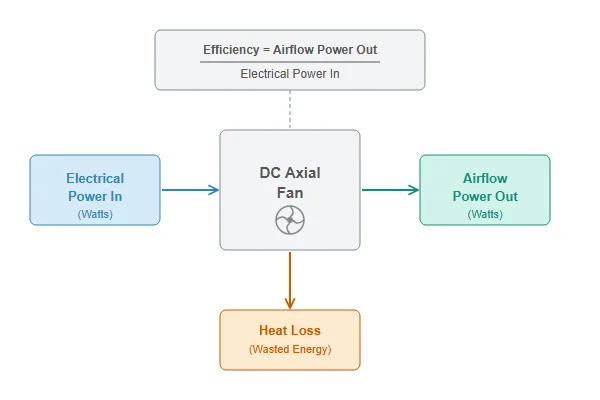
A common question we get from engineers is, "What's the efficiency of this fan?" While I can give them a number, I always follow up by explaining that the number is only part of the story. Think of it like a car's fuel economy. The sticker might say 30 MPG, but your actual mileage depends on whether you're driving uphill, in city traffic, or on a flat highway. Similarly, a fan's efficiency is not a fixed value. It changes dramatically based on the backpressure it has to work against. This resistance is called system impedance. A fan is only "most efficient" at a specific point on its performance curve where airflow and pressure are perfectly balanced. The datasheet's peak efficiency number often occurs in free air (zero impedance), a condition that rarely exists in a real product with vents, filters, and components.
What Are the Key Efficiency Metrics You Should Actually Use?
Datasheets are full of numbers like CFM, static pressure, and watts. It's confusing. Focus on the right metrics to make a confident choice and avoid analysis paralysis.
Instead of one efficiency percentage, focus on the P-Q (Pressure vs. Airflow) curve and the Input Power curve. These charts help you find the fan's actual operating point and efficiency within your specific system.
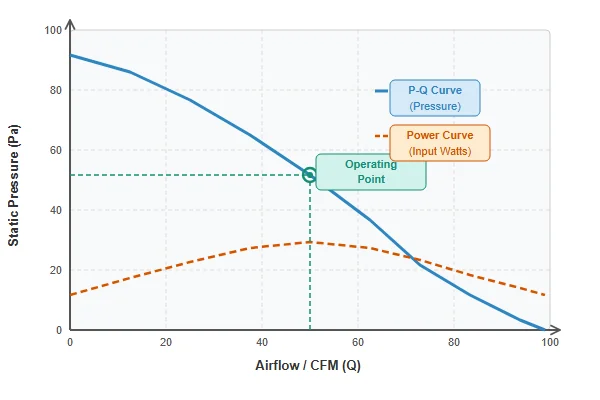
When we help a customer select a fan, we don't start with a single efficiency percentage. We start with the P-Q curve. This graph is your single most important tool for making an informed decision.
The P-Q Curve: Your Best Friend
The P-Q curve shows the fan's performance across its entire operating range. It plots static pressure (P) on the y-axis against airflow (Q, often measured in CFM) on the x-axis. At one end, you have maximum airflow at zero static pressure (free air). At the other end, you have maximum static pressure at zero airflow (a completely blocked outlet). The fan will operate somewhere between these two extremes.
System Impedance: The Other Half of the Equation
Your device creates resistance to airflow. This is the system impedance. It’s caused by everything that gets in the air's way. The more resistance, the steeper your system impedance curve will be. The point where your system's impedance curve intersects the fan's P-Q curve is the actual operating point. To choose the most efficient fan, you need one whose peak efficiency range is close to this operating point.
| Fan P-Q Curve Point | What It Means | Application Suitability |
|---|---|---|
| Max Airflow (CFM) | Open-air performance with no resistance. | Good for general ventilation in an open case. |
| Max Static Pressure | Pushing power against a total blockage. | Indicates strength against dense filters or heatsinks. |
| "The Knee" | The bend in the curve. A good balance. | Often the most efficient operating region.2 |
What Common Factors Reduce a Fan's Real-World Efficiency?
Your new fan isn't moving as much air as you expected. This common problem is frustrating. You need to understand the hidden factors that kill airflow performance and efficiency.
The biggest factor reducing fan efficiency is system impedance—the resistance from filters, grilles, densely packed components, and tight spaces. Obstructions near the fan's inlet or outlet also create turbulence, further hurting performance.
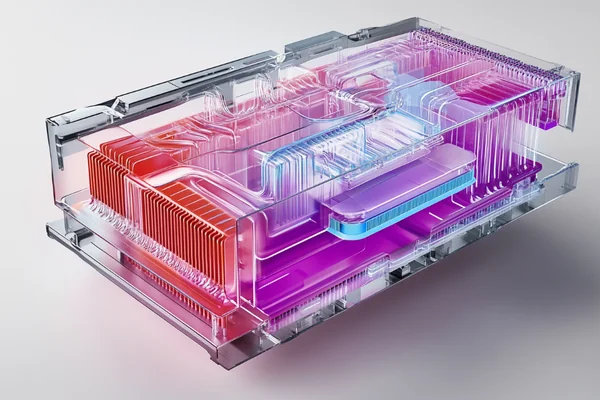
What we've seen in post-delivery feedback is that high system impedance is often the main reason for disappointing cooling performance. The fan itself is working as designed, but the system is fighting against it. Improving efficiency is often about fixing the system, not just swapping the fan.
System Impedance is the #1 Culprit
Any object that obstructs the path of the air contributes to the total system impedance. The more restrictive the path, the harder the fan has to work, pushing it away from its peak efficiency point. This results in less airflow, more noise, and higher power consumption for the cooling you get. We've seen many cases where simply changing a restrictive finger guard to a wire form guard significantly improved airflow. It's crucial to consider these factors during the initial design phase.
Here are some of the most common sources of resistance:
| Obstruction Type | Impact on Airflow | What It Means for Fan Selection |
|---|---|---|
| Dust Filters | High resistance, especially when dirty. | Requires a fan with high static pressure. |
| Honeycombs/Grilles | Moderate resistance, depends on design. | A standard axial fan may work, but test it. |
| Densely Packed PCBs | Blocks paths and creates turbulence. | May need multiple fans or a high-pressure blower. |
| Sharp 90° Bends | Creates significant pressure loss.3 | Avoid in ducting; use smooth, curved paths. |
How Can You Improve Airflow Efficiency in Your System?
The fan is running, but the device is still hot. You feel stuck. Improving efficiency isn't about the fan alone; it's about improving the entire system's design for better airflow.
Improve system efficiency by reducing airflow resistance: use less restrictive grilles, clean filters, and increase vent sizes. Then, select a fan whose P-Q curve is best suited for your system's specific impedance.
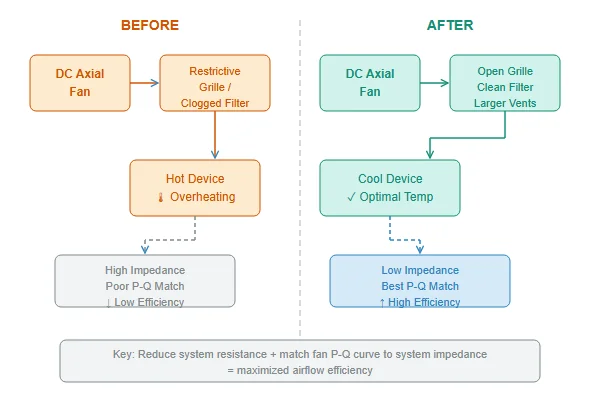
You can't really "improve" a fan's built-in efficiency. That's determined by its motor, blade design, and materials4. What you can do is ensure the fan operates at or near its most efficient point. This is a two-step process involving your system design and your fan selection.
Step 1: Reduce System Impedance
Before you even look at fans, look at your enclosure. The easiest and cheapest way to improve cooling efficiency is to make it easier for air to move. This means providing a clear, wide path from the air inlet to the outlet. Can you increase the size of your ventilation holes? Can you switch from a stamped metal grille to a less-restrictive wire form guard? Can you rearrange components to clear the airflow channel? Every bit of resistance you remove allows the fan to work more efficiently, moving more air with less effort and noise.
Step 2: Select the Right Fan for the Job
Once you've optimized your system's layout, you can choose a fan. We often guide customers through this process. Don't just pick the fan with the highest maximum CFM. If your system has high impedance (like a 1U server or a device with a HEPA filter), you need a fan designed for high static pressure. A high-airflow fan will "stall" against that resistance and move very little air. Conversely, for an open case needing general ventilation, a high-airflow fan is perfect. The goal is to match the fan's strengths to your system's challenges.
Are DC Fans More Efficient Than AC Fans for Energy Savings?
You need an energy-efficient cooling solution. Choosing between AC and DC fans seems complicated. Understand the key differences to make a smarter, more cost-effective choice for your application.
Yes, DC brushless fans are significantly more energy-efficient than AC fans of a similar size. Their motors use less power, generate less waste heat, and allow for easy speed control, leading to major energy savings.
For customers building products that run continuously or have tight power budgets, the choice is clear. DC fans are the superior option for efficiency. The technology behind them is fundamentally different and more advanced.
Why DC Motors Use Less Power
An AC fan uses alternating current to create rotating magnetic fields in the motor, which is an inherently lossy process that generates waste heat. A brushless DC fan uses a more sophisticated electronic circuit to switch power to permanent magnets in the motor. This method is far more precise and consumes much less energy to produce the same rotational force. This efficiency difference can be huge, with DC fans often consuming up to 60-70% less power than their AC counterparts5 for the same airflow output. This is a critical factor for industrial equipment, network devices, and any product where lifetime operating cost is a concern.
Here's a quick breakdown:
| Feature | DC Brushless Fan | AC Fan |
|---|---|---|
| Power Consumption | Very Low | High |
| Precise Speed Control | Easy and efficient with PWM signal | Difficult and inefficient |
| Waste Heat (Motor) | Low | High |
| Operating Voltage | Low Voltage (5V, 12V, 24V, 48V) | High Voltage (115V, 230V) |
| EMI (Interference) | Can be higher, requires good design | Generally lower |
While the initial purchase price of a DC fan might be slightly higher, the long-term energy savings and added features like PWM speed control almost always provide a better total value.
Conclusion
Fan efficiency is not a single number on a spec sheet. It's about matching the right fan to your system's unique resistance to achieve optimal, reliable, and quiet performance.
"Fan types and test setup requirements for ISO 5801 / ...", https://downloads.regulations.gov/EERE-2013-BT-STD-0006-0099/attachment_1.pdf. Fan performance testing standards, such as AMCA 210 and ISO 5801, define repeatable test methods conducted in controlled environments, often using specific apparatuses that minimize external aerodynamic effects. These conditions are designed to measure the fan's intrinsic performance, which may differ from its performance once installed in a system with its own impedance. ↩
"[PDF] Understanding Fan Efficiency Grades (FEG) - Greenheck", https://content.greenheck.com/public/DAMProd/Original/10002/CS104-13_FEG.pdf. The 'knee' of a fan's P-Q curve, which marks the transition away from the peak pressure region, is often located near the fan's point of maximum efficiency. Operating in this region avoids the instabilities of the stall area (at lower flow) and the inefficiencies of the free-delivery area (at higher flow), representing a stable and efficient balance of pressure and airflow. ↩
"[PDF] Pressure losses for fluid flow in 90 degrees pipe bends", https://nvlpubs.nist.gov/nistpubs/jres/21/jresv21n1p1_A1b.pdf. In fluid mechanics, sharp 90-degree bends are a major source of 'minor losses' in duct systems. The flow separation and turbulence created by the sharp change in direction result in a high loss coefficient (K-factor), leading to a significant drop in static pressure that the fan must overcome. ↩
"[PDF] Improving Fan System Performance - A Sourcebook for Industry", https://docs.nrel.gov/docs/fy03osti/29166.pdf. A fan's peak efficiency is a function of its integrated design. Key factors include the efficiency of the electric motor, the aerodynamic design of the blades (including airfoil shape, twist, and solidity), the clearance between the blade tips and the housing (shroud), and the shape of the hub and struts. ↩
"Ignoring energy efficiency, are DC fans worth the extra money/much ...", https://www.reddit.com/r/fans/comments/1q1xyyj/ignoring_energy_efficiency_are_dc_fans_worth_the/. Comparative studies and manufacturer data sheets show that for the same airflow performance, a brushless DC fan can consume significantly less power than a comparable AC fan. The energy savings can be substantial, with reductions often cited in the range of 50% to 70%, depending on the specific models and their operating points. ↩

Liang
I've been working with DC fans for 30 years — long enough to have seen the industry evolve from basic sleeve bearing designs to today's high-efficiency, IP68-rated systems built for the harshest environments imaginable. I founded Herays because I believed manufacturers and engineers deserved a supplier who could talk technical from day one. Not just hand over a datasheet, but actually help you select the right fan for your thermal load, your enclosure, your certification requirements. Most of what I write here comes directly from problems I've solved on the factory floor or in customer applications — medical devices, laser equipment, industrial automation, you name it. If it involves moving air efficiently and reliably, I've probably spent time thinking about it. When I'm not obsessing over airflow curves, I'm usually helping a customer figure out why their cooling system isn't performing the way their simulation said it would.
View all posts by Liang