A fan rated for 100,000 hours MTBF sounds like it should run for over 11 years straight. That's not actually what the number promises, and misreading it has caused more than a few disappointing field failures.
MTBF (Mean Time Between Failures) for a DC fan is a statistical average calculated across a large population of units under specified test conditions, not a guaranteed lifespan for any individual fan -- understanding how it's calculated is the difference between using it correctly and being misled by it.
- MTBF is a population-level statistic, not an individual unit's expected lifespan -- a 100,000-hour rating doesn't mean your specific fan will run 100,000 hours before failing.
- Manufacturers calculate MTBF differently, often under different test conditions, which means MTBF numbers from different suppliers aren't always directly comparable.
- L10 (10% failure point) and L50 (50% failure point, closer to median life) describe very different things, and confusing the two leads to overly optimistic expectations.
- Real operating temperature, vibration, and duty cycle can move actual field reliability well away from the datasheet MTBF number calculated under controlled lab conditions.
- MTBF is most useful as a comparative tool between fans tested under the same methodology, not as an absolute prediction you can plug into a warranty calculation.
Getting real value out of an MTBF number means understanding exactly what it is -- and isn't -- claiming to tell you.
Table of Contents
What Does MTBF Actually Mean for a DC Fan?
The name itself causes some of the confusion -- it sounds more like a promise than a statistic.
MTBF means the average time between failures across a large population of fans tested under specified conditions, calculated as a statistical figure, not a minimum guaranteed lifespan for any single unit you actually purchase.
The Statistical Reality Behind the Number
If a manufacturer tests a large batch of fans and calculates a 100,000-hour MTBF, that doesn't mean each individual fan is expected to run for 100,000 hours. It means that, statistically, across that population under those test conditions, failures occur at a rate consistent with an average interval of 100,000 hours between them. Some units in that population fail much earlier; the statistic describes the population's behavior, not any individual unit's fate.
| What MTBF Is | What MTBF Is Not |
|---|---|
| A population-level statistical average | A guaranteed individual unit lifespan |
| Useful for comparing fans under the same test method | Directly comparable across different test methods |
| Calculated under specified conditions | Automatically valid at your actual operating conditions |
How Do Fan Manufacturers Actually Calculate That MTBF Number?
The calculation method matters as much as the resulting number, and it varies more between suppliers than most buyers realize.
Manufacturers typically calculate MTBF using accelerated life testing on a sample population, then extrapolating a failure rate to normal operating conditions using statistical models -- and the specific test conditions, sample size, and model assumptions all affect the final number.
Why the Method Behind the Number Matters
Accelerated life testing runs a sample of fans under elevated stress (higher temperature, sometimes higher voltage) for a shorter period, then uses statistical models to extrapolate what that failure behavior would look like under normal operating conditions over a much longer time. The extrapolation model, the specific accelerated conditions chosen, and the sample size all influence the final MTBF figure, which is exactly why two manufacturers testing genuinely similar fans can report meaningfully different MTBF numbers without either one being dishonest -- they may simply be using different methodologies.
L10 vs L50: Which Lifespan Rating Should You Actually Trust?
These two figures describe genuinely different points in a fan population's failure curve, and mixing them up leads to real misunderstandings.
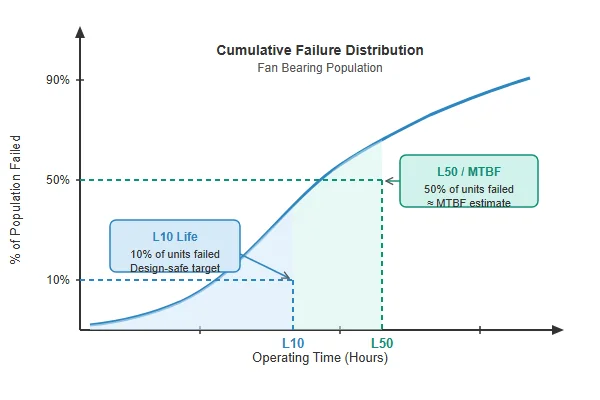
L10 life1 describes the operating hours at which 10% of a fan population has failed, while L50 describes the point at which 50% has failed -- L10 is the more conservative, more commonly used figure in engineering specifications, and treating an L50 number as if it were L10 significantly overstates expected reliability.
Why L10 Is the More Useful Engineering Number
L10 life is the industry-standard conservative figure because it represents an early failure threshold rather than the median -- by the time 50% of a population has failed (L50), a meaningful portion of "good" units have already failed too, which isn't a useful design target for anything where reliability matters. Bearing manufacturers and fan suppliers who report L10 life are giving a more conservative, generally more useful number for engineering purposes than a bare MTBF figure or an L50 rating, which is why L10 is worth specifically asking for when comparing reliability claims.
Which Operating Conditions Actually Move the MTBF Number?
The datasheet MTBF assumes specific conditions, and real-world deployment rarely matches those exactly.
Operating temperature, vibration exposure, and duty cycle all meaningfully affect real-world fan reliability relative to the datasheet MTBF figure, since that figure was calculated under a specific, often moderate, set of test conditions that many real applications exceed.
The Gap Between Test Conditions and Field Conditions
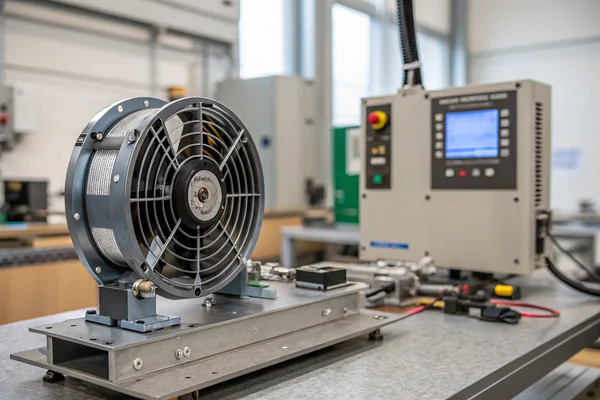
A fan's MTBF is typically calculated at a moderate ambient temperature and rated voltage -- push the fan into a genuinely hot enclosure, subject it to continuous vibration from nearby machinery, or run it at a duty cycle far more demanding than the test conditions assumed, and real-world reliability can diverge meaningfully from the datasheet number. This is exactly why a fan's MTBF rating should be treated as a starting point for a conversation with the supplier about your actual application conditions, not a number that transfers automatically to every deployment scenario.
How Should You Actually Use MTBF in a Real System Design?
MTBF has real value in system design, as long as it's used for what it's actually good at.
Use MTBF as a comparative tool for evaluating fan options under matched test conditions, and as an input into system-level redundancy and maintenance planning, rather than as a direct prediction of when a specific unit will fail in your application.
From Datasheet Number to Design Decision
For applications where fan failure has real consequences -- continuous-duty infrastructure, safety-critical systems, hard-to-access installations -- MTBF should feed into broader design decisions like whether redundancy is warranted, what a reasonable proactive replacement interval looks like, and how field-monitoring for early failure signs might reduce risk. Treating a single MTBF number as sufficient justification to skip those broader design questions is how a statistically reasonable component choice still ends up causing an unplanned outage in practice.
Why Do Two Suppliers Quote Wildly Different MTBF Numbers for a Similar Fan?
This is one of the more common points of confusion buyers run into during sourcing.
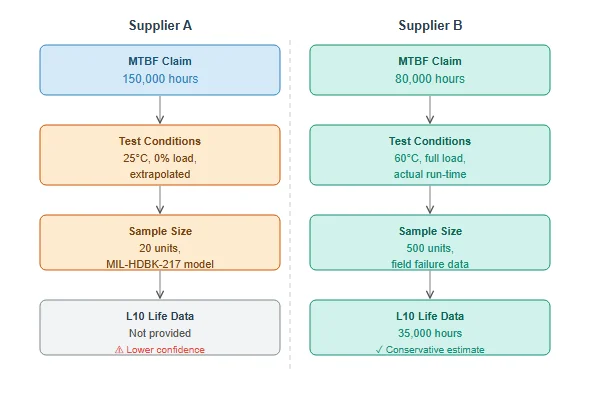
Two suppliers can quote very different MTBF numbers for similar fans because of differences in test methodology, accelerated test conditions, statistical extrapolation models, and even how conservatively each supplier chooses to round or report their results -- not necessarily because one fan is genuinely more reliable.
Getting an Apples-to-Apples Comparison
The only reliable way to compare MTBF claims across suppliers is asking each one directly how the number was calculated -- test conditions, sample size, extrapolation methodology -- and ideally requesting L10 life data specifically, since it's a more standardized and conservative figure than a bare MTBF claim. A supplier unwilling or unable to explain their methodology is giving you a number with much less practical value than one who can walk through exactly how it was derived.
Does a Higher MTBF Always Justify a Higher Price?
Not automatically, and this is worth evaluating deliberately rather than assuming.
A higher MTBF justifies a higher price only when the improved reliability actually matters for your specific application's failure cost -- for low-consequence applications, paying a premium for extended MTBF may deliver little practical value, while for high-consequence continuous-duty applications, it often pays for itself many times over.
Matching Reliability Investment to Failure Cost
The right question isn't "is a higher MTBF fan better," it's "what does a fan failure actually cost in this specific application." A consumer product with easy field replacement and low failure consequences may not justify paying a premium for extended MTBF. A continuous-duty industrial or infrastructure application where failure means real downtime, safety risk, or expensive emergency service absolutely can justify that premium, often many times over relative to the added unit cost.
We've built and validated DC fans for over 20 years, and MTBF questions from customers are almost always really questions about real-world reliability at their specific operating conditions, not the datasheet number itself. Our bearing life and MTBF figures come from our own in-house dynamic balance and life-testing equipment as part of our IATF 16949 and ISO 9001 quality process, and we can provide L10 life data alongside MTBF, along with test conditions matched as closely as possible to your actual application's temperature and duty cycle.
FAQ
Is MTBF the same thing as a fan's warranty period?
No. MTBF is a statistical reliability figure; warranty period is a business commitment that may be set well below the MTBF-implied lifespan for cost and risk management reasons.
Does a fan running at lower speed have a longer effective MTBF?
Generally yes -- lower speed typically means less bearing wear and lower operating temperature, both of which tend to improve real-world reliability relative to running at maximum rated speed continuously.
Can I calculate my own expected fan lifespan from a manufacturer's MTBF figure?
Not precisely, since MTBF is a population statistic under specific test conditions, not a formula for individual unit lifespan. It's more useful for comparative and system-design purposes than for predicting a single unit's exact failure date.
Why do some datasheets report MTBF in hours and others in years?
Both describe the same underlying statistic, just converted between units (typically assuming continuous 24/7 operation for the years conversion). Neither format changes what the number actually represents.
Should I ask for MTBF data at my actual operating temperature, or is the datasheet number sufficient?
Ask for data as close to your actual operating temperature and duty cycle as the supplier can provide -- the datasheet number, calculated at standard test conditions, may not reflect real performance in a genuinely hot or demanding application.
Is a fan with no published MTBF automatically a red flag?
Not necessarily for very low-cost consumer applications where reliability data is less standard, but for any application where fan failure has real consequences, a supplier unable or unwilling to provide reliability data is worth questioning further.
MTBF is a genuinely useful number once you understand what it's actually measuring, and genuinely misleading if treated as a guarantee. At Herays, our Dongguan facility has tested and validated fan reliability for over 20 years under ISO 9001 and IATF 16949 certification, and we provide L10 life data alongside MTBF so customers can evaluate reliability claims properly rather than taking a single number at face value. If a supplier's MTBF number matters to your design decision, ask how it was calculated before you rely on it.
L10 life is a bearing reliability rating originating from bearing engineering standards, representing the operating hours at which 10% of a population is statistically expected to have failed. It's a more conservative figure than a bare MTBF number and is widely used as a standard reliability benchmark. ↩

Liang
I've been working with DC fans for 30 years — long enough to have seen the industry evolve from basic sleeve bearing designs to today's high-efficiency, IP68-rated systems built for the harshest environments imaginable. I founded Herays because I believed manufacturers and engineers deserved a supplier who could talk technical from day one. Not just hand over a datasheet, but actually help you select the right fan for your thermal load, your enclosure, your certification requirements. Most of what I write here comes directly from problems I've solved on the factory floor or in customer applications — medical devices, laser equipment, industrial automation, you name it. If it involves moving air efficiently and reliably, I've probably spent time thinking about it. When I'm not obsessing over airflow curves, I'm usually helping a customer figure out why their cooling system isn't performing the way their simulation said it would.
View all posts by Liang