A wine cooler that keeps drifting a few degrees too warm isn't always a refrigerant problem. Often it's a condenser fan quietly losing the fight against a room that's warmer than the unit was ever tested for.
A DC axial fan matters in wine coolers and refrigeration because the condenser has to reject heat into the surrounding room, and a fan that can't move enough air across that condenser leaves the whole refrigeration cycle working harder for a worse result -- unstable temperature, higher energy use, or both.
- The fan's job in refrigeration is moving air across the condenser to reject heat into the room, not cooling the cabinet interior directly -- that's the refrigerant cycle's job.
- Condenser fans need airflow matched to the condenser coil's surface area and the system's actual heat rejection load, not a generic small-appliance fan spec.
- Home wine coolers need genuinely quiet fans, since these units often sit in kitchens, dining rooms, or living spaces where compressor and fan noise is highly noticeable.
- Refrigeration environments expose fans to real moisture and condensation risk, which makes moisture-resistant construction a practical requirement, not an upgrade.
- A struggling condenser fan often shows up first as inconsistent internal temperature, not an obvious fan failure -- which makes it an easy problem to misdiagnose.
Getting fan selection right for refrigeration and wine cooling means understanding that the fan's real job is heat rejection at the condenser, not cabinet cooling itself.
Table of Contents
What Job Do Fans Actually Do Inside a Refrigeration System?
It's easy to assume the fan cools the cabinet directly. It doesn't -- the refrigerant cycle does that job.
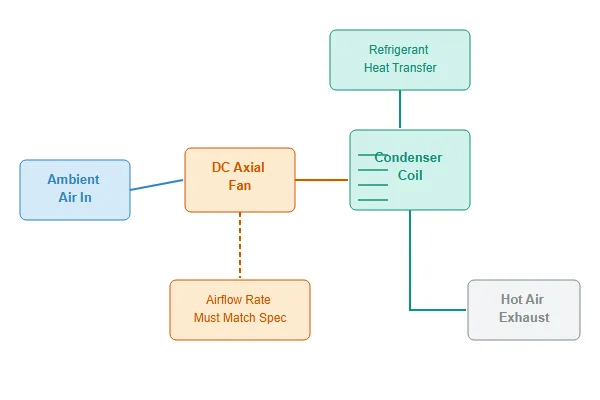
Fans in a refrigeration cycle1 move air across the condenser to reject the heat the refrigerant has absorbed from inside the cabinet, releasing it into the surrounding room -- the fan supports the refrigeration cycle rather than cooling the interior space directly.
The Refrigeration Cycle's Actual Heat Path
The refrigerant absorbs heat from inside the cabinet at the evaporator, then carries that heat to the condenser, where it needs to release it into the surrounding air before the cycle can repeat. The condenser fan's job is moving enough air across that condenser coil to actually carry the rejected heat away -- if the fan can't keep up, the condenser stays hotter than it should, which reduces the whole system's efficiency and can leave the cabinet running warmer than its setpoint despite the compressor working normally.
| System Component | Role | Fan's Relationship |
|---|---|---|
| Evaporator | Absorbs heat from cabinet interior | Sometimes has its own circulation fan |
| Compressor | Pressurizes refrigerant | No direct fan interaction |
| Condenser | Rejects absorbed heat to room air | This is the fan's primary job |
What Does a Condenser Fan Actually Need to Perform Well?
Condenser fan sizing is a heat-rejection problem, matched to the specific coil it's cooling.
A condenser fan needs airflow matched to the condenser coil's surface area and the system's actual heat rejection load, since undersized airflow leaves the condenser running hotter than designed, reducing overall system efficiency and cooling performance.
Matching Fan Airflow to Real Heat Rejection Load
The condenser coil is designed to reject a specific amount of heat given a certain airflow rate across its surface -- undersize the fan relative to that design, and the coil runs hotter than intended, which increases condensing pressure and reduces the refrigeration cycle's overall efficiency. This relationship is why condenser fan replacement should match original airflow specifications closely, rather than assuming any similarly-sized fan will perform equivalently.
How Quiet Does a Wine Cooler Fan Need to Be for a Living Space?
Wine coolers live in spaces where kitchen appliance noise is scrutinized more than most people expect.
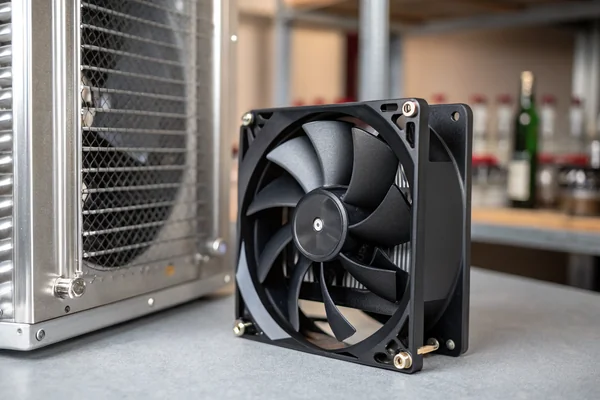
Home wine coolers typically need quiet fans, often under 35-40 dBA including compressor contribution, since these units commonly sit in kitchens, dining rooms, or living spaces where continuous appliance noise is noticeable during quiet moments at home.
Why Wine Cooler Noise Gets Noticed
Unlike a garage refrigerator or commercial cooling equipment, a home wine cooler is often positioned as a visible, integrated piece of furniture in a living or dining space, running continuously in a room where people spend relaxed time. That combination makes fan noise (alongside compressor noise) a real purchase consideration, pushing manufacturers toward quieter fan designs, vibration-dampened mounting, and speed control that avoids running the fan harder than the current cooling load actually requires.
Why Do Refrigeration Fans Need Real Moisture Resistance?
Condensation is a normal, expected part of refrigeration operation, and it's genuinely hard on standard electronics.
Refrigeration fans need real moisture resistance because condensation forms naturally around cold components and humid air cycling near the condenser and evaporator, and a fan without adequate moisture protection is exposed to corrosion and electrical risk that a typical dry-environment fan never faces.
Where the Moisture Actually Comes From
Temperature differentials inherent to refrigeration -- cold evaporator surfaces meeting warmer ambient air, condensate drainage near the cooling components -- create a genuinely humid, sometimes directly wet, operating environment for any fan positioned nearby. Standard fans without adequate ingress protection can experience bearing corrosion, winding degradation, or electrical issues in this environment far faster than in typical dry electronics cooling applications, which is why moisture-resistant construction is a practical baseline requirement for refrigeration fan applications, not an optional upgrade.
How Do You Replace a Fan in a Refrigeration Unit Without Making Things Worse?
Refrigeration fan replacement carries a couple of risks that don't apply to typical electronics fan swaps.
Replace a refrigeration fan by matching original airflow and moisture-resistance specifications closely, confirming correct mounting orientation relative to the condenser or evaporator, and testing actual cabinet temperature performance after replacement rather than just confirming the fan spins.
What's Different About Refrigeration Fan Replacement
Beyond matching electrical and mounting specifications, refrigeration fan replacement needs attention to airflow direction and moisture resistance specifically, since a fan that spins but pushes air the wrong direction relative to the coil, or one that lacks adequate moisture protection in a genuinely humid location, can create problems that aren't obvious from a quick visual check. Confirming actual cabinet temperature stability over a full cooling cycle after replacement is a more reliable verification than simply confirming the new fan runs.
Does Ambient Room Temperature Change How Hard the Condenser Fan Works?
Room temperature directly affects how much work the condenser fan has to do to reject the same amount of heat.
Higher ambient room temperature increases the condenser fan's workload, since the temperature differential between the condenser and the surrounding air -- the thing that actually drives heat rejection -- shrinks as room temperature rises, requiring more airflow to move the same amount of heat.
Why the Same Fan Performs Differently in Different Rooms
A wine cooler or refrigeration unit placed in a warm garage, an enclosed cabinet with poor ventilation, or a kitchen that runs warm in summer asks more of its condenser fan than the same unit in a cool, well-ventilated space, even though the internal cooling target hasn't changed. This is a common, often overlooked reason a unit that performed well in one location struggles after being moved or installed in an enclosed cabinet -- the fan and condenser combination that was adequate at moderate ambient temperature may not keep up once ambient conditions get more demanding.
What Happens to Food or Wine Storage When a Refrigeration Fan Fails?
The consequences of a failed condenser fan build gradually rather than announcing themselves immediately.
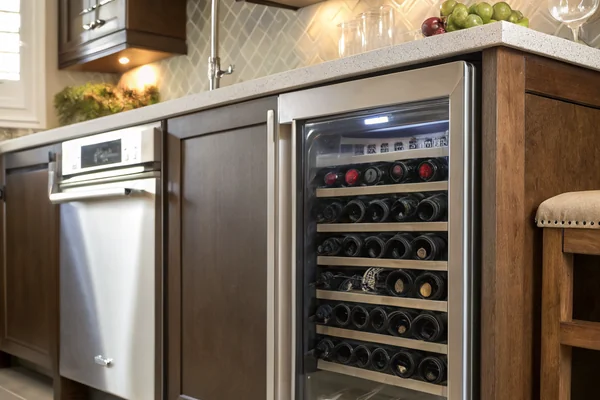
When a condenser fan fails, internal temperature typically drifts upward gradually rather than failing suddenly, since the compressor keeps running and trying to compensate -- which means the problem can go unnoticed until stored wine or food has already been exposed to unsafe or undesirable temperatures for some time.
Why Gradual Drift Is the More Dangerous Failure Mode
A completely failed compressor is obvious quickly -- the unit stops cooling and temperature rises fast. A failed condenser fan is subtler: the compressor keeps running, working harder against an overheating condenser, and internal temperature drifts upward more slowly, sometimes staying within a range that doesn't trigger an obvious alarm even though it's well outside the ideal storage range for wine or food. This gradual failure mode is exactly why unexplained temperature drift in a refrigeration unit is worth checking against condenser fan operation early, rather than assuming the compressor or refrigerant charge is automatically the cause.
We've supplied fans into refrigeration and appliance cooling programs for over 20 years, and moisture resistance is consistently the spec that gets underestimated relative to its real-world importance. Every fan we build for refrigeration customers goes through our in-house moisture and corrosion testing as part of our IATF 16949 and ISO 9001 quality process, and we can supply condenser fan options matched to specific airflow and static pressure requirements, validated for the humid, condensation-prone conditions refrigeration equipment actually operates in.
FAQ
Can I use a standard electronics cooling fan as a condenser fan replacement?
Not reliably. Standard electronics fans typically lack the moisture resistance refrigeration environments require, and may not match the airflow performance the condenser was designed around.
Why is my wine cooler's temperature inconsistent even though the compressor runs normally?
This is a common symptom of a struggling condenser fan -- the compressor works normally, but inadequate airflow across the condenser prevents efficient heat rejection, leaving the system unable to maintain stable internal temperature.
Do built-in (enclosed cabinet) wine coolers need different fan specs than freestanding units?
Often yes. Built-in units frequently have more restricted airflow paths and higher ambient temperatures around the condenser, which can require a fan with better static pressure performance than a freestanding unit in open air.
How often should refrigeration condenser fans be inspected?
Periodic visual and dust-buildup inspection is reasonable for most home units, while commercial refrigeration often follows a more formal maintenance schedule given the higher cost of an undetected failure.
Does dust on the condenser coil affect fan performance too?
Yes -- dust buildup on the coil itself increases resistance to airflow, similar to a loading air filter, which can make even a healthy fan struggle to move adequate air across a dust-restricted condenser.
Is a noisy condenser fan always a sign it's failing?
Not always, but a fan that's become noticeably louder than when new is worth checking -- it can indicate bearing wear, dust accumulation, or debris interference, any of which is worth investigating before it leads to a full failure.
Condenser fan performance is the quiet variable that determines whether a refrigeration or wine cooling system actually delivers the stable temperature it's designed for, and it fails gradually enough to go unnoticed until stored goods have already been affected. At Herays, our Dongguan facility has supplied moisture-resistant DC fans into refrigeration and appliance programs for over 20 years, validated under ISO 9001 and IATF 16949 certification. If you're specifying or replacing a condenser fan, match real airflow performance and moisture resistance, not just the mounting hole pattern.
The vapor-compression refrigeration cycle moves heat from inside a cooled space to the surrounding environment by cycling a refrigerant through evaporation (absorbing heat) and condensation (releasing heat) phases. The condenser fan's job is moving air across the condenser to carry that released heat away. ↩

Liang
I've been working with DC fans for 30 years — long enough to have seen the industry evolve from basic sleeve bearing designs to today's high-efficiency, IP68-rated systems built for the harshest environments imaginable. I founded Herays because I believed manufacturers and engineers deserved a supplier who could talk technical from day one. Not just hand over a datasheet, but actually help you select the right fan for your thermal load, your enclosure, your certification requirements. Most of what I write here comes directly from problems I've solved on the factory floor or in customer applications — medical devices, laser equipment, industrial automation, you name it. If it involves moving air efficiently and reliably, I've probably spent time thinking about it. When I'm not obsessing over airflow curves, I'm usually helping a customer figure out why their cooling system isn't performing the way their simulation said it would.
View all posts by Liang