Engineers often default to axial fans out of habit, then discover mid-project that a long, narrow airflow path was exactly the problem a tangential fan was built to solve.
Tangential (cross-flow) fans and axial fans solve different airflow problems: tangential fans deliver a wide, uniform air curtain along their entire length, while axial fans deliver concentrated, higher-pressure airflow through a round duct or opening -- the right choice depends on the shape of the space you're actually trying to move air through.
- Tangential fans move air perpendicular to their rotor's long axis, producing a wide, even airflow curtain -- a fundamentally different airflow pattern than an axial fan's concentrated round output.
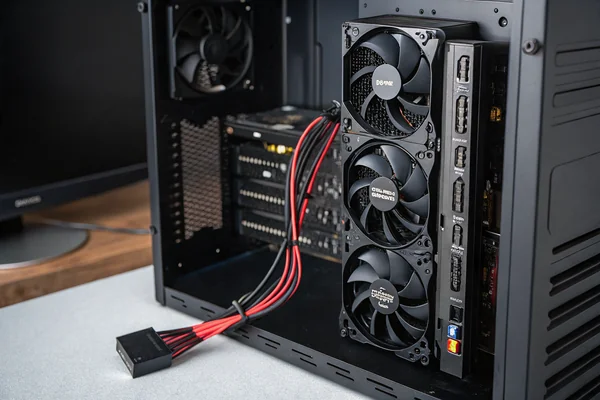
- Axial fans generally deliver higher static pressure and higher velocity through a compact round opening, which suits typical electronics cooling and ducted applications.
- Tangential fans excel wherever airflow needs to be uniform across a long, narrow opening -- air curtains, PTC heaters, and long linear heat sinks are classic examples.
- Noise characteristics differ between the two designs, and neither is universally quieter -- it depends on the specific application and how each fan is actually loaded.
- Tangential fans are typically more expensive and mechanically more complex than axial fans of comparable airflow capacity, which matters when a standard axial fan would do the job just as well.
Choosing between tangential and axial designs comes down to matching the fan's actual airflow pattern to the shape of the space and the problem you're solving.
Table of Contents
What Exactly Is a Tangential (Cross-Flow) Fan?
Tangential fans look and behave nothing like the round fans most engineers picture by default.
A tangential fan1, also called a cross-flow fan, uses a long cylindrical rotor with many small blades to draw air in and push it out perpendicular to the rotor's long axis, producing a wide, uniform sheet of airflow along the fan's entire length rather than a concentrated round output.
How the Airflow Path Actually Works
Unlike an axial fan, where air moves parallel to the rotor's spinning axis, a tangential fan's air enters and exits perpendicular to that axis -- air flows across the rotor tangentially, hence the name, rather than through it. This geometry is what allows a tangential fan to produce an even airflow curtain along its full length, which can be quite long (sometimes over a meter), something a round axial fan simply can't replicate without arranging multiple units side by side.
| Characteristic | Tangential Fan | Axial Fan |
|---|---|---|
| Airflow direction relative to rotor | Perpendicular (cross-flow) | Parallel (through the rotor) |
| Airflow pattern | Wide, uniform curtain | Concentrated, round |
| Typical length | Can be quite long (linear) | Compact, round diameter |
How Are Tangential and Axial Fans Actually Built Differently?
The mechanical differences follow directly from the different airflow goals each design is built around.
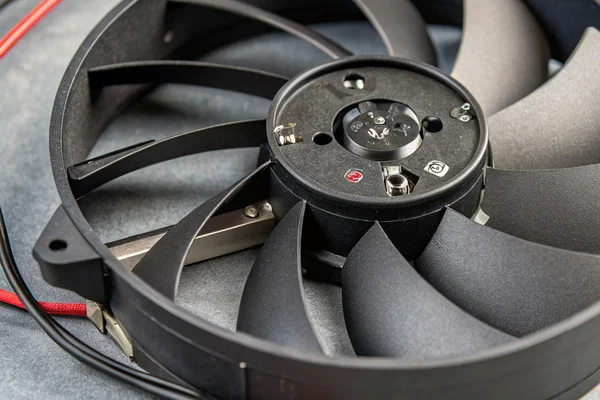
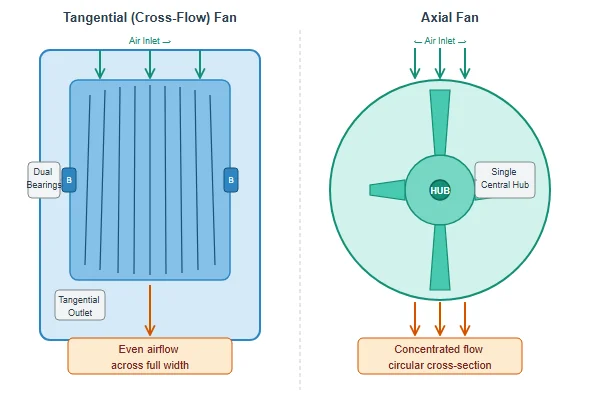
Tangential fans use a long, multi-bladed cylindrical rotor supported at both ends, while axial fans use a compact hub with a small number of curved blades spinning around a central motor -- the tangential design trades mechanical simplicity for the ability to deliver uniform airflow across a long span.
Why the Mechanical Complexity Differs
A tangential fan's rotor needs to be long, straight, and well-balanced along its full length, often supported by bearings or bushings at both ends rather than a single central hub, which adds mechanical complexity and cost relative to a compact axial fan's simple hub-and-blade design. That added complexity is the direct tradeoff for the tangential fan's ability to produce genuinely even airflow across a long opening, which a round axial fan geometrically cannot do on its own.
How Do Their Airflow Patterns Actually Compare in Practice?
The practical difference shows up most clearly when you actually need to cool or heat something long and narrow.
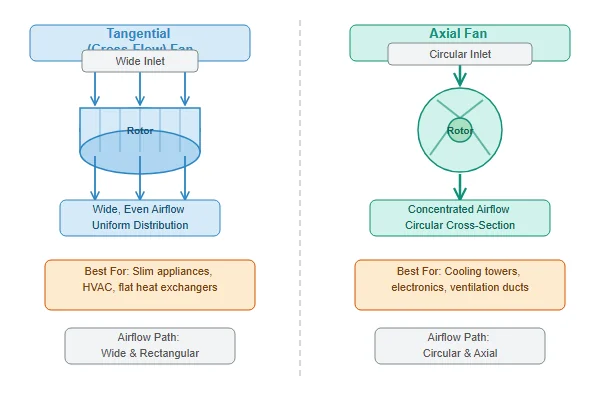
In practice, an axial fan concentrates airflow into a round column suited to ducts, vents, and compact openings, while a tangential fan spreads airflow evenly across a long linear opening -- trying to use the wrong one for the wrong shape typically means uneven coverage or wasted capacity.
What Happens When the Shape Doesn't Match
Point an axial fan at a long, narrow heating element or heat sink, and coverage is uneven -- strong airflow near the fan, weak airflow farther along the length, unless multiple fans are arranged to compensate. A tangential fan solves that specific problem directly, delivering roughly consistent airflow along its entire length. Conversely, use a tangential fan where you actually need concentrated, higher-pressure airflow through a small round opening, and it's mechanically the wrong tool -- axial (or centrifugal blower) designs are built for that job.
Where Does a Tangential Fan Genuinely Outperform an Axial Fan?
There are specific applications where the tangential geometry isn't just different -- it's genuinely the better engineering choice.
Tangential fans genuinely outperform axial fans in applications needing uniform airflow across a long, narrow opening -- air curtains, PTC ceramic heaters, long linear heat sinks, and similar equipment where even coverage along the fan's length matters more than concentrated static pressure.
Where the Long, Even Airflow Actually Matters
Air curtains at doorways need a consistent air barrier across the full width of the opening, which is exactly the uniform, linear airflow a tangential fan delivers naturally. PTC ceramic heaters and similar linear heating elements benefit from even airflow across their full heating surface rather than concentrated hot spots an axial fan's round output would create. In these applications, achieving comparable coverage with axial fans would require multiple units carefully arranged and balanced, adding cost and complexity that a single well-designed tangential fan avoids.
When Should You Just Stay With Axial?
For most electronics cooling and general-purpose airflow needs, axial remains the simpler, more cost-effective default.
Stay with an axial fan whenever the application involves a compact, round opening, a duct, or general electronics cooling -- which covers the large majority of cooling applications -- since axial fans are simpler, less expensive, and deliver better static pressure performance for that geometry than a tangential design would.
Why Axial Remains the Default for Good Reason
Most cooling applications -- electronics enclosures, PC cases, industrial equipment, appliances -- involve moving air through a round vent, duct, or compact opening, which plays directly to the axial fan's strengths in static pressure, cost, and mechanical simplicity. Reaching for a tangential fan outside its specific wheelhouse of long, linear airflow needs usually means paying more for a mechanically more complex solution that doesn't actually solve a problem the application has.
Does Noise Differ Meaningfully Between Tangential and Axial Fans?
Noise characteristics genuinely differ between the two designs, though neither wins universally.
Tangential and axial fans have different noise characteristics rooted in their different mechanical designs -- tangential fans can run quieter at a given airflow volume for wide-coverage applications, since the airflow is spread across many small blades rather than concentrated through fewer larger ones, but this advantage only applies within the specific applications tangential fans are actually suited for.
Why the Comparison Depends on the Application
Comparing noise between the two designs only makes sense within a matched application -- a tangential fan delivering even airflow across a meter-long opening versus multiple axial fans trying to achieve similar coverage often does win on noise, since the tangential design spreads the work across many blades rather than concentrating it. But that comparison doesn't transfer to compact, round-opening applications where a single well-chosen axial fan is already the efficient, appropriately-sized solution -- there, the axial fan typically wins on both noise and simplicity.
How Do the Costs Compare Between Tangential and Axial Fan Designs?
Cost differences follow directly from the mechanical complexity difference between the two designs.
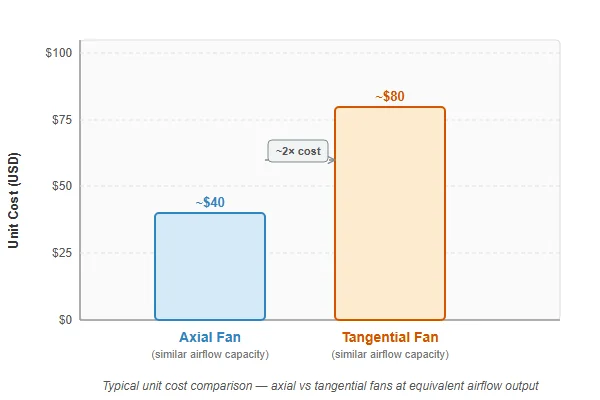
Tangential fans typically cost more than axial fans of comparable airflow capacity, reflecting their more complex rotor construction and dual-end bearing support -- which reinforces why tangential fans make the most economic sense specifically where their unique airflow pattern is actually needed, not as a general-purpose alternative to axial.
Why the Premium Is Usually Justified Only in the Right Application
The added manufacturing complexity of a long, precisely balanced tangential rotor, supported at both ends, costs more to produce than a compact axial fan's simpler hub-and-blade assembly. That cost premium is easily justified in an air curtain or linear heater application where achieving equivalent coverage with axial fans would require multiple units and added engineering complexity anyway. It's much harder to justify in a standard electronics cooling application where a single appropriately-sized axial fan already solves the problem at lower cost.
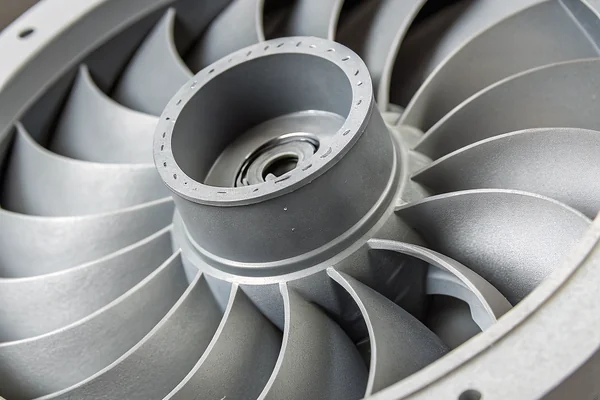
We've built DC axial fans and centrifugal vortex blowers for over 20 years, and customers occasionally come to us comparing our axial and blower options against tangential fans for a specific application. Our honest answer, backed by our in-house CFM and static pressure testing under ISO 9001 and IATF 16949 certification, is that the right choice depends entirely on your airflow geometry -- for compact round openings and typical electronics cooling, our axial and blower lines are usually the better fit, but for genuinely long, linear airflow needs, a tangential design deserves serious consideration even though it's outside our own product line.
FAQ
Can a tangential fan be used for general electronics cooling?
Technically yes, but it's rarely the practical choice -- axial or centrifugal blower fans are simpler, less expensive, and better suited to the round, compact openings typical electronics enclosures present.
Are tangential fans harder to source than axial fans?
Generally yes, since they're a more specialized product with a narrower range of applications, which can mean fewer suppliers and longer lead times compared to widely available axial fan options.
Do tangential fans require different mounting hardware than axial fans?
Yes -- tangential fans need support at both ends of their elongated rotor, which is mechanically different from the single central mounting point typical of axial fans.
Is a tangential fan more or less efficient than an axial fan?
Efficiency comparisons only make sense within a matched application. Within their intended use (long, uniform airflow needs), tangential fans can be quite efficient; outside that use case, axial fans are typically the more efficient choice.
Can multiple axial fans replace a single tangential fan for a long opening?
Sometimes, with careful arrangement, but achieving the same uniform coverage a tangential fan delivers naturally often requires more engineering effort and can leave uneven spots between fan positions.
Do tangential fans come in DC voltage options like axial fans?
Yes, DC tangential fans exist, though the range of available sizes and specifications is generally narrower than the very wide range available in DC axial fans.
Tangential and axial fans aren't competing for the same job -- they're built around fundamentally different airflow geometries, and the right choice depends entirely on the shape of the space you're actually moving air through. At Herays, our Dongguan facility has specialized in DC axial and centrifugal vortex blower fans for over 20 years, validated under ISO 9001 and IATF 16949 certification, and we're glad to talk through whether an axial or blower solution actually fits your application, or whether you genuinely need to look at tangential options instead.
A cross-flow (tangential) fan uses an elongated cylindrical rotor to move air perpendicular to its rotational axis, producing a wide, uniform airflow curtain rather than the concentrated round output typical of axial or centrifugal fan designs. ↩

Liang
I've been working with DC fans for 30 years — long enough to have seen the industry evolve from basic sleeve bearing designs to today's high-efficiency, IP68-rated systems built for the harshest environments imaginable. I founded Herays because I believed manufacturers and engineers deserved a supplier who could talk technical from day one. Not just hand over a datasheet, but actually help you select the right fan for your thermal load, your enclosure, your certification requirements. Most of what I write here comes directly from problems I've solved on the factory floor or in customer applications — medical devices, laser equipment, industrial automation, you name it. If it involves moving air efficiently and reliably, I've probably spent time thinking about it. When I'm not obsessing over airflow curves, I'm usually helping a customer figure out why their cooling system isn't performing the way their simulation said it would.
View all posts by Liang