Bolting two fans side by side doesn't automatically double your airflow, and stacking two fans front-to-back doesn't automatically double your pressure. Fan array design has real rules, and getting them wrong wastes money on fans that aren't actually helping.
Fan array design uses parallel arrangements to increase airflow and series (stacked) arrangements to increase static pressure, but neither combination scales as cleanly as simple multiplication once real system resistance and fan interaction enter the picture.
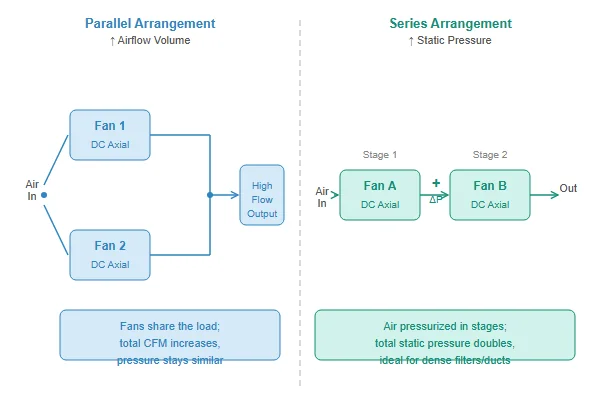
- Parallel fans increase total airflow, but the gain shrinks as system resistance rises -- two fans rarely deliver exactly double the CFM of one once real resistance is involved.
- Series (stacked) fans increase static pressure capability more than airflow, useful for pushing through genuinely restrictive paths a single fan can't handle alone.
- N+1 redundancy in a fan array means sizing for full performance even if one fan fails, which is standard practice in facility-critical cooling.
- Fans running in an array don't need to be perfectly synchronized to work correctly, but mismatched speeds between units can create turbulence that reduces overall efficiency.
- Mixing fan brands or models in the same array is possible but adds real risk if their performance curves and noise characteristics don't match well.
Designing a fan array correctly means understanding how airflow and pressure actually combine, not assuming more fans simply means proportionally more of everything.
Table of Contents
Why Use Multiple Fans Instead of One Bigger One?
Multiple smaller fans solve problems a single larger fan sometimes can't.
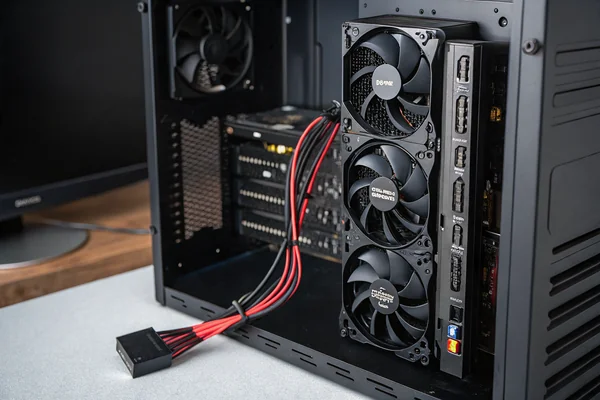
Multiple fans get used instead of one larger fan for redundancy, for covering a wide or irregularly shaped opening a single fan can't address well, or because the combined performance of several smaller fans fits a design constraint better than one large fan would.
When Multiple Fans Genuinely Make Sense
A single large fan concentrates all your cooling capacity in one point of failure, while an array of smaller fans keeps the system running (at reduced capacity) if one unit fails. Multiple fans also let you distribute airflow across a wider opening or multiple hot zones more effectively than one large fan positioned in a single location, and in height-constrained designs, several thinner fans can sometimes fit where one larger-diameter fan physically wouldn't.
| Reason for Multiple Fans | What It Actually Solves |
|---|---|
| Redundancy | System keeps running if one fan fails |
| Wide/irregular opening | Better coverage than one fan in one spot |
| Height constraints | Multiple thin fans fit where one large fan won't |
Does Running Fans in Parallel Actually Double Your Airflow?
The math is more nuanced than simple multiplication once real resistance enters the picture.
Running fans in parallel does increase total airflow, but the gain is less than exact multiplication once system resistance is factored in -- two fans in parallel typically deliver noticeably more than one fan alone, but rarely precisely double the single-fan CFM.
Why the Gain Shrinks as Resistance Rises
At zero resistance (free air), two identical fans running in parallel genuinely do add their CFM ratings together. But real systems have resistance, and as more air tries to move through the same restrictive path, that resistance increases faster than airflow, which means the combined system's actual operating point delivers less than a simple doubling would suggest. This is exactly why parallel fan performance should be evaluated against the system's actual resistance curve, not assumed as a clean multiplication of single-fan specs.
Does Running Fans in Series Actually Increase Static Pressure?
Stacking fans front-to-back is a different strategy solving a different problem than parallel arrangement.
Running fans in series (stacked front-to-back) increases the array's static pressure capability more than its airflow, which makes it the right choice for pushing air through genuinely restrictive paths -- dense filters, long ducts -- that a single fan's pressure rating can't handle alone.
Why Series Helps With Pressure, Not Volume
Each fan in a series stack adds its pressure-generating capability to the next, similar in principle to pumps in series1 increasing total head pressure, while the airflow volume through the stack is limited by the single-fan CFM rather than multiplying. This makes series arrangement useful specifically when the bottleneck is pressure -- a dense HEPA filter, a long restrictive duct -- rather than raw volume, where parallel arrangement would be the better fit instead.
How Do You Design N+1 Redundancy Into a Fan Array?
N+1 redundancy is a design philosophy, not just extra hardware bolted on.
Design N+1 redundancy by sizing the array so it delivers full required performance even with one fan removed from the count -- meaning the array actually has one more fan than the bare minimum needed, and the control system or airflow path is designed to tolerate a single fan's absence gracefully.
Why N+1 Requires More Than Just an Extra Fan
True N+1 redundancy means the remaining fans, after one failure, can still deliver the airflow the application actually needs -- which requires sizing the whole array with that failure scenario in mind from the start, not simply adding one more fan on top of a design that was only sized for normal operation. This is standard practice in facility-critical applications like UPS and data center cooling, where a fan failure during peak demand is exactly the scenario the redundancy exists to protect against.
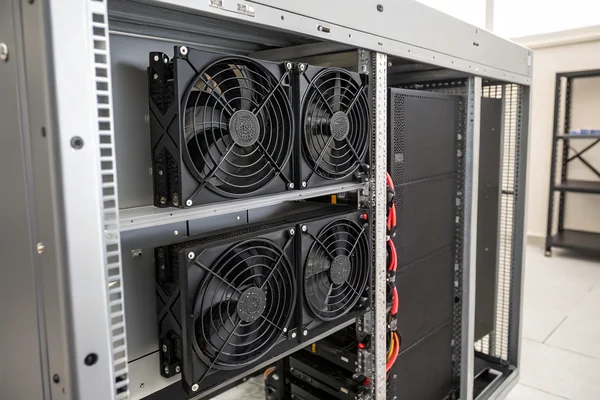
Do Multiple Fans Need to Be Synchronized, and Does It Affect Noise?
Fans in an array don't need to spin in lockstep, but mismatched behavior does have real consequences.
Fans running in an array don't need to be precisely synchronized to function correctly, but significant speed mismatches between units can create turbulence that reduces combined efficiency and adds noise beyond what matched-speed operation would produce.
Why Matched Speed Still Matters Even Without True Synchronization
Independent fans in a parallel or series array don't need their blades to be in phase with each other, but if one fan runs meaningfully faster or slower than its neighbors -- due to different PWM signals, aging, or a partial fault -- the resulting turbulence between mismatched airflows can reduce the array's overall efficiency and add audible noise beyond what evenly matched fans would produce. Using fans from the same specification, on the same control signal, keeps this risk low without requiring true synchronization.
Can You Mix Fan Brands or Models in the Same Array?
Mixing is technically possible, but it introduces real risk that's worth weighing against the reasons for doing it.
Mixing fan brands or models in the same array is possible, but it adds real risk if their performance curves, noise characteristics, or control signals don't match well -- generally worth avoiding unless there's a specific supply chain reason that outweighs the added engineering uncertainty.
Why Matched Fans Are Usually the Safer Choice
Two fans with different P-Q curves running in the same parallel array can end up fighting each other slightly at certain resistance points, since each fan wants to operate at a different point on its own curve. Different noise characteristics between mixed units can also create an uneven, harder-to-predict acoustic result. Unless there's a specific reason -- supply chain flexibility, a legacy replacement scenario -- using matched fans from the same specification is the lower-risk default for array design.
What Happens to Airflow When One Fan in an Array Fails?
The consequence of a single fan failure depends entirely on whether the array was actually designed with that scenario in mind.
When one fan fails in an array without redundancy built in, total airflow drops roughly proportional to the lost fan's contribution, which can push the system below its required cooling threshold; in a properly designed N+1 array, the remaining fans still deliver adequate performance.
Why This Is a Design Decision, Not an Afterthought
An array sized only for normal operation with no redundancy margin will genuinely underperform once a fan fails, potentially triggering thermal issues in whatever the array cools. An array designed with N+1 redundancy from the start absorbs that same failure without falling below the required performance threshold, which is exactly the difference redundant design is meant to deliver. Whether a single fan failure is a minor event or a real problem comes down entirely to decisions made at the design stage, not something that can be fixed after the fact without rework.
We've supplied fans into multi-fan array designs for over 20 years, and the arrays that perform best in the field are the ones where redundancy was designed in from the start rather than added as an afterthought. Every fan we build is characterized on our in-house CFM and static pressure rigs as part of our ISO 9001 and IATF 16949 quality process, and we can supply matched-curve fan sets specifically for array applications where consistent performance across units genuinely matters.
FAQ
How many fans can realistically be arranged in parallel before gains stop being worthwhile?
This depends on the system's resistance curve, but diminishing returns set in as more fans are added, since each additional fan faces the same rising resistance as airflow increases. Beyond a certain point, a larger single fan or a different airflow strategy often makes more sense.
Is series or parallel arrangement better for a dusty filtered application?
Series arrangement is usually better suited to filtered applications, since the filter adds significant static pressure resistance that series stacking is specifically designed to overcome.
Do all fans in a redundant array need to run simultaneously, or can some stay on standby?
Both approaches exist -- some designs run all fans continuously at reduced speed for even wear, while others keep redundant fans on standby, activating them only if a primary fan fails.
Does adding more fans to an array always increase noise proportionally?
Not exactly proportionally, since each additional fan can often run at a lower speed to achieve the same total airflow, which partially offsets the noise from having more units running.
Can a fan array be controlled to speed up automatically if one unit fails?
Yes, in properly designed systems with speed control and fan status monitoring, the remaining fans can ramp up to help compensate for a lost unit, though this doesn't fully replace the redundancy of true N+1 sizing.
Is it worth paying more for fans specifically matched for array use?
For applications where consistent, predictable array performance matters -- facility-critical cooling, precision environments -- yes. For lower-consequence applications, standard fans from a consistent specification are usually adequate.
Fan array design rewards understanding how airflow and pressure actually combine across multiple units, rather than assuming simple multiplication -- and redundancy only works if it's designed in deliberately, not bolted on after the fact. At Herays, our Dongguan facility has supplied matched fan sets into array and redundant cooling designs for over 20 years, characterized under ISO 9001 and IATF 16949 certification. If you're designing a multi-fan system, we're glad to help match performance curves across units before you commit to a layout.
Series and parallel arrangement principles apply to fans the same way they apply to pumps: series arrangement adds pressure capability, while parallel arrangement adds flow volume. Neither combination scales as a simple multiple once real system resistance is factored in. ↩

Liang
I've been working with DC fans for 30 years — long enough to have seen the industry evolve from basic sleeve bearing designs to today's high-efficiency, IP68-rated systems built for the harshest environments imaginable. I founded Herays because I believed manufacturers and engineers deserved a supplier who could talk technical from day one. Not just hand over a datasheet, but actually help you select the right fan for your thermal load, your enclosure, your certification requirements. Most of what I write here comes directly from problems I've solved on the factory floor or in customer applications — medical devices, laser equipment, industrial automation, you name it. If it involves moving air efficiently and reliably, I've probably spent time thinking about it. When I'm not obsessing over airflow curves, I'm usually helping a customer figure out why their cooling system isn't performing the way their simulation said it would.
View all posts by Liang