Brushed DC fan motors still exist, still cost less, and still fail faster in almost every way that matters for a modern electronics application. Understanding why brushless won isn't complicated, but it explains a lot of what's actually inside a fan you're buying.
Brushless (BLDC) DC fan motors last longer, run more efficiently, and generate less electrical noise than brushed motors, which is why brushless has become the default for nearly all modern DC fans -- brushed motors persist mainly in the lowest-cost, shortest-lifespan applications.
- Brushed DC motors use physical contacts that wear down through friction, creating a hard mechanical limit on service life that brushless motors don't share.
- Brushless motors use electronic commutation instead of physical brushes, eliminating the main wear mechanism and enabling significantly longer service life.
- Brushless motors are generally more efficient than brushed motors at the same power level, converting more input power into actual airflow rather than friction losses.
- The brushless cost premium over brushed is usually recovered many times over across a fan's service life, especially in continuous-duty or hard-to-access applications.
- A small number of ultra-low-cost, short-lifespan consumer applications still use brushed motors, but the vast majority of modern DC fans -- including nearly everything Herays builds -- are brushless.
Understanding the difference between brushed and brushless fan motors explains most of what actually determines a fan's real-world reliability.
Table of Contents
How Does a DC Fan Motor Actually Spin the Blades?
Both motor types accomplish the same basic job through fundamentally different mechanisms.
A DC fan motor spins the blades by using electromagnetic force to rotate a shaft, but brushed and brushless designs achieve that rotation through fundamentally different mechanisms -- physical contact switching versus electronic switching -- which is the root of nearly every practical difference between them.
The Core Mechanical Difference
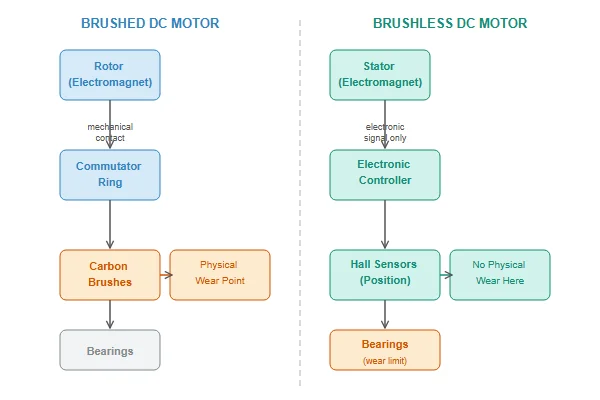
A brushed motor uses physical carbon or metal brushes making direct contact with a rotating commutator to switch current direction through the windings as the shaft turns. A brushless motor1 replaces that physical contact entirely with an electronic driver circuit that switches current through the windings based on rotor position, sensed electronically rather than through physical contact. That single difference -- physical contact versus electronic switching -- cascades into nearly every practical advantage brushless motors have.
What Are the Real Pros and Cons of a Brushed DC Motor?
Brushed motors aren't without genuine advantages, even though they've become uncommon in modern fans.
Brushed DC motors are simpler and less expensive to manufacture, but the physical brush-commutator contact wears down through friction over time, creating a hard mechanical limit on service life that makes them a poor fit for most continuous-duty or long-life applications.
Where Brushed Still Makes a Kind of Sense
The genuine advantage of a brushed motor is low manufacturing cost and mechanical simplicity -- no driver IC, no electronic commutation circuit required. The real disadvantage is that brush wear is a fundamental, unavoidable mechanical limit: every rotation involves physical friction and electrical arcing at the brush-commutator contact, which degrades over time regardless of how well the motor is otherwise built. That wear mechanism alone rules brushed motors out for most applications where multi-year service life matters.
| Factor | Brushed Motor | Brushless (BLDC) Motor |
|---|---|---|
| Wear mechanism | Physical brush contact wears down | No physical contact to wear |
| Typical lifespan | Shorter, hard mechanical limit | Significantly longer |
| Efficiency | Lower (friction and arcing losses) | Higher |
| Manufacturing cost | Lower | Higher |
| Electrical noise (EMI) | Brush arcing adds noise | Generally cleaner, though switching still generates some |
What Makes a Brushless (BLDC) Motor Genuinely Better?
The advantages of brushless motors follow directly from removing physical contact from the equation.
A brushless motor is genuinely better because eliminating physical brush contact removes the primary wear mechanism limiting brushed motor life, while also improving efficiency and reducing the electrical noise associated with brush arcing.
Why Removing One Component Changes Everything
Without brushes wearing down through friction, a brushless motor's service life becomes limited primarily by bearing wear rather than motor wear -- a fundamentally longer-lived failure mode. Electronic commutation is also generally more efficient than the mechanical switching in a brushed motor, since there's no friction loss at a brush contact and the driver circuit can optimize switching timing more precisely than a physical commutator geometry allows. The absence of brush arcing additionally reduces one significant source of electrical noise, though the switching electronics themselves still generate some EMI.
Why Did the Industry Basically Abandon Brushed Fan Motors?
The shift away from brushed motors reflects a fairly clear cost-benefit calculation playing out across the industry.
The industry moved away from brushed fan motors because the total cost of ownership advantage of brushless -- longer life, better efficiency, cleaner electrical performance -- outweighed the higher upfront manufacturing cost for nearly every application except the very lowest-cost, shortest-lifespan consumer products.
The Economics Behind the Shift
As driver IC costs declined over the past couple of decades, the manufacturing cost premium for brushless motors shrank considerably, while the reliability and efficiency gap between the two technologies remained substantial. For applications where fan failure has real consequences -- warranty costs, field service, customer experience -- brushless became the economically rational default even at a modest cost premium, which is why nearly all fans in electronics cooling, PC cooling, and industrial applications today are brushless.
Is the Brushless Cost Premium Actually Worth It Over the Fan's Lifespan?
The cost comparison looks very different depending on whether you're pricing the unit or pricing the total ownership cost.
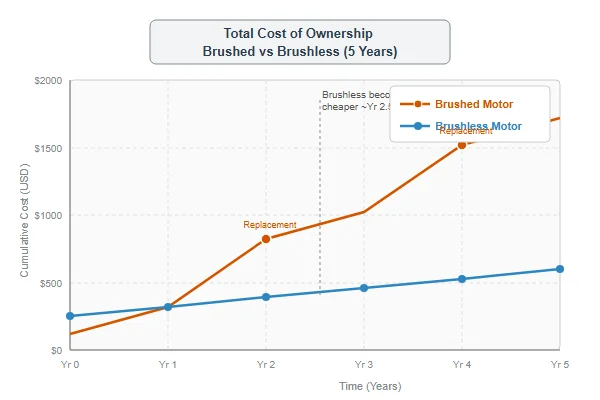
The brushless cost premium is almost always worth it over a fan's actual service life, since the extended lifespan and reduced failure rate typically save far more in replacement costs, field service, and downtime than the modest upfront price difference between brushed and brushless options.
Running the Real Numbers
A brushed fan might cost noticeably less per unit, but if it needs replacement two or three times over the same period a brushless fan would last once, the brushed option's true cost -- including labor for replacement, potential downtime, and shipping -- usually exceeds the brushless fan's higher upfront price by a wide margin. This calculation gets more lopsided the more expensive or difficult fan replacement is in a given application, which is exactly why brushed motors have mostly retreated to applications where fan replacement is trivial and cheap.
Are There Any Applications Where Brushed Still Makes Sense?
A narrow set of use cases still genuinely favors brushed motors, mostly for cost reasons alone.
Brushed motors still make sense in ultra-low-cost, short-lifespan consumer applications where the product itself has a limited expected life and fan replacement cost isn't a meaningful concern -- a narrowing category as brushless costs continue to decline.
Where the Cost Calculation Still Favors Brushed
Disposable or extremely price-sensitive consumer products, where the entire device has a short expected lifespan and low unit cost is the dominant purchasing factor, are about the only remaining category where a brushed motor's lower manufacturing cost outweighs brushless advantages. Even in these cases, the gap continues to narrow as brushless driver IC costs decline, making brushed an increasingly uncommon choice even at the low end of the market.
Does Motor Type Affect Fan Noise and EMI Differently?
Motor type genuinely changes the character of both acoustic and electrical noise a fan produces.
Brushed motors add mechanical and electrical noise from brush-commutator arcing on top of normal motor and airflow noise, while brushless motors are generally quieter mechanically but still generate electromagnetic interference from their electronic commutation switching, just through a different mechanism.
Two Different Noise Profiles
Brush arcing in a brushed motor creates both a mechanical/acoustic component (brush friction) and an electrical noise component (arcing-related EMI) that brushless motors simply don't have. Brushless motors trade that away for a different EMI source -- the driver IC's high-frequency switching -- which is generally more predictable and easier to filter than brush arcing noise, but still requires real EMI design consideration rather than being noise-free.
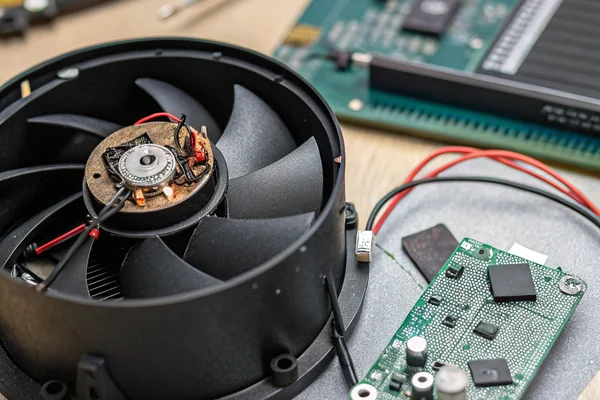
We've built brushless DC fan motors as our standard for over 20 years, and it's not a marketing choice -- it's a direct reflection of what our customers' applications actually need in terms of service life and reliability. Every brushless motor we build is validated for bearing life and electrical performance on our in-house dynamic balance and EMC testing equipment as part of our ISO 9001 and IATF 16949 quality process, and we can walk through the specific reliability data behind any fan we supply.
FAQ
Can I tell if a fan has a brushed or brushless motor just by looking at it?
Not usually from the outside. The distinction is internal to the motor design, though the datasheet or product specification should state it explicitly.
Do brushless motors require more complex wiring than brushed motors?
The fan itself typically has the same external wiring (2, 3, or 4 wires depending on features), since the driver electronics are integrated inside the fan -- the added complexity is internal, not something the end user has to wire differently.
Is a brushless motor always quieter than a brushed motor?
Generally yes, mechanically, since there's no brush friction or arcing, though overall noise also depends on bearing type, blade design, and speed -- motor type is one factor among several.
Does brushless motor technology apply to fan sizes across the whole range, from tiny to large?
Yes, brushless motors are used across the full range of DC fan sizes, from small embedded fans to large industrial units, though driver IC selection differs by size and power requirements.
Can a brushed fan be retrofitted with a brushless replacement?
Often yes, if the replacement matches physical mounting, voltage, and connector specifications, and this is a common upgrade path when reliability issues trace back to an older brushed-motor design.
Why do brushless motors still fail eventually if they don't have brush wear?
Bearing wear, driver IC degradation, or winding insulation breakdown over very long service life are the typical eventual failure modes for brushless motors, distinct from the brush wear mechanism that limits brushed motors.
The shift from brushed to brushless motors is one of the clearest examples of a technology upgrade paying for itself over a product's real service life, and it's why brushless has become the default across nearly every serious DC fan application. At Herays, our Dongguan facility has built brushless DC fan motors as our standard for over 20 years, validated under ISO 9001 and IATF 16949 certification. If you're evaluating motor technology for a new design, we're glad to share the reliability data behind the choice.
A brushless DC motor uses an electronic controller to switch current through the stator windings based on rotor position, eliminating the physical brush-commutator contact that brushed motors rely on and removing that contact's wear mechanism entirely. ↩

Liang
I've been working with DC fans for 30 years — long enough to have seen the industry evolve from basic sleeve bearing designs to today's high-efficiency, IP68-rated systems built for the harshest environments imaginable. I founded Herays because I believed manufacturers and engineers deserved a supplier who could talk technical from day one. Not just hand over a datasheet, but actually help you select the right fan for your thermal load, your enclosure, your certification requirements. Most of what I write here comes directly from problems I've solved on the factory floor or in customer applications — medical devices, laser equipment, industrial automation, you name it. If it involves moving air efficiently and reliably, I've probably spent time thinking about it. When I'm not obsessing over airflow curves, I'm usually helping a customer figure out why their cooling system isn't performing the way their simulation said it would.
View all posts by Liang