

Rework and SMD stations live or die on airflow that stays exactly where you aim it, at exactly the temperature the process calls for -- and that's a control problem, not a raw-power problem.
Hot air rework stations use DC blowers rather than axial fans because the heated air has to pass through a restrictive heating element and nozzle path, requiring higher static pressure than an axial fan can deliver, while still allowing precise, stable flow rate control critical to reflow and desoldering accuracy.
- Rework stations push air through a heating element and a narrow nozzle, both of which add resistance that favors a centrifugal blower's pressure characteristics over an axial fan's.
- Flow rate stability directly affects reflow temperature accuracy at the board -- inconsistent airflow translates into inconsistent heat delivery, risking cold joints or component damage.
- Blower and pump are sometimes used interchangeably in casual conversation, but they're mechanically different devices with different tradeoffs for this application.
- Temperature control integration matters as much as airflow -- most rework stations pair the blower with closed-loop temperature feedback rather than running open-loop.
- SMD rework blowers typically run a narrower, more specialized spec range than general-purpose blowers, since the application tolerates less variance in flow and heat delivery.
Understanding the specific demands of hot air delivery in rework equipment clarifies why blower selection here is more exacting than in many other blower applications.
Table of Contents
What Are the Actual Thermal Requirements of a Rework Station?
Rework stations need to deliver heat precisely enough to reflow solder without damaging nearby components or the board itself.
A hot air rework station typically needs to deliver controllable output temperatures from roughly 100°C up to 450°C or higher depending on the solder alloy and component type, with the blower providing the airflow that carries that heat to the target area at a flow rate precise enough to avoid overheating adjacent components.
Why Precision Matters More Here Than in General Heating Applications
Reflow and desoldering work on densely populated boards where components sit close together, meaning the airflow has to deliver enough heat to the target joint without excessive heat spreading to nearby components that weren't meant to be reflowed. This is fundamentally different from general industrial drying or heating, where some heat spread is tolerable or even desirable -- rework airflow needs the blower and nozzle system working together to keep the heated air reasonably focused, which puts real demands on both flow consistency and the mechanical design directing that flow.
Is a Blower Actually Different From a Pump for Hot Air Delivery?
The terms get used loosely in casual conversation, but the underlying mechanisms are genuinely different devices.
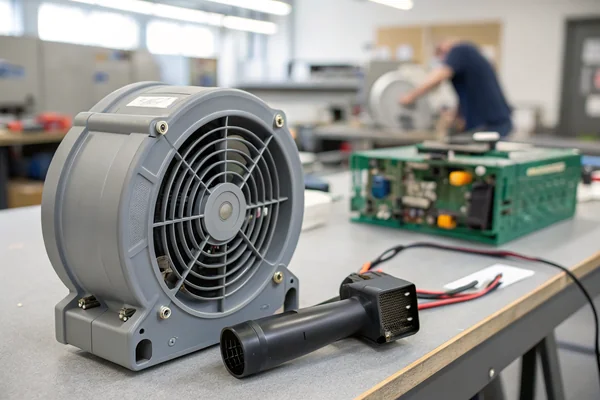
A blower moves air using a rotating impeller that draws air in and accelerates it outward, generating moderate pressure suited to overcoming the resistance of a heating element and nozzle -- a pump, by contrast, typically refers to a device moving liquid or gas through a sealed system at higher pressure, and isn't the correct mechanism for open-path hot air delivery in rework equipment.
Why This Distinction Actually Matters for Sourcing
Rework equipment manufacturers and component suppliers sometimes use "pump" loosely to describe the airflow source, which can cause confusion when sourcing a replacement part -- the actual component in nearly all hot air rework stations is a centrifugal DC blower, not a pump in the stricter mechanical sense. Specifying a replacement part correctly means confirming the actual blower specifications -- pressure, flow, and physical mounting dimensions -- rather than relying on whatever term the original equipment documentation happens to use.
How Do Flow Rate and Pressure Actually Balance in This Application?
Getting this balance wrong shows up directly as inconsistent reflow results on the bench.
A rework station blower needs enough static pressure to push air through the heating element's resistance and the nozzle's restriction, paired with a flow rate that's high enough to carry adequate heat energy to the target but low enough to avoid blowing small SMD components off the board during rework -- both extremes cause real problems.
Why Too Much Airflow Is Its Own Failure Mode
While insufficient airflow is an obvious problem -- inadequate heat delivery, slow or incomplete reflow -- excessive flow at the nozzle can physically displace small passive components before the solder even reflows, a well-known frustration in fine-pitch SMD rework. This is why rework station blowers are typically paired with adjustable flow control at the operator level, not just a fixed-speed design, giving the technician the ability to match airflow to the specific component size and board density being worked on.
Why Does Temperature Control Integration Matter So Much for Blower Selection?
The blower doesn't operate in isolation -- it's one half of a closed-loop system with the heating element.
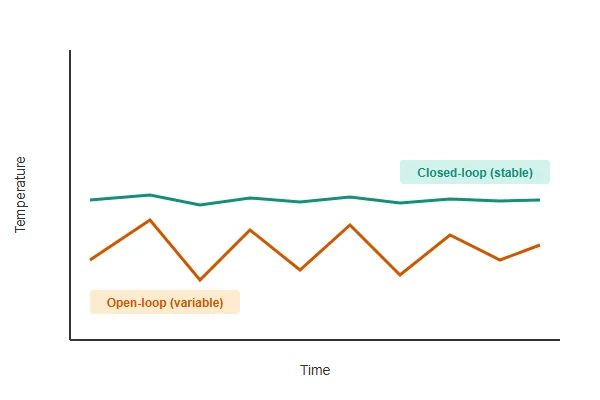
Most rework stations pair the blower with closed-loop temperature feedback, where a sensor near the nozzle or heating element continuously informs adjustments to either heater power or blower speed to hold a target temperature -- this means the blower needs stable, repeatable speed response to control signals, not just raw airflow capability.
Why Open-Loop Blower Control Falls Short for Precision Rework
An open-loop system -- fixed blower speed with only heater power adjusted -- struggles to compensate for airflow variance caused by ambient temperature changes, nozzle wear, or voltage fluctuation, all of which affect actual delivered temperature even when the heater itself is performing consistently. Closed-loop designs that can also modulate blower speed in response to a temperature sensor provide meaningfully tighter control, which is why blower response characteristics -- how predictably and quickly it responds to a control signal -- matter as much as its peak pressure and flow specs for this application.
What Blower Specs Should You Actually Look for in an SMD Rework Application?
Generic blower specs don't map cleanly onto this application without translation into rework-specific terms.
For SMD rework specifically, prioritize a blower with a narrow, well-documented pressure-flow operating range matched to your station's nozzle sizes, PWM or voltage speed control for fine adjustment, and confirmed compatibility with the heating element's thermal environment -- since the blower often sits close to significant heat, not just moving cool ambient air.
Why Thermal Proximity to the Heating Element Is a Real Design Constraint
Unlike most blower applications where the blower itself stays relatively cool, rework station blowers often operate in close physical proximity to a heating element reaching several hundred degrees, meaning the blower's own motor and bearing components need adequate thermal isolation or a rated operating temperature that accounts for this proximity. A blower spec'd only for standard ambient-temperature electronics cooling may not hold up reliably in this specific thermal environment, which is a detail worth confirming directly with a supplier rather than assuming from a general catalog spec.
We manufacture DC high-speed vortex blower fans engineered for precise, stable flow control in demanding thermal environments, validated on our in-house CFM airflow test system and temperature cycling equipment at our Dongguan facility. We work directly with rework and hot air equipment manufacturers on matching blower response characteristics to specific heating element and nozzle configurations, backed by over 20 years of production experience under ISO 9001 and IATF 16949 certification.
How Should You Approach Sourcing a Replacement Blower for Rework Equipment?
Replacing a failed blower in existing equipment has its own specific sourcing considerations beyond a new design.
When sourcing a replacement blower for an existing rework station, match the original unit's physical mounting dimensions, electrical specifications, and pressure-flow operating point as closely as possible -- a blower that's close on paper but meaningfully different in its actual P-Q curve can produce noticeably different rework results even if it physically fits.
Why "Close Enough" Specs Can Still Produce Different Results
Two blowers with similar peak CFM and pressure ratings can still behave differently at the specific operating point your rework station actually uses, since the shape of the full P-Q curve -- not just the headline numbers -- determines real performance. A supplier who can review the original blower's full specification and confirm a genuine match, rather than just comparing peak numbers, reduces the risk of a replacement that fits physically but performs noticeably differently in practice.
FAQ
Can a standard cooling fan be substituted for a blower in a rework station?
No -- standard axial cooling fans don't generate enough static pressure to push air through the heating element and nozzle's resistance effectively, which would result in inadequate airflow reaching the target area.
How do I know if my rework station's airflow issues are a blower problem or a nozzle problem?
A clogged or damaged nozzle typically produces uneven or reduced airflow at the tip even with the blower running normally, while a failing blower usually shows reduced airflow across all nozzle configurations. Testing with a known-good nozzle can help isolate which component is at fault.
What's a reasonable expected lifespan for a rework station blower?
This depends heavily on duty cycle and thermal exposure, but bearing type matters significantly here given the thermal proximity to the heating element -- ask suppliers for MTBF figures specifically measured under representative thermal conditions, not just standard ambient testing.
Is variable-speed control standard on most modern rework stations?
Most mid-range and higher rework stations include adjustable airflow, typically through PWM blower speed control, though very basic units may only offer fixed or limited-step speed settings.
Does blower noise matter in a rework/production environment?
It can, particularly in shared workshop spaces with multiple stations running simultaneously, though noise is typically a secondary consideration behind flow precision and thermal stability for this application.
Can the same blower serve both hot air rework and general SMD hot air work?
Often yes, if the pressure-flow specs and thermal rating match the intended nozzle and heating element configuration -- but always verify against the specific station's original specification rather than assuming general compatibility.
Blower selection for hot air rework equipment comes down to precision under thermal stress, not just raw airflow output. At Herays, our Dongguan facility has engineered DC brushless blowers validated for demanding thermal and flow-control applications for over 20 years under ISO 9001 and IATF 16949 certification. If you're specifying or replacing a blower for rework or SMD hot air equipment, we're glad to work through the pressure and flow operating point with you directly.

Liang
I've been working with DC fans for 30 years — long enough to have seen the industry evolve from basic sleeve bearing designs to today's high-efficiency, IP68-rated systems built for the harshest environments imaginable. I founded Herays because I believed manufacturers and engineers deserved a supplier who could talk technical from day one. Not just hand over a datasheet, but actually help you select the right fan for your thermal load, your enclosure, your certification requirements. Most of what I write here comes directly from problems I've solved on the factory floor or in customer applications — medical devices, laser equipment, industrial automation, you name it. If it involves moving air efficiently and reliably, I've probably spent time thinking about it. When I'm not obsessing over airflow curves, I'm usually helping a customer figure out why their cooling system isn't performing the way their simulation said it would.
View all posts by Liang

