

Specifying the wrong fan type doesn't just mean a spec mismatch -- it can mean redesigning your power supply, control circuit, or entire enclosure around a fan that never should have been the default choice.
DC fans offer precise speed control, lower power consumption at partial load, and easier integration with low-voltage electronics, while AC fans offer simpler direct-line-voltage operation and are often more cost-effective at higher power ratings -- the right choice depends on your available power source and whether variable speed control actually matters for your application.
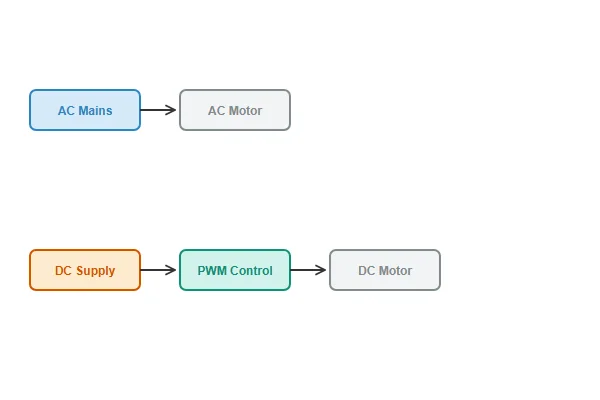
- DC fans run on low-voltage DC power (commonly 5V-48V) and integrate naturally with electronics already running on DC rails, while AC fans connect directly to mains voltage.
- Speed control is the clearest DC advantage -- PWM or voltage-based control is straightforward with DC motors, while AC fan speed control requires additional circuitry and is generally less precise.
- Energy efficiency favors DC fans at partial load, since they can reduce speed (and power draw) proportionally, while many AC fans run at a fixed speed regardless of actual cooling need.
- AC fans remain common in industrial and legacy equipment already wired for mains power, where adding a DC power supply just for the fan adds unnecessary cost and complexity.
- Cost and availability can favor either type depending on power rating and volume -- there's no universal cost winner across the full range of applications.
Understanding what actually differs between these two fan types -- beyond the label -- clarifies which one genuinely fits your specific power and control requirements.
Table of Contents
What's the Fundamental Power Source Difference Between AC and DC Fans?
This distinction determines nearly everything else about how each fan type integrates into a system.
AC fans connect directly to alternating current mains power (commonly 100-240V depending on region), while DC fans run on low-voltage direct current, typically supplied by a power supply, battery, or the same DC rail powering nearby electronics -- this fundamental difference shapes the wiring, control, and integration approach for each.
Why This Difference Shapes the Entire Design Around the Fan
An AC fan can often be wired directly to mains power with minimal additional circuitry, which is attractive for standalone equipment already connected to wall power with no other low-voltage electronics nearby. A DC fan, by contrast, integrates naturally into a system that's already running DC electronics -- computers, embedded systems, battery-powered devices -- without needing a separate AC connection or the safety isolation mains voltage requires. Choosing between them often comes down to which power source is already present and convenient in your specific system.
| Factor | AC Fan | DC Fan |
|---|---|---|
| Power source | Mains voltage (100-240V) | Low voltage DC (5-48V typical) |
| Speed control | Requires added circuitry | Native PWM/voltage control |
| Typical integration | Standalone mains-powered equipment | Electronics already on DC power |
| Partial-load efficiency | Generally fixed speed | Scales with demand |
How Does Speed Control Actually Differ Between AC and DC Fans?
Speed control is often the deciding factor for applications where variable cooling response matters.
DC fans support straightforward, precise speed control through PWM signal or voltage adjustment, integrating easily with thermal management systems that need to respond to changing conditions -- AC fan speed control requires additional circuitry (like a triac-based controller) and generally offers coarser, less responsive control than native DC methods.
Why This Makes DC the Default for Variable-Speed Applications
Because DC motor speed can be controlled by varying the input signal directly at the motor driver level, implementing a responsive fan curve -- ramping speed based on real-time temperature -- is a natural fit for DC fans and the control systems already common in electronics. AC fan speed control, by contrast, typically requires phase-control or frequency-based methods that add cost and complexity, and even then often can't match the fine-grained responsiveness of native DC control. This is a major reason electronics cooling has shifted heavily toward DC fans even in some applications that historically used AC.
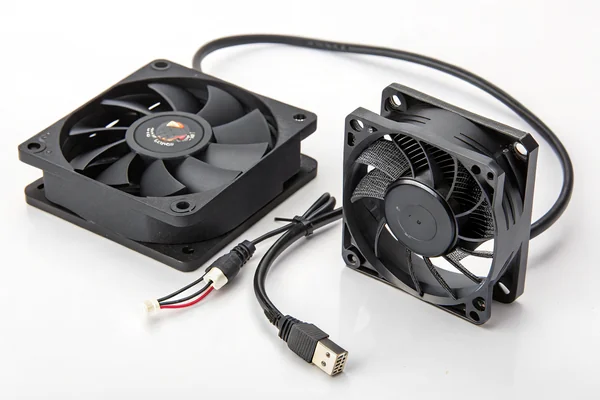
Which Fan Type Is Actually More Energy Efficient?
Efficiency comparisons need to account for actual operating conditions, not just rated power at full speed.
DC fans generally achieve better energy efficiency at partial load, since reducing speed proportionally reduces power draw, while many AC fans run at a fixed speed regardless of actual cooling demand, consuming close to their full rated power continuously -- at full speed, efficiency differences between well-designed AC and DC fans of similar output are often smaller than the partial-load difference suggests.
Why Partial-Load Behavior Matters More in Real-World Use
Most cooling applications don't require maximum airflow continuously -- actual thermal demand varies with load, ambient temperature, and time of day, meaning a fan that spends most of its operating life at partial demand benefits significantly from being able to reduce speed and power draw accordingly. A DC fan running a well-tuned speed curve captures this efficiency advantage across its actual operating life, while a fixed-speed AC fan draws close to full power whether or not that much cooling is actually needed at a given moment.
How Do Cost and Availability Actually Compare?
Cost comparisons shift depending on power rating, volume, and application context rather than favoring one type universally.
Neither AC nor DC fans have a universal cost advantage -- DC fans are often more cost-effective and widely available at the lower power ratings common in electronics cooling, while AC fans can be more economical for larger industrial applications already using mains-powered equipment throughout the facility, where a single power infrastructure serves everything.
Why the Cost Comparison Depends Heavily on Context
A facility with extensive mains-powered industrial equipment may find AC fans cheaper to integrate simply because the electrical infrastructure already supports them without adding DC power supplies throughout. Conversely, a product built around DC electronics from the ground up will find DC fans both cheaper to integrate and more readily available in the specific voltage and size ranges common to electronics cooling. Evaluating cost in the context of your actual system architecture, rather than comparing fan unit prices alone, gives a more accurate picture.
When Should You Actually Choose AC Over DC, or Vice Versa?
A practical decision framework helps translate these differences into an actual sourcing decision.
Choose DC fans when your system already runs on low-voltage DC power, when precise or responsive speed control matters, or when partial-load energy efficiency is a priority -- choose AC fans when your equipment is standalone and mains-powered with no other low-voltage electronics, when fixed-speed operation is acceptable, or when integrating with existing AC-powered industrial infrastructure is simpler than adding a DC supply.
Why This Decision Should Happen Early in System Design
Retrofitting a DC fan into a system designed entirely around AC power (or vice versa) typically requires adding power conversion circuitry that wouldn't have been necessary with the right fan type chosen from the start. Making this decision during initial system architecture, based on what power source and control requirements the application actually has, avoids the added cost and complexity of bridging between power types later in the design process.
Does Fan Type Affect Noise or Reliability Differently?
Noise and reliability differences between AC and DC fans are generally smaller than the power and control differences already discussed.
Noise and reliability for a given fan largely depend on bearing type, blade design, and build quality rather than whether the motor runs on AC or DC power -- a well-engineered fan of either type can achieve comparable acoustic and reliability performance, meaning fan type selection should be driven primarily by power and control requirements, not noise or reliability assumptions.
Why Motor Type Isn't the Primary Noise or Reliability Driver
Bearing quality, blade aerodynamics, and manufacturing consistency have a larger practical effect on a fan's noise and reliability than whether its motor runs on AC or DC current. This means comparing two specific fan models on their actual bearing type and published noise/reliability data is more useful than assuming one power type is inherently quieter or more reliable than the other -- that assumption doesn't hold up consistently across the wide range of fans available in each category.
We manufacture DC axial, case, and blower fans from our Dongguan facility, engineered for the precise speed control and partial-load efficiency that DC power enables in electronics cooling applications. Every fan is validated on our in-house CFM airflow and dynamic balance testing equipment, backed by over 20 years of production experience under ISO 9001 and IATF 16949 certification -- if your system is transitioning from AC to DC cooling, we're glad to help evaluate the specific integration requirements.
How Does Sourcing and Supplier Selection Differ Between AC and DC Fans?
Procurement conversations for each fan type tend to emphasize different priorities.
Sourcing DC fans typically involves closer attention to voltage compatibility, connector type, and speed control specifications, while sourcing AC fans focuses more on voltage/frequency compatibility with your target market's mains standard (110V/60Hz vs 220-240V/50Hz) and safety certification for direct mains connection.
Why Regional Mains Standards Complicate AC Fan Sourcing Specifically
An AC fan designed for one region's mains voltage and frequency standard generally isn't compatible with another region's standard without a different model or a voltage converter, adding a sourcing complexity that DC fans -- typically usable across regions once appropriately powered -- don't share to the same degree. This is worth confirming explicitly with a supplier if your product ships to multiple markets with different mains standards, since it can mean stocking region-specific AC fan variants rather than a single global part number.

FAQ
Can I replace an AC fan with a DC fan in existing equipment?
Only if you add appropriate DC power supply circuitry, since the equipment's existing wiring assumes mains voltage -- this is a meaningful redesign, not a drop-in replacement, and worth evaluating against the actual benefit gained.
Do DC fans require more complex control circuitry than AC fans?
For basic on/off operation, no -- DC fans can run directly off a DC supply just like AC fans run off mains. The added complexity only comes in if you want speed control, which is actually simpler to implement for DC than AC.
Are AC fans becoming obsolete in favor of DC?
Not universally -- AC fans remain common and practical in mains-powered industrial equipment and legacy systems, though DC has become the default for most new electronics cooling applications where variable speed control is valuable.
Does fan lifespan differ meaningfully between AC and DC types?
Lifespan depends primarily on bearing type and operating conditions rather than power type -- comparing specific models' bearing specifications and rated MTBF is more informative than assuming either power type inherently lasts longer.
Can AC and DC fans be mixed within the same system?
Yes, if each is appropriately powered and controlled -- some industrial systems do use both, with AC fans for general enclosure ventilation and DC fans for precision electronics cooling within the same cabinet.
Is there a size or power rating where one type becomes clearly better?
DC fans dominate at the lower power ratings typical of electronics cooling, while very high-power industrial ventilation applications more often use AC motors -- though DC options exist across a wide range, making this more of a general tendency than a strict rule.
Choosing between AC and DC fans comes down to matching power source and control requirements to your actual system architecture, not assuming one type is universally better. At Herays, our Dongguan facility has engineered DC fans for precise control and efficiency for over 20 years under ISO 9001 and IATF 16949 certification. If you're evaluating fan type for a new design or a power architecture transition, we're glad to help work through the tradeoffs.

Liang
I've been working with DC fans for 30 years — long enough to have seen the industry evolve from basic sleeve bearing designs to today's high-efficiency, IP68-rated systems built for the harshest environments imaginable. I founded Herays because I believed manufacturers and engineers deserved a supplier who could talk technical from day one. Not just hand over a datasheet, but actually help you select the right fan for your thermal load, your enclosure, your certification requirements. Most of what I write here comes directly from problems I've solved on the factory floor or in customer applications — medical devices, laser equipment, industrial automation, you name it. If it involves moving air efficiently and reliably, I've probably spent time thinking about it. When I'm not obsessing over airflow curves, I'm usually helping a customer figure out why their cooling system isn't performing the way their simulation said it would.
View all posts by Liang

