

The cheapest fan on the quote sheet is rarely the cheapest fan once energy use, replacement labor, and downtime risk get factored into the real total.
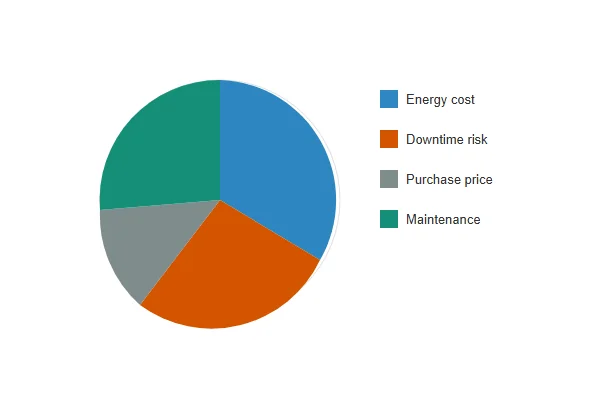
Total cost of ownership for a cooling fan includes the purchase price, energy consumption over its service life, maintenance and eventual replacement costs, and the cost of any downtime a failure causes -- a lower-priced fan with higher energy draw or shorter lifespan frequently costs more overall than a higher-priced fan optimized for efficiency and longevity.
- Purchase price is often a small fraction of a fan's total lifetime cost once energy consumption over years of operation is factored in.
- Energy consumption differences between fan models compound significantly over a typical 5-year deployment, especially for continuously-running applications.
- Maintenance and replacement costs include not just the replacement part but labor, and in some cases system downtime during the swap.
- Downtime cost from an unplanned fan failure can dwarf every other cost category, particularly in production or critical-infrastructure applications.
- A quality fan with a higher unit price but better efficiency and reliability data often produces a better return on investment than repeatedly replacing cheaper units.
Working through each cost category separately -- rather than defaulting to purchase price as the deciding factor -- reveals which fan option actually costs less across its real service life.
Table of Contents
How Does Initial Purchase Price Compare to Lifetime Cost?
Purchase price is the most visible number on a quote, but it's rarely the largest number in a full cost accounting.
Initial purchase price typically represents a small fraction of a cooling fan's total lifetime cost once energy consumption, maintenance, and potential downtime are added across a multi-year deployment -- a fan priced 20-30% higher upfront can easily cost less overall if it delivers meaningfully better efficiency or reliability over its service life.
Why Purchasing Decisions That Stop at Unit Price Miss the Bigger Picture
Procurement processes focused primarily on minimizing unit cost per fan can inadvertently select for options that cost more overall once the fan is actually deployed and running for years, simply because energy and reliability costs don't appear on the initial purchase order. Building a total cost comparison that extends across the fan's realistic service life, not just the purchase transaction, is what actually identifies the lower-cost option in practice.
How Much Does Energy Consumption Actually Add Up Over 5 Years?
Energy costs compound in ways that aren't always intuitive from a single fan's modest individual power draw.
A fan's power consumption, multiplied by continuous or near-continuous operating hours over a 5-year deployment, can represent a meaningful cost that scales further when multiplied across a fleet of units in volume deployments -- even a few extra watts per fan adds up significantly across thousands of operating hours and multiple units.
Why Small Per-Unit Differences Become Large Fleet-Level Costs
A difference of even 1-2 watts between two fan options seems negligible for a single unit, but multiplied across continuous operation for 5 years (over 40,000 hours) and then across a deployment of hundreds or thousands of units, that seemingly small difference compounds into a real, calculable energy cost difference. This is exactly the kind of cost that doesn't show up when comparing unit purchase prices side by side but becomes very visible in a full fleet-level total cost analysis.
| Cost Category | Single Fan (5 yr) | 1,000-Unit Fleet (5 yr) |
|---|---|---|
| Purchase price difference ($2/unit) | $2 | $2,000 |
| Energy difference (2W, $0.12/kWh, continuous) | ~$10.50 | ~$10,500 |
| One replacement due to failure ($15 part + labor) | Varies | Scales with failure rate |

What Maintenance and Replacement Costs Should Actually Be Factored In?
Replacement costs extend beyond the part price itself in ways worth accounting for explicitly.
Maintenance and replacement costs include the replacement fan's purchase price, labor time to access and swap the unit (which varies significantly by how accessible the fan is within the equipment), and in some cases system downtime during the replacement -- a fan mounted in an easily accessible position costs less to replace than one requiring significant disassembly to reach.
Why Accessibility Affects Total Replacement Cost as Much as Part Price
A $10 fan requiring 30 minutes of technician labor and equipment downtime to access and replace can cost meaningfully more in total than a $20 fan mounted in an easily accessible position requiring only a few minutes to swap. This is worth considering not just for the fan's own cost but for equipment design generally -- positioning fans for accessible maintenance, where the design allows it, reduces the labor component of total replacement cost across the equipment's service life.
How Significant Is Downtime Cost From Fan Failure, and How Do You Estimate It?
This cost category is the most variable across applications but often the largest for critical systems.
Downtime cost from a fan failure depends entirely on what the fan was cooling and how critical that system's continuous operation is -- for non-critical applications, downtime cost may be negligible, while for production equipment, data center infrastructure, or medical devices, a single failure-related downtime event can cost far more than the fan's entire purchase price and years of energy consumption combined.
Why This Cost Category Deserves Explicit Estimation, Not Assumption
Because downtime cost varies so dramatically by application, assuming it's negligible without actually estimating it for your specific system risks underweighting reliability in the fan selection decision. Estimating even a rough downtime cost -- lost production value per hour, service level agreement penalties, or safety implications -- and factoring it into fan selection, particularly for critical applications, often justifies paying a premium for a more reliable fan option than pure energy and purchase price comparison alone would suggest.
Does Choosing a Higher-Quality Fan Actually Produce a Measurable ROI?
Quantifying the return on a quality-focused fan choice makes the case more concrete than a general "quality matters" argument.
A higher-quality fan's ROI comes from the combination of better energy efficiency reducing operating cost, longer rated lifespan reducing replacement frequency, and lower failure rate reducing downtime risk -- calculating this ROI explicitly, using your own application's energy costs, replacement labor costs, and downtime cost estimate, produces a concrete business case rather than a general quality preference.
Why an Explicit Calculation Beats a General Quality Assumption
Building an actual total cost comparison using your specific application's numbers -- not a generic industry average -- produces a defensible business case for fan selection that can be communicated to purchasing stakeholders focused primarily on unit price. This calculation approach also reveals cases where the cheaper option is genuinely the better choice, such as low-criticality applications where downtime cost is minimal and a shorter-lifespan fan doesn't meaningfully increase total cost -- the goal is an accurate total cost picture, not a blanket assumption that expensive always wins.
We provide the energy consumption, reliability, and MTBF data customers need to build accurate total cost of ownership comparisons, validated on our in-house CFM airflow and dynamic balance testing equipment at our Dongguan facility. With over 20 years of production experience under ISO 9001 and IATF 16949 certification, we're glad to work through a specific TCO calculation for your application and deployment volume.
How Should You Actually Build a TCO Comparison When Evaluating Suppliers?
Turning this framework into a practical procurement tool requires structuring the comparison consistently across candidate suppliers.
Build a TCO comparison by requesting energy consumption and MTBF data from each candidate supplier for the same operating conditions, applying your own energy cost and labor rate assumptions consistently across all options, and adding your application's estimated downtime cost per failure event -- comparing suppliers on this structured basis, rather than purchase price alone, surfaces the genuinely lower-cost option.
Why Consistent Assumptions Across Suppliers Matter
Comparing supplier A's data measured under one set of test conditions against supplier B's data measured differently can produce a misleading comparison, which is why requesting data measured under comparable conditions -- or normalizing the data yourself -- is worth the extra diligence. A structured, consistent TCO comparison template used across every supplier evaluation also makes the analysis repeatable for future purchasing decisions, not just a one-time calculation.

FAQ
How do I estimate downtime cost if my application doesn't have an obvious dollar figure?
Consider lost productivity time, any contractual service level obligations, and the practical cost of emergency repair versus planned maintenance -- even a rough estimate is more useful for decision-making than ignoring this cost category entirely.
Does total cost of ownership analysis apply differently to consumer versus industrial applications?
The framework applies to both, though the relative weight of each cost category shifts -- industrial and critical applications typically weight downtime cost much more heavily, while consumer applications may weight purchase price and energy cost more heavily given lower failure consequences.
How much does bearing type actually affect total cost of ownership?
Significantly for continuous-duty applications -- a more expensive bearing type (fluid dynamic versus sleeve) that meaningfully extends service life can reduce both replacement frequency and downtime risk enough to justify its higher upfront cost in many applications.
Should energy cost calculations account for fan speed variation, or just rated maximum power?
Real-world energy calculations should account for actual operating speed distribution if the fan runs a variable speed curve, since actual average power draw is often well below rated maximum for fans that spend significant time at reduced speed.
Is total cost of ownership analysis worth doing for a small, low-volume purchase?
It's most valuable at scale, but even for smaller purchases, a rough TCO comparison can reveal whether a modest price premium is justified by efficiency or reliability differences worth considering.
How often should a total cost of ownership analysis be revisited?
Whenever energy costs, deployment volume, or application criticality change meaningfully, or when evaluating a new fan generation or supplier, since the underlying cost inputs can shift enough to change which option is actually cheaper.
Fan purchasing decisions based on unit price alone frequently miss the larger costs that accumulate over a multi-year deployment. At Herays, our Dongguan facility provides the performance and reliability data needed to build accurate total cost comparisons, backed by over 20 years of experience under ISO 9001 and IATF 16949 certification. If you're evaluating fan options for a volume deployment, we're glad to help build out the total cost picture.

Liang
I've been working with DC fans for 30 years — long enough to have seen the industry evolve from basic sleeve bearing designs to today's high-efficiency, IP68-rated systems built for the harshest environments imaginable. I founded Herays because I believed manufacturers and engineers deserved a supplier who could talk technical from day one. Not just hand over a datasheet, but actually help you select the right fan for your thermal load, your enclosure, your certification requirements. Most of what I write here comes directly from problems I've solved on the factory floor or in customer applications — medical devices, laser equipment, industrial automation, you name it. If it involves moving air efficiently and reliably, I've probably spent time thinking about it. When I'm not obsessing over airflow curves, I'm usually helping a customer figure out why their cooling system isn't performing the way their simulation said it would.
View all posts by Liang

