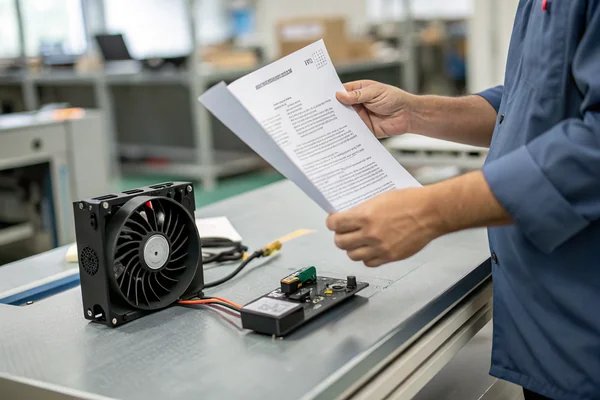
A fan that works perfectly in a lab bench test can fail within months once it's actually bolted into a vehicle -- the temperature swings, constant vibration, and EMC requirements automotive electronics demand are a different category of problem entirely.
DC axial fans for automotive electronics need a wider operating temperature range, real vibration and shock resistance, and compliance with automotive EMC standards -- requirements that go well beyond what typical consumer or industrial electronics cooling fans are built to handle.
- Automotive electronics face genuinely wide temperature swings, from sub-zero cold starts to under-hood heat, that most standard cooling fans were never rated for.
- Vibration and mechanical shock from the vehicle itself is a constant, not an occasional stress, which demands real vibration-rated bearing and frame construction.
- Automotive EMC standards like CISPR 25 are stricter and more specific than general consumer electronics standards, since automotive systems sit close together and can't tolerate cross-interference.
- 12V and 24V are both standard depending on vehicle platform -- passenger vehicles typically run 12V, while commercial trucks often run 24V.
- Fan placement -- under-hood versus cabin -- changes the real-world temperature and contamination exposure significantly, even within the same vehicle.
Getting fan selection right for automotive electronics means designing around a genuinely harsher combination of temperature, vibration, and EMC requirements than most other cooling applications.
Table of Contents
Why Is Automotive Electronics Cooling Such a Demanding Problem?
Vehicles subject electronics to a combination of stresses few other applications face together.
Automotive electronics cooling is demanding because vehicles combine wide temperature swings, constant vibration, and strict EMC requirements simultaneously, in an environment where fan failure can affect vehicle safety systems rather than just convenience features.
Why the Combination Matters More Than Any Single Factor
A fan that's individually rated for extended temperature, or individually rated for vibration resistance, still might not be adequate if it wasn't validated for both stresses occurring together, continuously, over years of vehicle service. Automotive electronics increasingly include safety-relevant systems -- ADAS processors, battery management, power steering electronics -- where a cooling failure has consequences beyond the inconvenience typical in consumer electronics.
| Stress Factor | Automotive Reality |
|---|---|
| Temperature range | -40°C cold start to 85°C+ under-hood heat |
| Vibration | Continuous, from road and engine, not occasional |
| EMC | Must not interfere with other vehicle electronics |
How Wide Does the Operating Temperature Range Really Need to Be for Automotive?
Automotive temperature requirements span a genuinely wide range compared to most electronics cooling applications.
Automotive fans often need an operating range spanning roughly -40°C to 85°C or wider, covering cold-climate startup conditions through under-hood or direct-sun cabin heat, which is considerably wider than typical consumer or general industrial fan ratings.
Why the Full Range Matters, Not Just the Extremes
A fan that starts reliably at -40°C but derates significantly by 85°C, or vice versa, isn't actually meeting the real requirement -- automotive applications need consistent performance across the full range, since a vehicle genuinely experiences both extremes depending on climate and season. Cold-start reliability specifically deserves attention, since bearing lubricant behavior and material brittleness at very low temperatures can affect whether a fan starts reliably at all, not just how well it performs once running.
How Much Vibration and Shock Does an Automotive Fan Actually Need to Survive?
Vehicle vibration is continuous and varied, unlike the more predictable vibration profiles in most industrial applications.
Automotive fans need to survive continuous road-induced vibration across a range of frequencies, plus occasional shock events from potholes or rough terrain, validated through standardized automotive vibration and shock test profiles rather than general industrial vibration ratings.
Why Automotive Vibration Testing Is Its Own Category
Road vibration isn't a single frequency or amplitude -- it varies with vehicle speed, road surface, and mounting location, which is why automotive-qualified components are typically tested against standardized vibration profiles that simulate this variability rather than a single fixed-frequency test. Shock resistance matters separately, covering discrete high-amplitude events like potholes that a continuous vibration test alone doesn't capture. A fan genuinely validated for automotive use should have data against both types of testing, not just a general "vibration resistant" claim.
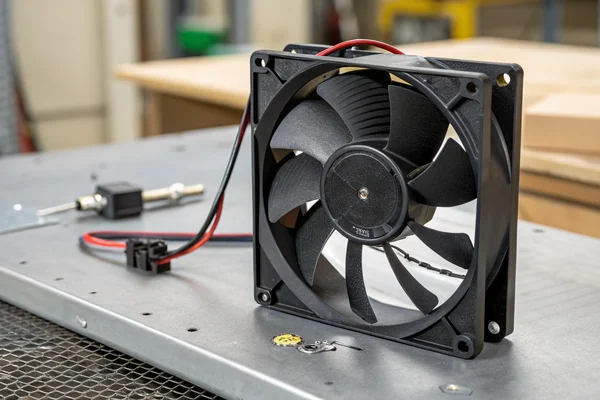
What EMC Standards Actually Apply to Automotive Cooling Fans?
Automotive EMC requirements are stricter and more specific than general consumer electronics standards.
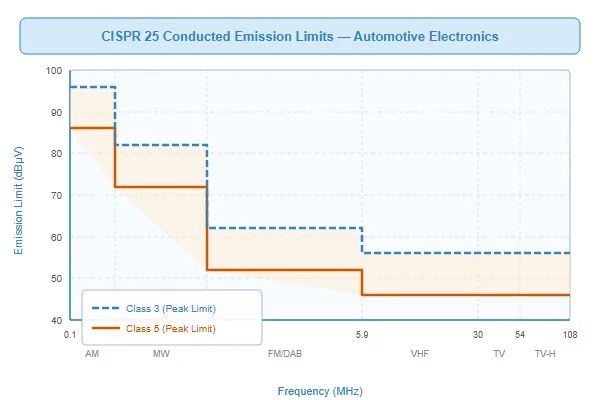
Automotive cooling fans typically need to comply with CISPR 251, the international standard for automotive component emissions, which sets tighter conducted and radiated emission limits than general consumer electronics standards, reflecting how closely packed and interference-sensitive vehicle electronics actually are.
Why Automotive EMC Is Its Own Stricter Category
Modern vehicles pack dozens of electronic control units, sensors, and communication buses into close physical proximity, which means even modest EMI from one component can realistically interfere with another critical system nearby -- a risk automotive OEMs take seriously enough to mandate CISPR 25 compliance for components like cooling fans. A fan supplier who can provide real CISPR 25 test data, not just a general compliance statement, gives automotive engineers a much clearer picture of how much EMC margin the fan is actually using up in the vehicle's overall budget.
12V or 24V: Which Fits Your Vehicle Platform?
Voltage selection here is almost entirely about matching the existing vehicle electrical architecture.
12V is standard across most passenger vehicles, while 24V is common in commercial trucks and heavy equipment -- the right choice depends entirely on matching the vehicle platform's existing electrical system, not on any inherent performance advantage of one voltage over the other.
Matching the Platform, Not Chasing Performance
Passenger car electrical systems have standardized around 12V nominal for decades, while commercial trucks, buses, and heavy equipment commonly run 24V systems, partly for the reduced current (and thinner wiring) that higher voltage allows at the same power level. A fan destined for aftermarket or OEM automotive use needs to match whichever voltage the target vehicle platform actually provides, since running a fan outside its rated voltage range risks unreliable operation or reduced service life.
Does Under-Hood vs Cabin Placement Change the Fan Requirement?
Physical location within the vehicle changes real-world exposure significantly, even for otherwise similar electronics.
Under-hood placement exposes a fan to higher peak temperatures, engine vibration, and contamination from oil, road debris, and moisture, while cabin placement generally sees more moderate temperatures but still needs to meet automotive vibration and EMC standards -- the two locations warrant genuinely different fan specifications.
Why Location-Specific Specification Matters
An under-hood fan needs to handle both higher sustained temperatures and a harsher contamination environment -- oil mist, road spray, dust -- than a cabin-mounted fan cooling an infotainment system or climate control unit typically faces. Treating both locations with the same generic "automotive-rated" spec without considering the specific placement's real exposure is a common way to either over-spec (and overpay for) a cabin application or under-spec an under-hood one.
What Certifications Should You Ask an Automotive Fan Supplier For?
Certification requests should match what actually matters for automotive qualification, not just general quality marks.
Ask an automotive fan supplier for CISPR 25 EMC test data, automotive vibration and shock test results, and temperature range validation at your specific application's conditions -- IATF 16949 quality certification is also worth confirming as a baseline indicator of automotive-grade manufacturing discipline.
Building a Real Qualification Package
IATF 16949 certification specifically addresses automotive quality management system requirements, making it a meaningful baseline indicator distinct from general ISO 9001 certification. Beyond that baseline, real automotive qualification requires the specific test data -- EMC, vibration, shock, temperature -- rather than general claims of "automotive grade," since that phrase alone doesn't guarantee any particular standard was actually met.
We've supplied fans into automotive electronics cooling programs for over 20 years, and CISPR 25 EMC data is consistently the piece automotive engineers ask for first. Every fan we build for automotive customers goes through our in-house vibration, temperature cycling, and EMC testing as part of our IATF 16949 automotive quality certification, and we can provide test data at your specific platform's voltage, temperature range, and mounting location before you commit to a design.
FAQ
Do all automotive fans need to be IATF 16949 certified?
The certification applies to the supplier's quality management system, not each individual fan, but sourcing from an IATF 16949-certified supplier is a strong indicator of automotive-grade manufacturing discipline.
Can a consumer-grade fan be used in a non-critical automotive accessory application?
Sometimes, for genuinely non-critical aftermarket accessories, but even accessory-level automotive use still benefits from basic vibration and temperature validation given the vehicle environment.
Does electric vehicle (EV) cooling have different requirements than combustion vehicle cooling?
EVs often add battery management and power electronics cooling needs beyond traditional combustion-vehicle electronics cooling, sometimes with higher continuous-duty demands given how central thermal management is to EV battery performance and safety.
How is automotive vibration testing typically performed?
Using standardized test profiles that simulate real-world road vibration across various frequencies, often combined with temperature cycling to simulate combined thermal and mechanical stress over the component's expected service life.
Is CISPR 25 the only EMC standard relevant to automotive fans?
It's the most widely referenced international automotive component EMC standard, though specific OEMs may have their own additional internal EMC requirements beyond the base CISPR 25 limits.
Does automotive fan sourcing typically require longer lead times than standard industrial fans?
Often yes, given the additional qualification testing and documentation automotive programs typically require, which is worth factoring into program timelines early.
Automotive electronics cooling asks more of a fan than almost any other application -- wide temperature swings, continuous vibration, and strict EMC compliance, all at once, over years of vehicle service. At Herays, our Dongguan facility has supplied vibration- and EMC-validated DC fans into automotive electronics programs for over 20 years, certified under IATF 16949. If you're specifying cooling for an automotive design, ask for real CISPR 25 and vibration test data before committing to a fan.
CISPR (International Special Committee on Radio Interference) publishes standards governing electromagnetic emissions. CISPR 25 specifically covers automotive component emissions, reflecting the tighter interference limits needed in the close-packed electronic environment of a modern vehicle. ↩

Liang
I've been working with DC fans for 30 years — long enough to have seen the industry evolve from basic sleeve bearing designs to today's high-efficiency, IP68-rated systems built for the harshest environments imaginable. I founded Herays because I believed manufacturers and engineers deserved a supplier who could talk technical from day one. Not just hand over a datasheet, but actually help you select the right fan for your thermal load, your enclosure, your certification requirements. Most of what I write here comes directly from problems I've solved on the factory floor or in customer applications — medical devices, laser equipment, industrial automation, you name it. If it involves moving air efficiently and reliably, I've probably spent time thinking about it. When I'm not obsessing over airflow curves, I'm usually helping a customer figure out why their cooling system isn't performing the way their simulation said it would.
View all posts by Liang