An air purifier that moves plenty of air but can't push it through a dense HEPA filter is a purifier that isn't actually purifying much. CFM on the box means little without static pressure to back it up.
A DC axial fan matters in air purifiers because it has to push air through a genuinely restrictive HEPA filter, not just move air freely -- which means static pressure, not raw CFM, is the spec that actually determines how well the purifier performs in real use.
- The fan's real job in an air purifier is pushing air through a dense filter stack, not just moving air around a room -- that's a static pressure problem, not a pure airflow problem.
- A high free-air CFM rating can be almost meaningless once the fan is working against a real HEPA filter's resistance -- static pressure at that resistance point is what actually matters.
- Bedroom and home-office purifiers need genuinely quiet fans, often under 30 dBA at normal operating speed, since these units run for hours at a time near people.
- Energy efficiency standards for appliance fans vary by region, and a fan that's efficient in free air isn't automatically efficient once it's working against filter resistance.
- Filter age changes the airflow equation over time -- a clean filter and a six-month-old filter present very different resistance to the same fan.
Getting fan selection right for an air purifier means designing around the filter's resistance curve, not around whatever CFM number looks most impressive on a spec sheet.
Table of Contents
What Job Does the Fan Actually Do Inside an Air Purifier?
The fan's job sounds simple -- move air -- but the real constraint is what that air has to pass through.
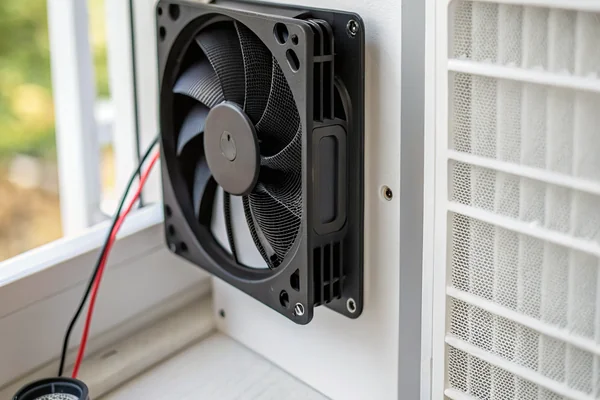
The fan's job in an air purifier is pulling room air through a HEPA or multi-stage filter and pushing it back out, which means it's working against real filter resistance the entire time it runs, not moving air freely.
Why This Isn't Just "Moving Air"
A HEPA filter is dense enough to capture particles down to 0.3 microns, and that density creates meaningful resistance to airflow -- resistance that increases further as the filter loads with captured particulate over time. A fan that would deliver excellent CFM blowing into open air can deliver dramatically less once it's pulling air through that same filter stack. This is the fundamental reason air purifier fan selection looks more like industrial filtered-airflow design than simple electronics cooling.
| Fan Job | What It's Actually Fighting | Key Spec |
|---|---|---|
| Move room air through filter | HEPA/carbon filter resistance | Static pressure at operating point |
| Maintain airflow as filter loads | Increasing resistance over filter life | Static pressure margin |
| Deliver rated CADR | Combined system resistance | Real (not free-air) CFM |
Why Does a HEPA Filter Care More About Static Pressure Than Raw CFM?
This is the single most common spec misunderstanding in air purifier design.
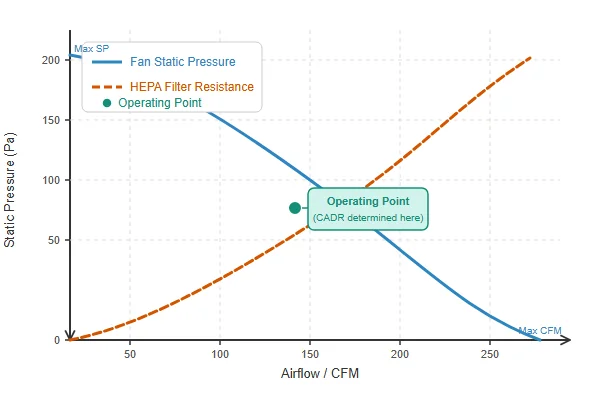
A HEPA filter cares more about static pressure than raw CFM because the filter's resistance determines how much of that free-air CFM number actually survives once the fan is working against real restriction -- a fan with mediocre static pressure can underperform a lower-CFM fan with better pressure capability.
Reading the Fan Curve at the Right Point
Every fan has a performance curve showing CFM at various levels of static pressure, and the number that matters for an air purifier isn't the free-air CFM at zero resistance -- it's the CFM the fan actually delivers at the specific resistance the filter stack presents. Two fans with identical free-air CFM ratings can perform very differently once real filter resistance enters the picture, if one has meaningfully better static pressure capability than the other.
This is why CADR (Clean Air Delivery Rate)1, the metric that actually matters to purifier performance, depends on the whole system -- fan curve and filter resistance together -- rather than the fan's datasheet CFM in isolation.
How Quiet Does an Air Purifier Fan Need to Be for Bedroom Use?
Noise tolerance for these fans is unusually strict, because the whole point is running for hours near people trying to sleep or work.
Bedroom and home-office air purifiers typically need fans under roughly 30 dBA at normal operating speed, since these units run for extended periods in close proximity to people who notice even modest fan noise over time.
Why Purifier Noise Tolerance Is Stricter Than Most Applications
Unlike a fan buried inside an electronics enclosure, an air purifier's fan noise is the product's primary audible characteristic to the end user -- there's no housing or distance to mask it. Bedroom units in particular need to be quiet enough to run overnight without disturbing sleep, which pushes fan selection toward ball bearings for consistent low-speed noise behavior and PWM speed control that lets the unit run at a genuinely quiet baseline speed most of the time, ramping up only when air quality sensors detect a real spike.
A purifier that's quiet at its lowest setting but loud at higher speeds still creates a real usability problem if the unit needs to run at higher speed regularly to handle actual room conditions.
What Energy Efficiency Standards Actually Apply to Air Purifier Fans?
Efficiency standards for these appliances vary meaningfully by region, and the fan is a real contributor to overall unit efficiency.
Energy efficiency standards for air purifiers vary by region -- ENERGY STAR in the US, similar appliance efficiency programs elsewhere -- and the fan's efficiency at its actual filtered operating point, not just free-air efficiency, is what determines whether the finished product meets those standards.
Efficiency Under Load, Not Just on the Datasheet
A fan can look efficient on a datasheet measured in free air and still contribute to a purifier failing to meet an efficiency standard, because the relevant efficiency number is watts consumed per unit of actual airflow delivered through the filter, not watts per unit of theoretical free-air CFM. This is another place where filter resistance changes the real answer -- a fan needs to be evaluated for efficiency at the resistance point it will actually operate at inside the finished product, not in isolation.
Manufacturers targeting a specific efficiency certification should confirm fan efficiency data at the system's actual filtered operating point before finalizing a design, rather than assuming a datasheet efficiency number transfers directly.
Does Purifier Room Size Actually Change Which Fan You Need?
Room size drives the CADR target, and CADR target drives fan sizing more directly than room size itself.
Purifier room size changes fan requirements indirectly, through the CADR target needed to clean that room's air volume in a reasonable time -- larger rooms need higher real (filtered) airflow, which usually means either a larger fan or better static pressure performance, not just a bigger motor.
Sizing Backward From CADR, Not Forward From Room Size
The standard approach is sizing backward: determine the CADR needed for the target room size and desired air changes per hour, then select or design a fan (and filter combination) capable of delivering that real airflow at the system's actual resistance point. A larger room doesn't automatically mean "bigger fan" -- it might mean a fan with better static pressure capability, a larger filter surface area to reduce resistance, or genuinely higher CFM capacity, depending on which part of the system is the limiting factor.
Does Filter Age Change How Hard the Fan Has to Work?
A filter's resistance isn't static over its service life, and neither is the airflow the fan can actually deliver through it.
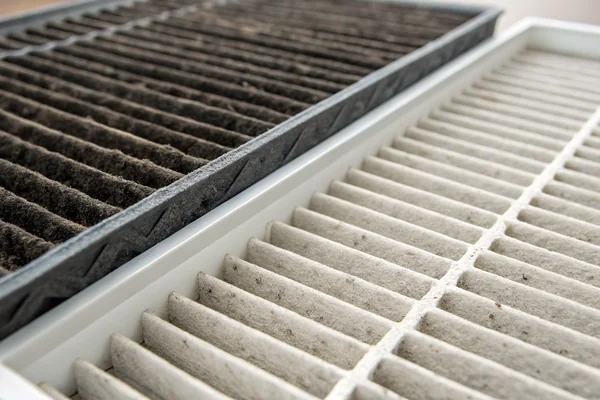
Filter resistance increases as particulate accumulates over the filter's service life, which means the fan delivers less real airflow through an aging filter than a fresh one at the same speed -- purifiers need either a speed margin to compensate or a clear filter-replacement signal.
Designing for the Filter's Whole Life, Not Just Day One
A fan sized to just barely meet CADR targets with a brand-new filter can fall short of that target well before the filter's rated replacement interval, as accumulated particulate steadily increases resistance. Well-designed purifiers build in speed margin -- the fan can run faster than its baseline setting to compensate for rising resistance as the filter ages -- and often pair this with a differential pressure sensor or simple time-based indicator that tells the user when filter resistance has climbed enough to warrant replacement.
Sizing the fan only around fresh-filter performance is a common shortcut that shows up later as declining real-world purifier performance well before the filter's official end of life.
Should an Air Purifier Fan Run at Constant Speed or Auto-Adjust?
Fixed-speed and auto-adjusting designs trade off simplicity against both noise and energy efficiency.
Auto-adjusting fan speed, tied to an air quality sensor or filter resistance signal, generally outperforms fixed-speed operation on both noise and energy use, since the fan only runs harder when actual conditions call for it rather than running at a single compromise speed regardless of need.
What Auto-Adjust Actually Buys You
A fixed-speed fan has to be set for a worst-case scenario to guarantee adequate CADR when it matters, which means it often runs louder and draws more power than necessary during normal conditions when air quality is already good. A fan tied to a real-time air quality sensor, or at minimum to a filter-age-aware speed curve, spends most of its life at a quieter, more efficient baseline and only ramps up when conditions genuinely call for it -- a smoke event, a dusty day, or a filter approaching the end of its resistance margin.
We've supplied fans into consumer air purifier programs for over 20 years, and the most common design mistake we see is a fan selected purely on free-air CFM without validating static pressure performance against the actual filter stack. Every fan we build for appliance customers is tested on our in-house CFM and static pressure rigs at the customer's actual filter resistance point, not just in free air, as part of our ISO 9001 and IATF 16949 quality process, and we can supply PWM-controlled options validated for the low-noise thresholds bedroom and office purifiers require.
FAQ
What CFM rating should I look for in an air purifier fan?
There's no universal number -- the right CFM depends on the target CADR for your room size and the specific filter's resistance. A fan's free-air CFM alone doesn't tell you enough without static pressure data at the actual filter resistance point.
Does a bigger fan always mean better air purification?
Not necessarily. A larger fan with poor static pressure performance can underperform a smaller fan with a stronger pressure curve once both are working against the same filter resistance.
Why do some air purifiers get noticeably louder as the filter ages?
Because the fan is compensating for rising filter resistance by running faster to maintain airflow, which increases noise even though the fan itself hasn't changed.
Is ball bearing always better than sleeve bearing for air purifier fans?
Ball bearings generally offer more consistent low-speed noise behavior over the fan's life, which matters for the quiet, continuous-duty operation air purifiers need, though the right choice also depends on cost targets and expected duty cycle.
How do I know if my air purifier's fan is actually delivering its rated CADR?
CADR is a system-level certification test, not something you can directly verify from the fan alone, but declining airflow at the vents over the filter's life is a practical indicator that resistance has climbed enough to affect real performance.
Does PWM speed control meaningfully reduce air purifier energy use?
Yes, generally. Running at a lower baseline speed most of the time and ramping up only when needed reduces average power draw compared to a fixed high speed that guarantees worst-case performance at all times.
Air purifier fan selection is a filtered-airflow problem wearing the disguise of a simple cooling fan spec, and static pressure at the filter's real resistance point is the number that actually predicts performance. At Herays, our Dongguan facility has supplied DC fans into consumer appliance programs for over 20 years, testing static pressure and noise performance under real filter conditions as part of our ISO 9001 and IATF 16949 quality process. If you're specifying a fan for a filtered appliance, ask for performance data at your actual resistance point, not just free-air numbers.
Clean Air Delivery Rate measures how much filtered air an air purifier delivers per minute, combining airflow volume with filtration effectiveness. It's a system-level metric, not a fan-only spec, since it depends on both fan performance and filter resistance together. ↩

Liang
I've been working with DC fans for 30 years — long enough to have seen the industry evolve from basic sleeve bearing designs to today's high-efficiency, IP68-rated systems built for the harshest environments imaginable. I founded Herays because I believed manufacturers and engineers deserved a supplier who could talk technical from day one. Not just hand over a datasheet, but actually help you select the right fan for your thermal load, your enclosure, your certification requirements. Most of what I write here comes directly from problems I've solved on the factory floor or in customer applications — medical devices, laser equipment, industrial automation, you name it. If it involves moving air efficiently and reliably, I've probably spent time thinking about it. When I'm not obsessing over airflow curves, I'm usually helping a customer figure out why their cooling system isn't performing the way their simulation said it would.
View all posts by Liang