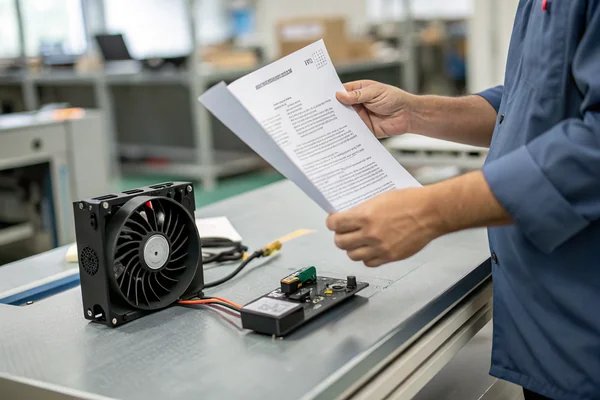
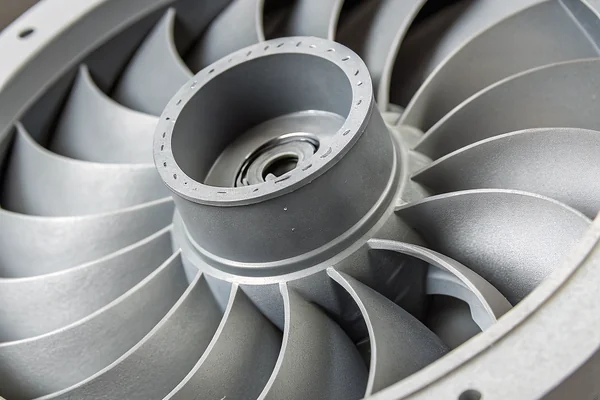
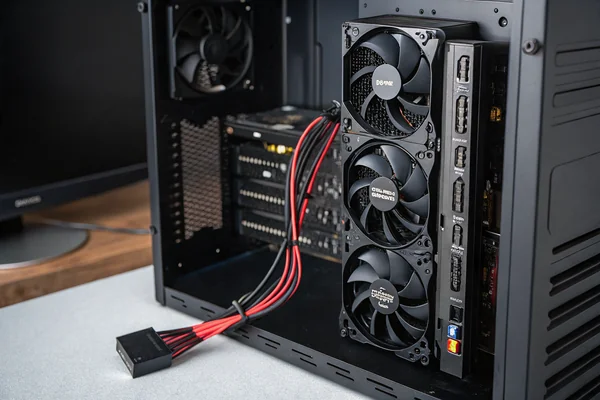
A projector packs a genuinely bright light source into an enclosure the size of a shoebox, then asks a fan smaller than your palm to keep it from cooking itself. That's a harder cooling problem than it looks.
A DC axial fan matters in projectors because the light source -- lamp, LED, or laser -- concentrates significant heat in a compact sealed enclosure, and that heat has to move through a genuinely restrictive optical and electronics layout without the fan being so loud it ruins the viewing experience.
- Projector light sources generate concentrated heat in a small space, and the optical path and electronics layout leave limited room for airflow to actually move.
- Projector cooling is a static pressure problem more than a raw airflow problem, since air has to squeeze through narrow channels around lenses, mirrors, and circuit boards.
- Home theater projectors need genuinely quiet fans, since they run for hours in a room where the whole point is an immersive, distraction-free experience.
- Compact fan sizes are often non-negotiable in projector design, which pushes selection toward fans engineered for high static pressure in a small footprint rather than simply high CFM.
- Lamp-based projectors generally run hotter than LED or laser models, which changes both the cooling requirement and the expected fan service life.
Getting fan selection right for a projector means treating it as a compact, high-restriction cooling problem from the start, not a scaled-down version of typical electronics cooling.
Table of Contents
Why Do Projectors Run So Hot in Such a Small Enclosure?
The light source is the whole reason a projector needs serious active cooling at all.
Projectors run hot because their light source -- a traditional lamp, LED array, or laser module -- concentrates significant heat output in a compact enclosure that also has to house optics, electronics, and limited airflow paths around all of it.
Where the Heat Actually Comes From
A traditional lamp-based projector converts a meaningful share of the lamp's input power into heat rather than usable light, and that heat has to be removed quickly to protect both the lamp itself and the surrounding optics and plastics from thermal damage. LED and laser light engines run cooler than traditional lamps but still generate real heat, especially at higher brightness settings, and pack that heat generation into an even more compact module in many modern designs.
| Light Source Type | Relative Heat Output | Typical Cooling Demand |
|---|---|---|
| Traditional UHP1 lamp | Highest | High airflow, high static pressure |
| LED light engine | Moderate | Moderate, steady airflow |
| Laser light engine | Moderate to high at peak brightness | Moderate to high, concentrated |
Why Do Projector Fans Need Static Pressure, Not Just Airflow?
Getting air into a projector is easy. Getting it past the optics and electronics inside is the real challenge.
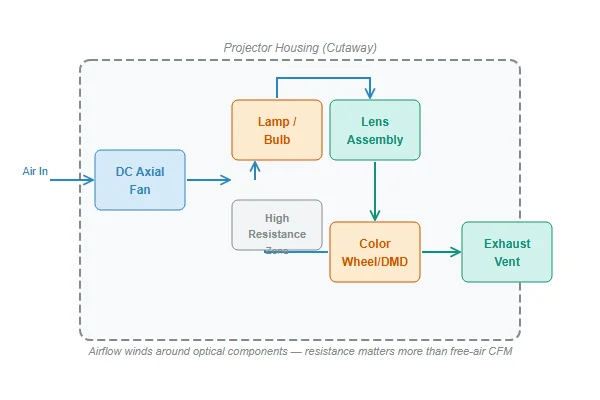
Projector fans need strong static pressure because air has to travel through narrow, obstructed channels around lenses, mirrors, and circuit boards, not through an open path -- a fan with high free-air CFM but weak static pressure will underperform inside the actual enclosure.
Why the Internal Layout Fights the Airflow
A projector's internal layout is dictated by optical requirements first and thermal requirements second, which means airflow paths often wind around components rather than running in a straight line. That restrictive path presents real resistance to airflow, similar in principle to pushing air through a dense filter -- the fan's performance at that specific resistance point matters far more than its rated free-air CFM.
How Quiet Does a Projector Fan Need to Be for Home Theater Use?
Few applications are as noise-sensitive as a home theater projector running during a quiet scene.
Home theater projector fans typically need to run well under 30 dBA, since these units operate for hours in a room specifically designed for an immersive, distraction-free experience where even modest fan noise becomes noticeable during quiet audio moments.
Why Projector Noise Standards Are Especially Strict
Unlike most electronics cooling applications, a projector fan's noise has no competing ambient sound to hide behind during quiet movie scenes, and the projector is often mounted close to or above the audience rather than tucked away in a rack. That combination pushes premium home theater projectors toward ball bearings for consistent low-speed behavior, careful acoustic enclosure design around the fan itself, and PWM speed control that keeps the fan at its quietest sustainable speed except when brightness or ambient temperature genuinely demand more airflow.
How Small Can a Projector Fan Get Before Cooling Suffers?
Projector form factors keep shrinking, and fan size is often one of the tightest constraints in the whole design.
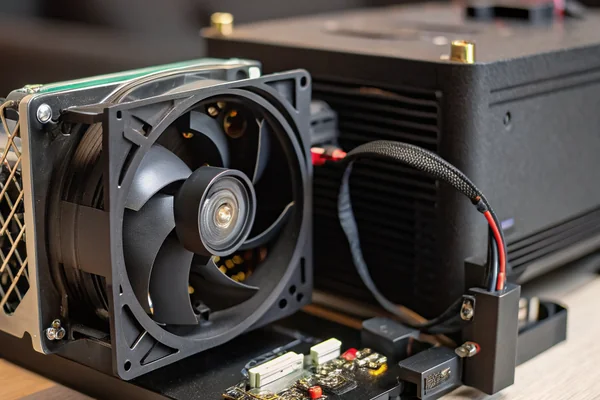
Projector fans can get quite small -- often 40mm or smaller in compact and portable models -- but shrinking fan size without compensating for lost static pressure and CFM is how compact projectors end up running hotter than their larger counterparts.
The Tradeoff Compact Designs Actually Make
Smaller fans move less air at a given speed than larger ones, all else equal, which compact projector designs typically compensate for with higher fan speeds, multiple smaller fans working together, or genuinely high-static-pressure fan designs engineered specifically for restrictive small enclosures. This is exactly why fan selection for compact projectors leans toward fans purpose-built for high static pressure in a small footprint, rather than simply the smallest fan that physically fits the available space.
How Long Should a Projector Fan Actually Last?
Fan life expectations should roughly track how long the projector itself is expected to stay in service.
A projector fan should be rated for continuous or near-continuous duty across the projector's expected service life, which for many business and education projectors means tens of thousands of hours of real operating time, not just a fan that happens to work when new.
Matching Fan Life to Real Use Patterns
A projector used for a few hours a week in a home theater has very different cumulative run-hours over its life than one running most of a school or office day, five days a week, for years. Bearing type and rated life should be matched to the actual expected use pattern, not a generic assumption -- specifying a fan rated for light-duty consumer use in a projector destined for daily classroom or conference room service is a common way to end up with premature fan failure well before the projector's optics or light source reach end of life.
Does Lamp Type (LED, Laser, Lamp) Change the Cooling Requirement?
Light source choice changes both how much heat needs removing and how forgiving the system is if cooling briefly falls short.
Traditional lamp-based projectors generally need more aggressive cooling than LED or laser models, and lamps are also less tolerant of cooling interruptions -- inadequate airflow can shorten lamp life meaningfully, while LED and laser sources tend to degrade more gradually under similar thermal stress.
Why Lamp-Based Systems Are Less Forgiving
A traditional projector lamp is a genuinely hot, high-intensity light source that depends on consistent cooling to reach its rated hours of service life -- running it hot, even briefly, can measurably shorten that lifespan. LED and laser light engines, while not immune to heat, tend to respond to thermal stress with gradual output reduction rather than the sharper lifespan penalty a traditional lamp experiences. This doesn't mean LED and laser projectors need less cooling attention, but it does mean the cost of a marginal cooling design shows up differently depending on which light source technology the projector uses.
What Happens to Picture Quality When a Projector Runs Hot?
Overheating in a projector often shows up as a picture problem before it shows up as a hardware failure.
An overheating projector typically responds with automatic brightness reduction, color shift, or an outright thermal shutdown mid-presentation, since most modern projectors include thermal protection that prioritizes protecting the light source and electronics over maintaining full picture output.
Why This Matters Beyond Just Comfort
A projector that dims itself or shuts down mid-meeting or mid-movie isn't a minor annoyance -- for business and education use, it's a real reliability failure that reflects on the equipment and whoever specified it. This is the practical argument for not treating projector cooling as an afterthought relative to brightness or resolution specs: a projector with excellent optics and inadequate cooling will underperform its rated brightness in real use, precisely when ambient conditions or extended run time push internal temperature up.
We've supplied fans into projector programs for over 20 years, and compact static-pressure performance is the spec that gets underestimated most often at the design stage. Every fan we build for projector customers is tested on our in-house CFM and static pressure rigs at realistic restricted-airflow conditions, not just free air, as part of our IATF 16949 and ISO 9001 quality process, and we can supply compact high-static-pressure options validated for the noise thresholds home theater and conference room projectors require.
FAQ
Why does my projector fan get louder over time?
This is usually either dust accumulation increasing airflow resistance, ambient temperature rising, or bearing wear reducing fan efficiency -- all of which cause the fan to work harder (and louder) to maintain the same cooling.
Can I replace a projector fan with a higher-CFM aftermarket fan?
Only if it matches the mounting, voltage, and connector specifications, and ideally has comparable or better static pressure performance -- a mismatched fan can create more noise without improving cooling, or fail to fit the airflow path correctly.
Do laser projectors really need less cooling than lamp-based models?
Generally somewhat less aggressive cooling, since laser sources tend to run cooler than traditional lamps at comparable brightness, but they still generate real heat, especially at peak brightness settings, and still need properly engineered cooling.
Why do some compact projectors use two small fans instead of one larger fan?
Multiple smaller fans can be positioned to address different heat sources or restricted airflow paths more effectively than a single larger fan trying to cover the whole compact enclosure from one location.
Is fan noise rated in dBA on projector specs directly comparable across brands?
Not always reliably, since measurement conditions (distance, test environment, operating mode) can vary between manufacturers. Real-world listening comparison remains the most reliable way to evaluate projector noise for noise-sensitive use.
Does altitude affect projector cooling and fan speed?
Yes -- thinner air at higher altitude carries away less heat per unit of airflow, which is why many projectors have a "high altitude mode" that increases fan speed to compensate for reduced cooling efficiency.
Projector cooling is a compact, high-restriction airflow problem where static pressure performance matters more than headline CFM, and getting it wrong shows up as dimmed picture quality or shortened light source life, not just fan noise. At Herays, our Dongguan facility has supplied DC fans into projector programs for over 20 years, validating static pressure performance and noise under ISO 9001 and IATF 16949 certification. If you're specifying cooling for a compact optical device, ask for performance data at your actual restricted-airflow condition, not just a free-air spec sheet.
UHP (Ultra-High Performance) is a mercury vapor lamp technology widely used in traditional projectors for its high brightness in a compact arc. These lamps run hot and depend on consistent cooling to reach their rated service life. ↩

Liang
I've been working with DC fans for 30 years — long enough to have seen the industry evolve from basic sleeve bearing designs to today's high-efficiency, IP68-rated systems built for the harshest environments imaginable. I founded Herays because I believed manufacturers and engineers deserved a supplier who could talk technical from day one. Not just hand over a datasheet, but actually help you select the right fan for your thermal load, your enclosure, your certification requirements. Most of what I write here comes directly from problems I've solved on the factory floor or in customer applications — medical devices, laser equipment, industrial automation, you name it. If it involves moving air efficiently and reliably, I've probably spent time thinking about it. When I'm not obsessing over airflow curves, I'm usually helping a customer figure out why their cooling system isn't performing the way their simulation said it would.
View all posts by Liang