A chiller running quietly in the corner of a living room has one job that has nothing to do with the fish and everything to do with heat -- and a fan that can't handle the humidity right next to an open tank won't last long enough to matter.
A DC axial fan matters in aquarium equipment because chillers, LED lighting drivers, and other electronics generate real heat near a genuinely humid, splash-prone environment, which demands both effective cooling and real moisture resistance most standard electronics fans were never built for.
- Aquarium equipment -- chillers especially, but also LED drivers and filtration electronics -- generates real heat that needs active cooling, not just passive convection.
- Proximity to open water means genuine humidity and splash exposure, which standard electronics fans aren't built to handle without real moisture protection.
- Chiller fans specifically need to move enough air across a condenser coil to reject heat effectively, similar in principle to other refrigeration cooling.
- Home aquarium fans need to be genuinely quiet, since these systems run continuously in living spaces where people spend relaxed time.
- IP-rated, moisture-resistant fans are worth the added cost for anything mounted near or above open water, given how much faster standard fans degrade in that environment.
Getting fan selection right for aquarium equipment means treating humidity resistance as seriously as raw cooling performance.
Table of Contents
Why Does Aquarium Equipment Get Hot in the First Place?
The fish don't generate the heat -- the electronics running the system do.
Aquarium equipment gets hot because chillers, LED lighting drivers, protein skimmers, and other powered components convert a share of their input power into heat, just like any other electronics, and that heat needs to go somewhere even in a system built around keeping water cool.
Where the Real Heat Sources Actually Are
A chiller's compressor and condenser generate meaningful heat as part of the refrigeration cycle that's cooling the tank water -- ironically, the equipment cooling the tank needs its own cooling to function properly. LED lighting drivers, especially on higher-output reef lighting, dissipate real heat converting input power to the LED's drive current. None of this heat comes from the tank itself; it's generated by the electronics supporting the tank, in equipment that's often mounted in an enclosed cabinet stand with limited natural airflow.
| Equipment | Heat Source |
|---|---|
| Chiller | Compressor and condenser (refrigeration cycle) |
| LED lighting driver | Power conversion losses |
| Filtration/skimmer electronics | Motor and control circuit losses |
How Much Humidity and Splash Resistance Does an Aquarium Fan Actually Need?
Proximity to open water changes the moisture exposure calculation considerably compared to typical indoor electronics.
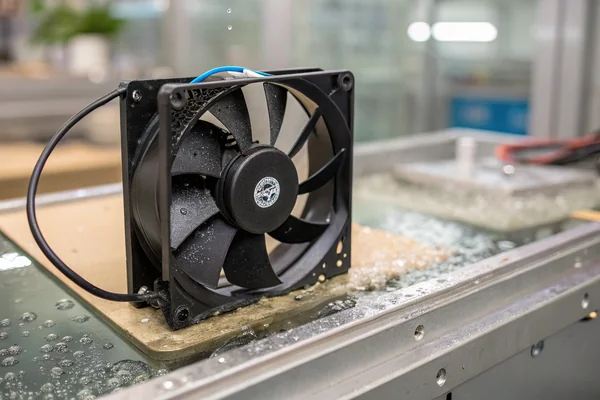
An aquarium fan typically needs real IP-rated moisture and splash resistance, since equipment mounted near or above an open tank faces genuine humidity from evaporation and realistic splash risk from water changes, feeding, or equipment maintenance.
Why Standard Fans Struggle Near Water
Open aquariums release meaningful humidity into the surrounding air continuously, and equipment stands or cabinets near the tank often trap that humidity in a semi-enclosed space with limited ventilation. Add the realistic chance of an actual splash during routine tank maintenance, and a standard, unprotected fan faces a genuinely harsher moisture environment than most indoor electronics cooling applications -- corrosion and electrical issues develop faster here than in a typical dry room.
What Does a Chiller Fan Actually Need to Perform?
Chiller fan requirements follow the same underlying logic as other refrigeration condenser cooling.
A chiller fan needs airflow matched to the condenser coil's surface area and heat rejection load, similar to condenser fans in other refrigeration equipment -- undersized airflow leaves the condenser running hot, reducing the chiller's overall cooling efficiency and potentially its ability to hold target tank temperature.
Why Chiller Cooling Follows Refrigeration Logic, Not General Electronics Cooling
A chiller is a refrigeration system, and its fan's job is rejecting heat at the condenser, not directly cooling any single component the way a typical electronics cooling fan does. If the condenser fan can't move enough air, condensing pressure rises and the whole refrigeration cycle loses efficiency, which can show up as the chiller struggling to hold target temperature even though nothing else about the system has changed -- a classic symptom of inadequate condenser airflow rather than a refrigerant or compressor problem.
How Quiet Does an Aquarium Fan Need to Be for a Living Room?
Home aquarium systems often live in exactly the kind of space where fan noise gets noticed most.
Home aquarium equipment fans typically need to run quietly, often under 35 dBA, since these systems operate continuously in living rooms, bedrooms, or offices where people spend relaxed time and notice persistent background noise.
Why Aquarium Fan Noise Gets Scrutinized
An aquarium is often a centerpiece feature in a living space, which means the equipment supporting it -- chiller, filtration, lighting -- needs to blend into the background acoustically rather than compete with conversation or a quiet evening at home. This pushes aquarium equipment fan selection toward quieter bearing types, vibration-dampened mounting, and speed control that avoids running harder than the current cooling load actually requires, similar to home appliance noise priorities more broadly.
What Fan Specs Should You Actually Look for in Aquarium Use?
The right combination of specs depends on both the cooling job and the moisture environment together.
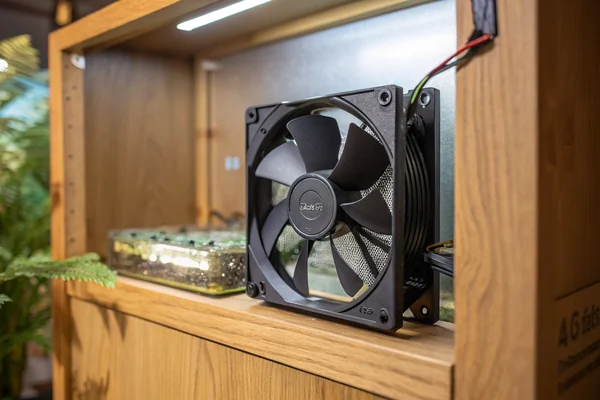
Look for a fan with adequate airflow matched to the specific equipment's heat rejection needs, real IP-rated moisture resistance appropriate for near-water placement, and quiet operation suited to a home living space -- all three matter together, not any single spec in isolation.
Balancing Performance, Protection, and Noise Together
A fan that excels at airflow but lacks moisture resistance will fail early near an open tank. A well-protected fan that's too loud will be a constant annoyance in a living space. Getting all three requirements right together -- rather than optimizing one at the expense of the others -- is what separates aquarium equipment that runs reliably for years from equipment that needs frequent, frustrating fan replacement.
What Happens If a Chiller Fan Fails on a Reef Tank?
The consequences of chiller cooling failure can be more serious for reef tanks than for hardier freshwater setups.
A failed chiller fan reduces condenser heat rejection, which can cause the chiller to lose efficiency or fail to hold target temperature, and for temperature-sensitive livestock like reef corals, even a moderate, sustained temperature drift can cause real stress or livestock loss before the problem is noticed.
Why Reef Tanks Are Especially Vulnerable
Many reef corals and sensitive marine species have a genuinely narrow ideal temperature range, and unlike some hardier freshwater fish, they can show real stress responses from temperature drift that might seem modest by everyday standards. A chiller struggling due to fan failure often doesn't stop cooling abruptly -- it gradually loses efficiency, meaning tank temperature can drift upward slowly enough to go unnoticed until livestock health is already affected, which is exactly why chiller fan reliability matters more here than in less temperature-sensitive setups.
Does Saltwater vs Freshwater Change the Fan Requirement?
The corrosive nature of a saltwater environment adds a real consideration beyond general humidity resistance.
Saltwater aquarium setups add real corrosion risk on top of general humidity exposure, since salt-laden air and occasional saltwater splash are more aggressive toward metal components and electronics than freshwater humidity alone -- worth prioritizing corrosion-resistant fan construction specifically for reef and marine setups.
Why Salt Changes the Materials Calculation
Salt spray1 and salt-laden humid air accelerate corrosion on metal components significantly faster than plain water humidity, which is a well-established issue in marine and coastal equipment generally, not just aquarium gear specifically. For saltwater and reef tank equipment, fan selection should weigh corrosion-resistant materials and coatings more heavily than for an equivalent freshwater setup, where humidity resistance alone is a somewhat lower bar to clear.
We've supplied fans into aquarium and marine equipment programs for over 20 years, and salt spray testing is one of the validations customers in this segment ask for most consistently. Every fan we build for humidity- and corrosion-sensitive applications goes through our in-house salt spray and moisture testing as part of our ISO 9001 and IATF 16949 quality process, and we can supply corrosion-resistant options validated specifically for near-water placement, not just general indoor humidity.
FAQ
Can a standard PC cooling fan be used safely near an aquarium?
Not recommended for anything mounted close to or above open water -- standard fans lack the moisture resistance to reliably handle aquarium humidity and splash risk over time.
How often should aquarium equipment fans be inspected for corrosion or wear?
Periodic visual inspection every few months is reasonable for most home setups, checking for visible corrosion, unusual noise, or reduced airflow that might indicate developing problems.
Do sump and cabinet stand fans need the same moisture resistance as chiller fans?
Generally yes, if they're positioned in the same enclosed, humid cabinet environment near the tank -- proximity to the humid microclimate matters more than the specific equipment being cooled.
Is a louder fan ever worth it for better chiller performance?
Sometimes, for larger or more demanding setups where cooling performance genuinely can't be compromised, though quieter high-static-pressure options should be evaluated first for most home applications.
Does tank size affect how much cooling the surrounding equipment needs?
Indirectly -- larger tanks often mean larger chillers and more powerful lighting and filtration, which generally increases the heat generated by the supporting equipment, even though the fan isn't cooling the tank water directly.
Can I retrofit a noisy aquarium equipment fan with a quieter replacement?
Often yes, provided the replacement matches mounting, voltage, and airflow specifications, and ideally offers better bearing quality or speed control for quieter sustained operation.
Aquarium equipment cooling sits at an unusual intersection of real heat generation, genuine moisture exposure, and strict home-living-space noise expectations, and getting any one of the three wrong shows up eventually as equipment failure or an unhappy household. At Herays, our Dongguan facility has supplied moisture- and corrosion-resistant DC fans into aquarium and marine equipment programs for over 20 years, validated under ISO 9001 and IATF 16949 certification. If you're specifying cooling for near-water equipment, prioritize real moisture resistance data, not just airflow numbers.
Salt spray testing exposes components to a controlled saline mist to evaluate corrosion resistance over an accelerated timeframe, commonly used to validate materials and coatings intended for marine or coastal environments before field deployment. ↩

Liang
I've been working with DC fans for 30 years — long enough to have seen the industry evolve from basic sleeve bearing designs to today's high-efficiency, IP68-rated systems built for the harshest environments imaginable. I founded Herays because I believed manufacturers and engineers deserved a supplier who could talk technical from day one. Not just hand over a datasheet, but actually help you select the right fan for your thermal load, your enclosure, your certification requirements. Most of what I write here comes directly from problems I've solved on the factory floor or in customer applications — medical devices, laser equipment, industrial automation, you name it. If it involves moving air efficiently and reliably, I've probably spent time thinking about it. When I'm not obsessing over airflow curves, I'm usually helping a customer figure out why their cooling system isn't performing the way their simulation said it would.
View all posts by Liang