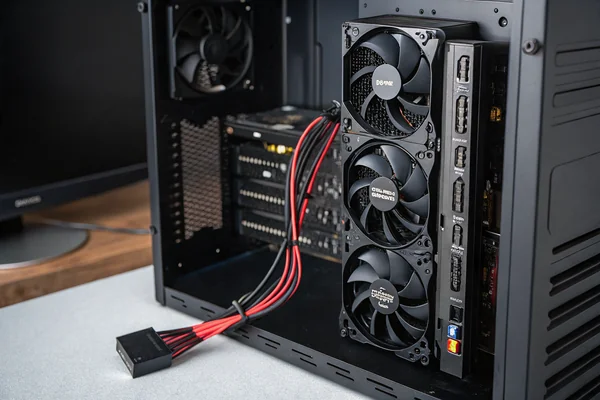
Ten millimeters of depth doesn't sound like much of a constraint until it's the exact number standing between a working thermal design and a fan that simply won't fit inside the enclosure.
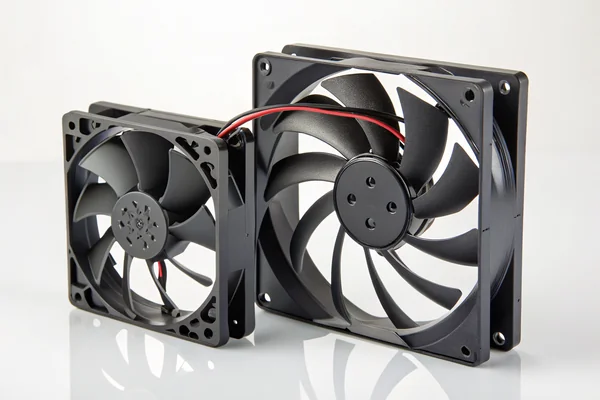
Slim DC axial fans -- often as thin as 10mm deep -- solve real space constraints in laptops, thin enclosures, and compact AV equipment, but that reduced depth comes with a genuine airflow and static pressure tradeoff compared to standard-depth fans of the same diameter.
- Standard-depth fans (typically 20-25mm+) simply don't fit in genuinely thin enclosures, which is exactly the gap slim fans exist to fill.
- Reduced blade depth means less air moved per rotation, so slim fans generally deliver lower CFM and static pressure than a standard-depth fan of the same diameter.
- 40x10, 60x10, and 80x15 are among the most commonly available slim fan sizes, though availability narrows compared to standard-depth equivalents.
- Laptops, thin enclosures, and slim AV equipment are the classic applications where the depth constraint simply overrides other considerations.
- Sourcing slim fans often means fewer supplier options and longer lead times than standard-depth fans, worth factoring into project timelines early.
Getting cooling right in a genuinely thin enclosure means accepting the performance tradeoff slim fans require and designing the rest of the thermal system around it.
Table of Contents
What Do You Do When a Standard-Depth Fan Just Doesn't Fit?
Sometimes the enclosure constraint isn't negotiable, and the fan has to adapt to it.
When a standard-depth fan doesn't physically fit, a slim fan -- with reduced blade and motor depth, often 10mm or even less -- becomes the practical option, accepting reduced airflow and static pressure performance in exchange for fitting the available space.
Why Depth Becomes the Overriding Constraint
In genuinely thin products -- slim laptops, compact AV receivers, thin monitor enclosures -- the available internal depth for a cooling fan is often fixed by the overall product design well before thermal engineering gets involved, leaving the fan as the component that has to adapt rather than the enclosure. This is a fundamentally different design process than typical fan selection, where the fan is chosen to match a thermal requirement -- here, the thermal requirement has to be met within a depth constraint that isn't up for negotiation.
| Standard Depth | Slim Depth | Typical Tradeoff |
|---|---|---|
| 25mm | 10mm | Lower CFM and static pressure at same diameter |
| 15mm | 10mm | Smaller reduction, still meaningful |
What Do You Actually Give Up With a Slim Fan?
The performance cost of going slim is real and worth understanding before committing to a design.
A slim fan gives up airflow and static pressure capability relative to a standard-depth fan of the same diameter, since reduced blade depth means less air moved per rotation -- the fan can partially compensate with higher speed, but that adds noise.
Why Blade Depth Directly Limits Performance
A fan blade's depth (along with its diameter and pitch) determines how much air it can move per rotation -- shrink that depth and the same rotational speed simply moves less air. Manufacturers can partially compensate by running a slim fan at higher RPM to recover some of the lost airflow, but higher speed increases both noise and bearing wear, so this compensation has real limits. The practical result is that slim fans generally can't fully match a standard-depth fan's performance at any reasonable noise level -- the depth reduction is a genuine tradeoff, not a free design choice.
What Are the Most Common Slim Fan Sizes You'll Actually Find?
Availability narrows meaningfully once you move into slim fan territory.
40x10mm, 60x10mm, and 80x15mm are among the most commonly available slim fan sizes, though the overall range of available slim options is narrower than the wide variety of standard-depth fan sizes on the market.
Why Availability Narrows for Slim Options
Standard-depth fans benefit from decades of high-volume manufacturing across a huge range of sizes, while slim fans serve a smaller, more specialized market, which means fewer suppliers stock a full range of slim sizes and depths. 40x10mm and 60x10mm cover many compact electronics applications, while 80x15mm sits in a middle ground offering somewhat better performance than the thinnest options while still fitting meaningfully tighter spaces than a standard 80x25mm fan.
Where Do Slim Fans Actually Get Used?
The applications that need slim fans share a common thread: depth genuinely isn't available.
Slim fans get used in laptops, thin external enclosures, compact AV equipment, and other products where overall product thinness is a design priority that leaves minimal internal depth for any cooling component, fan included.
Why These Applications Can't Use Standard-Depth Fans
Laptop cooling has driven much of the slim fan market's development, since thin laptop designs leave very little internal volume for cooling components generally. Thin external drive enclosures, compact AV receivers, and slim monitor or display electronics face the same fundamental constraint -- the product's overall thinness is a primary design goal that the cooling system has to work within, not override. In all these cases, a slim fan paired with a well-optimized heat sink and airflow path is usually the only way to achieve adequate cooling within the available depth.
What Should You Check When Sourcing a Slim DC Axial Fan?
Sourcing a slim fan successfully means confirming real performance data, not just the depth spec.
When sourcing a slim fan, confirm actual CFM and static pressure performance at your specific operating voltage and speed, check bearing type and rated life (which can be more constrained in slim designs), and verify lead time and minimum order quantities given narrower typical availability.
Why Real Performance Data Matters More Here
Because slim fans already operate with less performance margin than standard-depth equivalents, verifying real P-Q curve data at your intended operating point matters even more than with a standard fan, where a bit of extra margin might mask a marginal spec. Bearing life can also be more constrained in slim designs, since there's less physical space for larger, longer-lived bearing assemblies -- worth confirming explicitly rather than assuming slim and standard fans share equivalent reliability ratings.
Can a Slim Fan Ever Match a Standard-Depth Fan's Airflow?
There are some genuine limits to how much the performance gap can be closed.
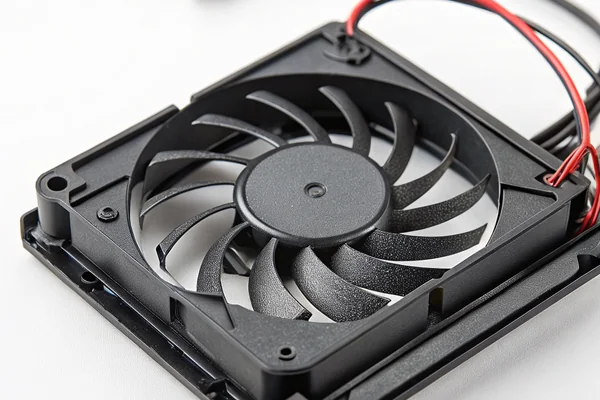
A slim fan can partially close the airflow gap with a standard-depth fan through higher rotational speed, more blades, or optimized blade geometry, but it generally can't fully match an equivalent-diameter standard-depth fan's airflow and static pressure without a meaningful noise penalty.
Why Full Parity Is Rarely Achievable
Design techniques like increasing blade count or optimizing blade pitch1 can meaningfully improve a slim fan's performance relative to a naive thin design, and manufacturers actively invest in this kind of optimization for popular slim sizes. But the fundamental physics of moving air with less blade depth available imposes a real limit -- closing the remaining gap generally requires higher speed, which trades away the acoustic advantage that might have made the slim design attractive in a noise-sensitive application in the first place.
Does Blade Count Matter More in Slim Fan Design?
Blade count becomes a more important optimization lever specifically because depth is constrained.
Blade count matters more in slim fan design because, with reduced depth limiting airflow per blade pass, increasing the number of blades is one of the more effective ways to partially recover lost performance without simply increasing speed and noise.
Why More Blades Helps More in a Slim Design
In a standard-depth fan, blade count is one of several performance levers alongside pitch and depth, but in a slim fan where depth is fixed and constrained, blade count becomes a comparatively more important tool for maximizing airflow within the available speed and noise budget. This is part of why well-optimized slim fans often use more blades than a standard-depth fan of similar diameter -- it's a deliberate design response to the depth constraint, not an arbitrary choice.
We've supplied slim DC axial fans into laptop, AV, and compact enclosure programs for over 20 years, and the real performance gap between slim and standard-depth fans is something we validate directly rather than estimate. Every slim fan we build is tested for actual CFM and static pressure on our in-house rigs as part of our ISO 9001 and IATF 16949 quality process, and we can supply comparative performance data against standard-depth equivalents so you know exactly what tradeoff you're accepting.
FAQ
Are slim fans significantly more expensive than standard-depth fans of the same diameter?
Often somewhat more expensive per unit, reflecting more specialized manufacturing and lower volume compared to standard-depth fans, though the difference varies by size and supplier.
Can I improve a slim fan's cooling by increasing its speed beyond the rated maximum?
Not safely -- running beyond rated speed risks bearing damage and reduced service life. Any speed increase should stay within the fan's rated operating range.
Do slim fans generally run louder than standard-depth fans at equivalent airflow?
Often yes, since achieving comparable airflow typically requires higher speed to compensate for reduced blade depth, and higher speed generally means more noise.
Is PWM speed control available on slim fans the same way it is on standard fans?
Yes, PWM control is available on many slim fan models, functioning the same way as on standard-depth fans.
What's the minimum practical depth for a functioning DC axial fan?
This varies by diameter and design, but very thin depths (well under 10mm) become increasingly difficult to engineer with adequate performance and bearing life, and availability narrows sharply below the common 10mm threshold.
Should I consider a centrifugal blower instead of a slim axial fan for a thin enclosure?
Sometimes -- centrifugal blowers can offer different tradeoffs for restricted spaces, particularly where static pressure matters more than raw airflow, and are worth evaluating alongside slim axial options for genuinely constrained designs.
Slim fan selection is fundamentally a negotiation between a fixed depth constraint and the performance you're willing to give up to meet it, and understanding that tradeoff clearly upfront avoids a thermal design that looks fine on paper but underperforms once built. At Herays, our Dongguan facility has supplied slim DC axial fans into laptop, AV, and compact enclosure programs for over 20 years, tested under ISO 9001 and IATF 16949 certification. If you're designing around a genuine depth constraint, we're glad to share real comparative performance data before you commit.
Blade pitch is the angle of a fan blade relative to its plane of rotation. Steeper pitch generally moves more air per rotation at the cost of requiring more torque, which is why pitch is one of the levers manufacturers adjust to partially compensate for reduced blade depth in slim fan designs. ↩

Liang
I've been working with DC fans for 30 years — long enough to have seen the industry evolve from basic sleeve bearing designs to today's high-efficiency, IP68-rated systems built for the harshest environments imaginable. I founded Herays because I believed manufacturers and engineers deserved a supplier who could talk technical from day one. Not just hand over a datasheet, but actually help you select the right fan for your thermal load, your enclosure, your certification requirements. Most of what I write here comes directly from problems I've solved on the factory floor or in customer applications — medical devices, laser equipment, industrial automation, you name it. If it involves moving air efficiently and reliably, I've probably spent time thinking about it. When I'm not obsessing over airflow curves, I'm usually helping a customer figure out why their cooling system isn't performing the way their simulation said it would.
View all posts by Liang