A fan that cools perfectly at sea level can quietly underperform once it's installed somewhere genuinely high up -- not because anything about the fan changed, but because the air it's moving got thinner.
Air density decreases with altitude, and since a fan moves air by volume rather than mass, thinner high-altitude air carries away less heat per unit of airflow -- which means cooling performance can derate meaningfully at elevation even though the fan itself is working exactly as designed.
- A fan's CFM rating describes volume moved, not mass -- at altitude, that same volume of air contains less actual mass, and therefore less cooling capacity.
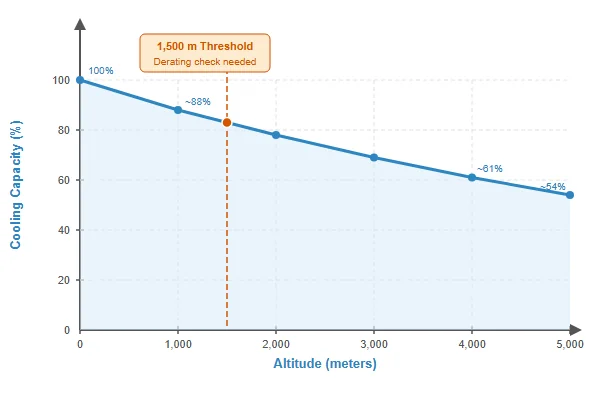
- Performance derating at high altitude is real and measurable, typically becoming meaningful above roughly 1,500-2,000 meters and more pronounced well above that.
- Telecom, mining, and outdoor equipment installed at high elevation are the applications most likely to actually encounter this problem in practice.
- Compensating for altitude derating usually means choosing a larger fan, running at higher speed, or both -- neither is free, in cost or noise.
- Practical derating calculations exist and are worth running explicitly for any installation above roughly 1,500 meters, rather than assuming sea-level ratings apply everywhere.
Understanding altitude derating means recognizing that a fan's rated CFM is a volume measurement, not a guarantee of cooling capacity everywhere it's installed.
Table of Contents
Why Does Air Density Matter So Much for Fans?
The physical thing a fan actually needs to move heat is air mass, not air volume.
Air density1 matters because cooling capacity depends on the actual mass of air moved past a hot surface, not just its volume -- a fan's CFM rating measures volume, so thinner high-altitude air delivers less real cooling capacity even at identical CFM.
Volume vs Mass: The Distinction That Actually Matters
Heat transfer from a hot component into moving air depends on how much air mass passes by, since mass -- not volume -- is what actually carries thermal energy away. A fan rated for a certain CFM at sea level moves that same volume of air at altitude, but because high-altitude air is less dense, that volume contains meaningfully less mass, and therefore delivers correspondingly less real cooling capacity than the same CFM rating would at sea level.
| Altitude | Approximate Air Density Reduction |
|---|---|
| Sea level | Baseline (100%) |
| 1,500m | Roughly 83-85% of sea-level density |
| 3,000m | Roughly 70-72% of sea-level density |
How Much Does Fan Performance Actually Derate at High Altitude?
The derating effect is real, measurable, and becomes more significant the higher the installation.
Fan cooling performance derates roughly in proportion to the reduction in air density, meaning a fan operating at 3,000 meters can deliver meaningfully less real cooling capacity -- often in the range of a quarter to a third less -- than the same fan would provide at sea level, even at identical CFM and speed.
Why This Becomes Significant Above Roughly 1,500 Meters
Below about 1,500 meters, the derating effect is often small enough to fall within normal design margin and go unnoticed. Above that threshold, and especially well above 2,000-3,000 meters, the effect becomes large enough that a cooling system sized purely around sea-level assumptions can genuinely underperform -- not due to any fan defect, but simply because the physics of moving less-dense air changed the real cooling math.
Which Applications Actually Run Into This Altitude Problem?
Most electronics never encounter this issue simply because most installations happen at moderate elevation.
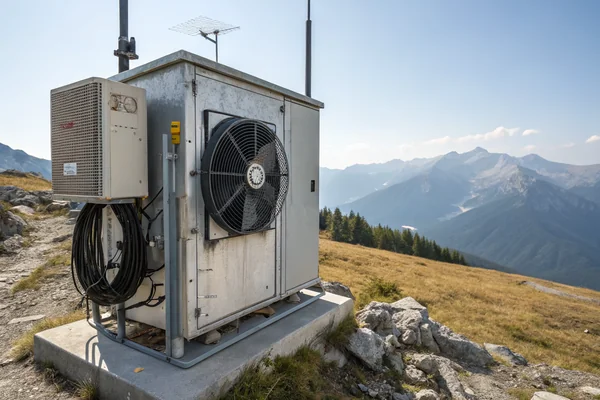
Telecom equipment on mountain sites, mining and industrial equipment at high-elevation locations, and outdoor infrastructure in genuinely mountainous regions are the applications most likely to actually encounter meaningful altitude derating -- most consumer and typical commercial electronics installations never reach elevations where this matters.
Where Altitude Derating Actually Shows Up in Practice
Telecom base stations and relay equipment are frequently installed at high elevation specifically because mountaintop locations improve signal coverage, making altitude derating a real, recurring design consideration for that industry. Mining operations and industrial equipment at high-elevation sites face the same issue, often combined with other harsh-environment factors like temperature extremes and dust. For equipment that stays at moderate elevations -- most cities, most data centers -- this remains a largely theoretical concern rather than a practical design constraint.
Bigger Fan or Higher Speed: How Do You Actually Compensate?
Two practical levers exist to offset altitude-related performance loss, each with its own tradeoff.
Compensate for altitude derating by selecting a larger fan (delivering more baseline CFM to offset the density reduction) or running the same fan at higher speed -- larger fans generally offer a better tradeoff, since higher speed alone increases noise and bearing wear proportionally more.
Weighing the Two Compensation Strategies
Choosing a larger fan increases baseline airflow capacity without necessarily increasing speed or noise proportionally, making it generally the more balanced compensation strategy when physical space allows it. Running an existing fan at higher speed can partially compensate without a hardware change, but this comes with a direct noise and bearing-wear penalty that scales with the speed increase, and won't fully close a large derating gap on its own at very high elevations. Many high-altitude designs actually combine both: a moderately larger fan and a modest speed increase, splitting the compensation between the two levers.
How Do You Actually Calculate the Derating for Your Application?
A practical derating calculation is straightforward once you have the right density figures for your installation elevation.
Calculate altitude derating by finding the air density ratio at your installation elevation relative to sea level (available from standard atmospheric tables), then applying that ratio to your fan's rated CFM to estimate real cooling capacity at altitude -- and sizing the fan (or adjusting speed) to compensate for the resulting gap.
Working Through a Practical Example
If a fan is rated for 50 CFM at sea level and your installation sits at an elevation where air density is roughly 80% of sea-level density, the real cooling capacity at that elevation is roughly 40 CFM-equivalent in terms of actual heat-carrying capacity, even though the fan is still physically moving close to 50 CFM of (thinner) air. Sizing the system around this adjusted figure, rather than the sea-level datasheet number, is the practical way to avoid under-provisioning cooling for a genuinely high-altitude installation.
Does Altitude Affect Cooling Electronics Differently Than Cooling the Fan Itself?
Altitude's effects extend beyond just the airflow the fan delivers to whatever it's cooling.
Altitude affects both the fan's cooling delivery to other electronics and, in some designs, the fan's own motor cooling and bearing behavior, since the fan's own internal components also rely on the same thinner air for their own heat dissipation.
Why the Fan Itself Isn't Immune to the Effect
A fan's motor generates its own heat during operation, and that heat also needs to dissipate into the surrounding air -- which means the fan's own components face reduced cooling effectiveness at altitude in addition to delivering reduced cooling capacity to whatever it's protecting. This is generally a secondary effect compared to the fan's reduced delivered cooling capacity, but it's worth factoring into genuinely extreme-altitude designs where every degree of thermal margin matters.
Should You Test at Altitude or Just Trust the Calculation?
For applications where the consequences of under-provisioned cooling are serious, real validation beats calculation alone.
For high-stakes or genuinely extreme-altitude applications, real testing at or near the actual installation elevation -- or in an altitude simulation chamber -- provides more confidence than calculation alone, since real-world factors like actual ambient temperature and enclosure airflow path interact with altitude derating in ways a simple density calculation doesn't fully capture.
Why Calculation Alone Sometimes Isn't Enough
The density-ratio calculation gives a reasonable first-order estimate, but real installations often combine altitude with other factors -- extreme temperature swings, dust, restricted enclosure airflow -- that interact with derating in ways a simple calculation doesn't fully capture. For applications where a cooling shortfall has real consequences (telecom infrastructure, safety-critical equipment), validating actual performance at or near real installation conditions is worth the additional testing effort beyond the calculated estimate.
We've supplied fans into high-altitude telecom and industrial programs for over 20 years, and altitude derating is a conversation we have regularly with customers installing equipment at elevation. Our in-house CFM and static pressure testing, part of our ISO 9001 and IATF 16949 quality process, can be supplemented with derating calculations and guidance for your specific installation elevation, and we're glad to help size a fan that accounts for real air density at your site rather than sea-level assumptions alone.
FAQ
At what altitude should I start worrying about fan derating?
Roughly 1,500 meters is a reasonable point to start checking derating explicitly, with the effect becoming more significant well above that, particularly past 2,000-3,000 meters.
Does altitude derating affect static pressure the same way it affects CFM?
Yes, static pressure capability is also affected by reduced air density, following similar general derating logic, though the exact relationship can vary by fan design.
Can electronic components other than the fan also be affected by altitude?
Yes -- reduced air density affects heat dissipation from any component relying on convective cooling, not just the fan, which is why high-altitude equipment design often needs a broader thermal review, not just fan sizing.
Is humidity also a factor at high altitude, alongside reduced density?
High-altitude environments often have lower humidity, which is a separate consideration from density-related derating but can also affect equipment design, particularly around static electricity and material behavior.
Do fan manufacturers publish altitude derating curves directly?
Some do, particularly manufacturers serving telecom and industrial markets where altitude is a common real-world consideration -- worth asking for directly if your application involves genuine elevation.
Does temperature interact with altitude derating in a way that makes the combined effect worse?
Yes -- high-altitude sites can also experience temperature extremes, and since both reduced density and elevated temperature separately reduce effective cooling, the combined effect at a hot, high-altitude site can be more significant than either factor alone.
Altitude derating is a real physical effect that's easy to overlook simply because most equipment never operates anywhere near the elevations where it matters -- but for telecom, mining, and outdoor infrastructure at genuine elevation, ignoring it means shipping a cooling system that looks adequate on paper and underperforms in the field. At Herays, our Dongguan facility has supplied DC fans into high-altitude telecom and industrial programs for over 20 years, tested under ISO 9001 and IATF 16949 certification. If your installation sits at meaningful elevation, we're glad to help run the real derating numbers before you finalize a fan spec.
Air density decreases with altitude as atmospheric pressure drops, meaning a given volume of air at high elevation contains less mass than the same volume at sea level. Since heat transfer depends on air mass rather than volume, this directly reduces a fan's real cooling capacity at altitude even at unchanged CFM. ↩

Liang
I've been working with DC fans for 30 years — long enough to have seen the industry evolve from basic sleeve bearing designs to today's high-efficiency, IP68-rated systems built for the harshest environments imaginable. I founded Herays because I believed manufacturers and engineers deserved a supplier who could talk technical from day one. Not just hand over a datasheet, but actually help you select the right fan for your thermal load, your enclosure, your certification requirements. Most of what I write here comes directly from problems I've solved on the factory floor or in customer applications — medical devices, laser equipment, industrial automation, you name it. If it involves moving air efficiently and reliably, I've probably spent time thinking about it. When I'm not obsessing over airflow curves, I'm usually helping a customer figure out why their cooling system isn't performing the way their simulation said it would.
View all posts by Liang