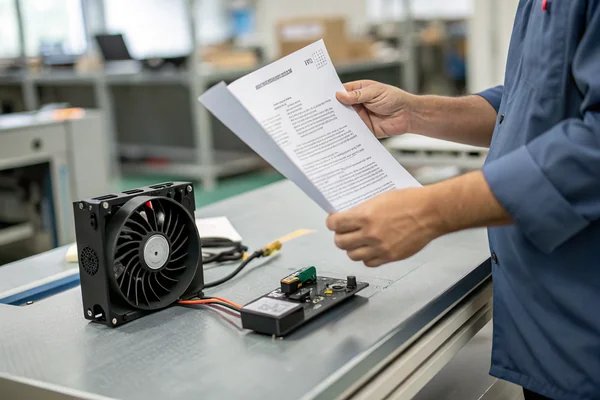
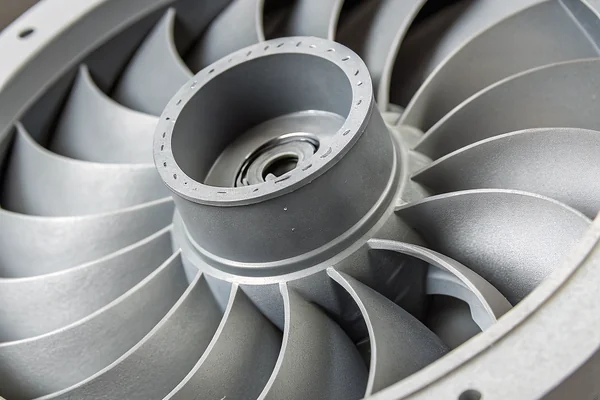
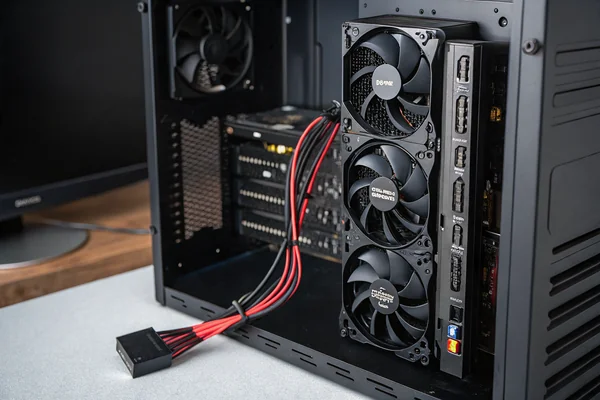
Two fans can look nearly identical -- same diameter, same blade count, same motor -- and still perform completely differently once spinning, because of a spec that rarely shows up on a datasheet at all: the angle the blades are actually cut at.
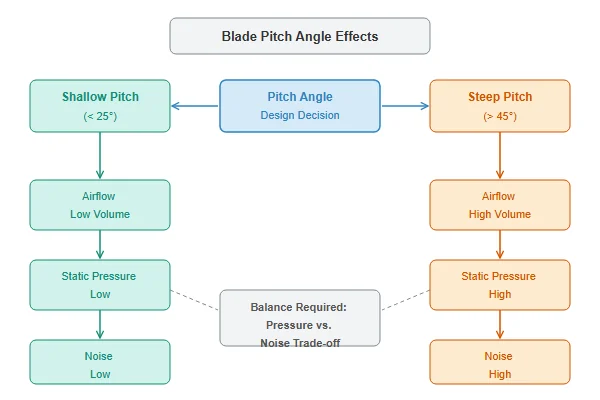
Blade pitch angle directly determines the tradeoff between static pressure and airflow a fan delivers, and between how much noise it generates doing it -- steeper pitch pushes more pressure at the cost of more noise, while shallower pitch favors airflow and quieter operation.
- Blade pitch angle is the angle of the blade relative to its plane of rotation, and it's one of the most consequential -- and least discussed -- specs in fan design.
- Higher pitch angles generate more static pressure per rotation, useful for restrictive airflow paths, but at the cost of more noise and higher power draw.
- Lower pitch angles favor airflow volume over pressure, and tend to run quieter at a given speed, making them well suited to open-air cooling.
- Manufacturers optimize pitch for a specific target application rather than using one universal angle, balancing airflow, pressure, noise, and efficiency together.
- Variable pitch fans exist but remain a niche, mechanically complex solution reserved for applications where the operating range genuinely justifies the added cost and complexity.
Understanding blade pitch angle explains a surprising amount of why two similar-looking fans can perform so differently.
Table of Contents
What Exactly Is Blade Pitch Angle, and Why Does It Matter?
Pitch angle is a simple geometric measurement with outsized real-world consequences.
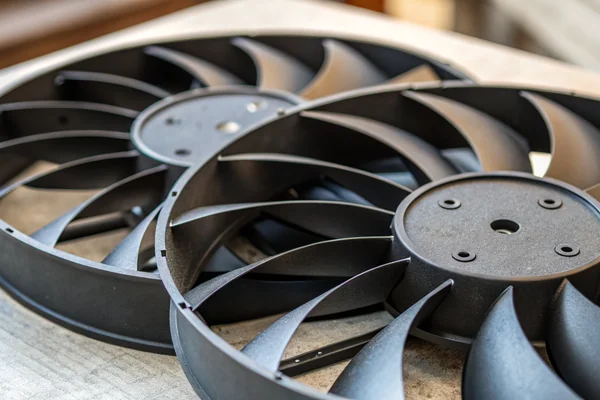
Blade pitch angle1 is the angle at which each blade is set relative to its plane of rotation, and it directly determines how much air a blade pushes per rotation and how much resistance (and noise) it generates doing so -- making it one of the most fundamental levers in fan performance design.
Why This Angle Shapes Nearly Everything Else
Think of blade pitch similarly to a propeller or a boat propeller's pitch -- a steeper angle "bites" more air per rotation, moving more volume or generating more pressure depending on the application, while a shallower angle moves less air per rotation but does so more efficiently and with less resistance. This single geometric parameter interacts with blade count, rotational speed, and diameter to determine a fan's overall performance character, which is why pitch angle is a foundational design decision rather than a minor detail.
| Pitch Angle | Airflow Effect | Pressure Effect | Noise Effect |
|---|---|---|---|
| Steeper | Can reduce free-air CFM | Higher static pressure | More noise, more power draw |
| Shallower | Higher free-air CFM | Lower static pressure | Generally quieter |
Why Does a Higher Pitch Angle Mean More Pressure and More Noise?
The pressure-and-noise relationship at steep pitch angles follows directly from basic aerodynamics.
A higher pitch angle generates more static pressure because each blade pass pushes against more resistance per rotation, which is useful for restrictive airflow paths, but that same aggressive air-pushing action creates more turbulence and blade-tip noise, along with higher power draw to maintain the same rotational speed.
Why More Pressure Doesn't Come for Free
Pushing air more aggressively per rotation means the blade is doing more mechanical work against the air, which shows up as increased turbulence at the blade tips and trailing edges -- a major source of fan noise generally. The motor also has to work harder to maintain speed against that increased resistance, drawing more power and generating more mechanical noise in the process. This is why high-pitch fan designs, while effective for pushing through filters or restrictive ducts, are rarely the quiet option.
Why Does a Lower Pitch Angle Mean More Airflow and Less Noise?
Shallow pitch trades pressure capability for efficiency and quieter operation.
A lower pitch angle favors moving a larger volume of air with less resistance per rotation, generally running quieter and more efficiently at a given speed -- but it produces lower static pressure, making it a poorer fit for restrictive airflow paths where pressure capability actually matters most.
Why Shallow Pitch Suits Open-Air Applications Best
With less aggressive air displacement per rotation, a shallow-pitch blade generates less turbulence and requires less torque to maintain speed, translating into both lower noise and better efficiency for a given airflow target. This makes shallow pitch well suited to open-air cooling applications -- general case cooling, unrestricted ventilation -- where moving a large volume of air quietly matters more than pushing through significant resistance.
How Do Manufacturers Actually Optimize Pitch for a Given Application?
Pitch selection reflects a deliberate design process matched to the fan's intended use, not an arbitrary choice.
Manufacturers optimize pitch angle by balancing the target application's airflow versus pressure requirements against acceptable noise and power draw limits, often validating the choice through iterative testing across candidate pitch angles rather than relying on theoretical calculation alone.
Why This Optimization Requires Real Testing
While aerodynamic theory provides a starting point, real fan performance depends on the interaction between pitch, blade count, blade shape, motor characteristics, and the specific application's actual resistance -- which is complex enough that manufacturers typically validate pitch choices through physical testing across a range of candidate designs rather than trusting calculation alone. A fan intended for restrictive filtered applications gets tuned toward higher pitch within acceptable noise limits, while a fan intended for quiet open-air cooling gets tuned toward the shallowest pitch that still meets its airflow target.
Do Variable Pitch Fans Actually Exist, and Who Needs Them?
Variable pitch mechanisms exist but remain a specialized, niche solution.
Variable pitch fans, where blade angle can be mechanically adjusted during operation, do exist but remain a niche solution reserved for applications with a genuinely wide operating range where the mechanical complexity and cost are justified -- most DC axial fan applications use a fixed pitch chosen for their specific use case instead.
Why Fixed Pitch Remains the Practical Default
Variable pitch mechanisms add real mechanical complexity, cost, and additional failure points compared to a simple fixed-pitch blade, which is difficult to justify unless an application genuinely needs to shift between very different operating regimes -- high pressure at one point, high airflow at another -- often enough to matter. For the large majority of DC axial fan applications, selecting an appropriately fixed pitch angle for the specific use case, rather than adding variable pitch complexity, remains the more practical and reliable engineering choice.
Can Blade Pitch Be Changed on an Existing Fan, or Is It Fixed at Manufacturing?
Pitch angle is generally a manufacturing-time decision, not a field-adjustable spec.
Blade pitch is fixed at manufacturing for the vast majority of DC axial fans, molded or formed into the blade geometry itself -- it's not something that can be adjusted after the fact on a standard fan, which means pitch needs to be specified correctly at the sourcing stage, not corrected later.
Why Pitch Selection Has to Happen Upfront
Since blade pitch is built into the physical geometry of the blade during manufacturing (typically injection molding for plastic blades), there's no practical way to adjust it on a finished fan the way you might adjust speed or add filtering after the fact. This makes pitch angle one of the specs worth getting right during initial fan selection or custom specification, rather than something that can be corrected through a later modification if the original choice turns out to be a mismatch for the application.
Does Pitch Angle Interact With Blade Count in Ways Engineers Should Know?
Pitch and blade count work together rather than independently, and the combination matters more than either spec alone.
Blade pitch angle and blade count interact significantly -- more blades at a given pitch can increase pressure capability similarly to a steeper pitch with fewer blades, which means fan designers balance the two together rather than treating pitch as an isolated variable, and it's worth understanding both specs together when evaluating a fan's likely performance character.
Why the Combination Matters More Than Either Spec Alone
A fan with fewer, more steeply pitched blades and a fan with more numerous, more shallowly pitched blades can sometimes achieve broadly similar pressure characteristics through different design paths, each with its own noise and efficiency profile. This is part of why comparing two fans on blade count or pitch alone, without considering how they interact, can miss real performance differences -- the combination of pitch, count, and blade shape together determines a fan's actual character more than any single spec read in isolation.
We've engineered blade geometry -- pitch, count, and shape together -- for over 20 years across our DC axial fan lines, tuning each design for its intended balance of airflow, pressure, and noise. Every blade design we produce is validated on our in-house CFM, static pressure, and anechoic noise testing equipment as part of our ISO 9001 and IATF 16949 quality process, and we can discuss the specific pitch and blade design tradeoffs behind any fan we supply for your application.
FAQ
Is a higher blade pitch angle always the wrong choice for a quiet application?
Generally yes, if quiet operation is the priority -- higher pitch trades toward pressure capability at the cost of noise, so quiet applications typically favor lower pitch designs instead.
Can two fans with the same pitch angle still perform differently?
Yes -- pitch is one factor among several (blade count, blade shape, diameter, motor characteristics) that together determine overall performance, so matching pitch alone doesn't guarantee matching performance.
Does blade material affect how pitch angle performs in practice?
Indirectly -- material affects blade rigidity, which can influence how much the blade flexes under load, subtly affecting real-world performance relative to the nominal pitch angle design.
Is pitch angle typically listed on a standard fan datasheet?
Not usually as an explicit number -- pitch is more often reflected indirectly through the fan's published P-Q curve and noise specifications rather than stated as a standalone spec.
Do centrifugal blower fans use the concept of blade pitch the same way axial fans do?
The underlying blade geometry principles are related but applied differently, since centrifugal blowers move air perpendicular to the intake rather than parallel to the axis, giving pitch a somewhat different practical role in blower blade design.
Should I ask a supplier about blade pitch specifically when sourcing a custom fan?
If your application has unusual pressure or noise requirements, yes -- discussing pitch and blade design directly with the supplier, rather than relying solely on standard datasheet specs, can help ensure the fan is genuinely optimized for your specific use case.
Blade pitch angle is one of the more invisible specs in fan design, rarely printed directly on a datasheet, yet it quietly shapes the fundamental tradeoff between pressure, airflow, and noise that determines whether a fan actually fits its intended application. At Herays, our Dongguan facility has engineered blade geometry for DC axial fans for over 20 years, validated under ISO 9001 and IATF 16949 certification. If your application has a specific pressure, airflow, or noise target, we're glad to discuss the blade design tradeoffs behind getting it right.
Blade pitch is the angle between a blade's chord line and its plane of rotation. Steeper pitch increases the volume of air displaced per rotation at the cost of more resistance and turbulence, which is the same underlying principle used in propeller and turbine blade design. ↩

Liang
I've been working with DC fans for 30 years — long enough to have seen the industry evolve from basic sleeve bearing designs to today's high-efficiency, IP68-rated systems built for the harshest environments imaginable. I founded Herays because I believed manufacturers and engineers deserved a supplier who could talk technical from day one. Not just hand over a datasheet, but actually help you select the right fan for your thermal load, your enclosure, your certification requirements. Most of what I write here comes directly from problems I've solved on the factory floor or in customer applications — medical devices, laser equipment, industrial automation, you name it. If it involves moving air efficiently and reliably, I've probably spent time thinking about it. When I'm not obsessing over airflow curves, I'm usually helping a customer figure out why their cooling system isn't performing the way their simulation said it would.
View all posts by Liang