A charging station that overheats and derates doesn't just annoy the driver waiting for a full charge -- it becomes a visible, public failure of infrastructure that's supposed to just work, every time, in a parking lot with nobody watching.
DC axial fans for EV charging infrastructure need to handle high-power, continuous-duty operation, real outdoor IP-rated protection, strict public-space noise limits, and redundant design -- charger reliability usually comes down to whether the cooling system was actually built for all four at once.
- EV chargers, especially DC fast chargers, convert and deliver serious power, and the conversion losses generate real heat that active cooling has to manage continuously.
- Charger fans run under genuinely high-power, continuous-duty conditions, closer to industrial power electronics cooling than typical consumer electronics.
- Outdoor chargers need real IP-rated fans, since public charging infrastructure faces rain, dust, and temperature extremes without the shelter typical indoor equipment gets.
- Public space noise constraints matter more for charging infrastructure than people expect, since chargers sit in parking lots and streetside locations near people.
- Redundant fan design is what actually determines whether a single fan failure takes a charger offline or just reduces its margin -- a real reliability differentiator between charger designs.
Getting cooling right for EV charging infrastructure means treating it as demanding, continuous-duty power electronics cooling in a public-facing outdoor environment, all at once.
Table of Contents
Why Does EV Charging Infrastructure Generate So Much Heat?
Moving serious power through a compact charger enclosure comes with real conversion losses.
EV charging infrastructure generates significant heat because converting and delivering high power -- especially in DC fast chargers -- involves real conversion losses in the power electronics, concentrated in a compact enclosure that has to manage that heat continuously during every charging session.
Where the Heat Actually Accumulates
DC fast chargers convert grid AC power to the DC power an EV battery actually needs, and that conversion, at genuinely high power levels, loses real energy as heat in the process -- more so than a Level 2 AC charger delivering power at a much lower rate. The faster the charging speed, the more power flows through the conversion electronics per unit time, and the more heat needs to be managed to sustain that charging rate without derating.
| Charger Type | Power Level | Cooling Demand |
|---|---|---|
| Level 2 AC | Moderate | Lower, often simpler cooling |
| DC Fast Charge | High | Significant, continuous-duty cooling |
What Does High-Power, Continuous-Duty Fan Operation Actually Demand?
Charger cooling fans face a duty cycle closer to industrial power electronics than typical consumer devices.
High-power, continuous-duty operation demands fans with bearing life rated for genuinely sustained running under real thermal load, since a charger in active public use can run its cooling system through many charging sessions per day, accumulating run-hours at a pace that intermittent-use consumer applications never approach.
Why This Isn't Like Typical Consumer Electronics Cooling
A charging station in a busy location might see dozens of charging sessions daily, each one putting the cooling system to real work for the duration of the charge, which adds up to substantially more cumulative fan run-hours and thermal cycling than most consumer electronics ever experience. This pushes fan selection toward the same continuous-duty reliability standards used in industrial and telecom power electronics cooling, not general-purpose consumer-grade fans.
What IP Rating Does an Outdoor Charger Fan Actually Need?
Outdoor charging infrastructure faces real weather exposure that indoor equipment simply doesn't.
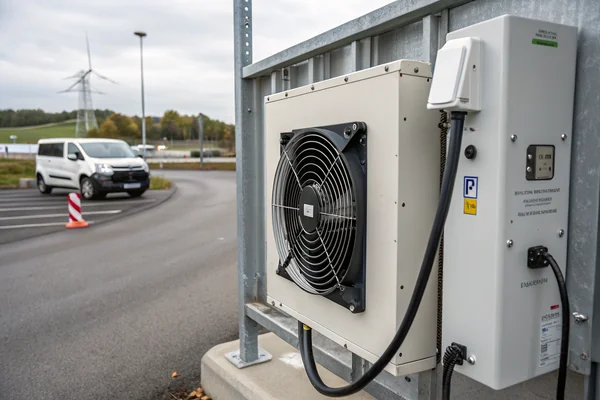
Outdoor charger fans typically need a meaningful IP rating1 -- often IP54 or higher -- to handle rain, dust, and general outdoor exposure without the sheltered conditions most indoor cooling fans can assume, since public charging stations sit exposed in parking lots and streetside locations year-round.
Why Standard Indoor Fan Ratings Fall Short Outdoors
A fan rated for typical indoor dust protection alone isn't necessarily built to handle direct or wind-driven rain, road spray from nearby traffic, or the freeze-thaw cycling outdoor installations experience across seasons. Public charging infrastructure needs to keep functioning reliably through all of this without special weather protection beyond the charger's own enclosure design, which is why IP rating deserves the same explicit attention as electrical and thermal specs when selecting a charger cooling fan.
How Quiet Does a Charger Fan Need to Be in a Public Parking Lot?
Charging infrastructure sits in genuinely public spaces where noise gets noticed differently than in dedicated equipment rooms.
Charger fans in public spaces typically need to stay within reasonable noise limits -- often comparable to general urban ambient noise -- since chargers are frequently located near pedestrian areas, retail entrances, or residential-adjacent parking, where persistent mechanical noise draws complaints and can affect siting approval.
Why Public Siting Makes Noise a Real Design Constraint
Unlike equipment tucked away in a utility room, a charging station is often deliberately placed for driver convenience -- near building entrances, in visible parking areas -- which puts it close to people who aren't there specifically to tolerate industrial equipment noise. Excessive fan noise can become a real friction point in permitting and community acceptance for charging infrastructure siting, which is exactly why noise specifications deserve real attention during charger cooling design, not just an afterthought once the electrical design is finalized.
Why Does Charger Reliability Usually Come Down to Redundant Fan Design?
A single point of cooling failure has outsized consequences for public charging infrastructure.
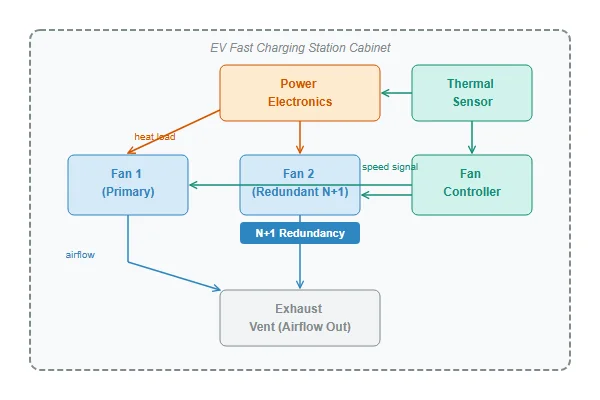
Charger reliability often comes down to redundant fan design because a single fan failure in a non-redundant system can force the charger to derate power output or shut down entirely, taking a public charging point offline until service arrives -- redundancy keeps the charger functional, even at reduced capacity, through a single fan failure.
Why Redundancy Matters More Here Than in Many Applications
A charging station is public-facing infrastructure that drivers actively rely on being available, and unlike equipment in a monitored facility, chargers are often unattended for long stretches between service visits. A cooling failure that takes a charger fully offline creates a visible, public reliability problem -- lost revenue for the operator, and a frustrated driver who can't charge -- which is exactly the scenario N+1 fan redundancy is designed to prevent, keeping the charger at least partially functional until scheduled maintenance can address the failed unit.
Does Fast Charging (DC Fast Charge) Change the Cooling Requirement vs Level 2?
Charging speed directly drives how demanding the cooling requirement actually is.
DC fast charging significantly increases cooling demand compared to Level 2 AC charging, since fast charging moves much higher power through the conversion electronics in a shorter time, generating proportionally more heat that needs to be managed continuously during each charging session.
Why Charging Speed and Cooling Demand Scale Together
Level 2 AC charging delivers power at a rate low enough that many installations manage with more modest cooling, sometimes even largely passive designs in favorable climates. DC fast charging, by delivering power an order of magnitude higher, generates correspondingly more heat in the conversion electronics, making active, high-capacity cooling a non-negotiable part of the design rather than an optional enhancement. This is a big part of why DC fast charger cooling systems look and perform more like industrial power electronics cooling than the simpler approach adequate for slower charging.
What Happens to Charging Speed When a Charger's Cooling Fan Fails?
The consequence of a cooling failure directly affects the charging experience drivers actually get.
When a charger's cooling fan fails, the charging system typically responds by derating output power to reduce heat generation, meaningfully slowing charging speed, or in more severe cases, shutting the charger down entirely -- either outcome is a visible, public-facing reliability failure for the charging network operator.
Why This Failure Mode Directly Affects the Customer Experience
Unlike a cooling failure in equipment tucked away from public view, a derated or offline charger is immediately obvious to the driver trying to use it, and directly affects their charging experience and trust in the network. This direct, visible connection between cooling reliability and customer-facing charger performance is exactly why charging network operators increasingly treat cooling system design and redundancy as a genuine reliability priority, not a secondary engineering detail.
We've supplied fans into EV charging infrastructure programs for over 20 years, and IP rating combined with continuous-duty bearing reliability is consistently what charging equipment manufacturers ask us to validate most rigorously. Every fan we build for charging infrastructure customers goes through our in-house salt spray, temperature cycling, and continuous-duty life testing as part of our ISO 9001 and IATF 16949 quality process, and we can supply redundant-ready fan configurations validated for real outdoor public deployment conditions.
FAQ
Do Level 2 chargers need the same cooling rigor as DC fast chargers?
Generally less, given the lower power levels involved, though outdoor Level 2 installations still need real weather protection and reasonable reliability regardless of the reduced thermal load.
How often should charging station cooling fans be inspected or serviced?
This varies by network operator policy, but given the public-facing consequences of failure, many operators schedule more frequent inspection than typical indoor industrial equipment would require.
Does charger cooling fan noise get regulated by local ordinances?
It can, depending on jurisdiction and the specific siting location -- worth checking local noise ordinances during charger siting and design, particularly for residential-adjacent installations.
Can charger cooling fans be monitored remotely for early failure detection?
Many modern charging systems support remote monitoring, including fan status, which lets operators catch developing cooling issues before they cause a full charger outage.
Does climate (hot vs cold region) change charger fan requirements significantly?
Yes -- hot climate installations face a harder cooling challenge with less ambient thermal margin, while cold climate installations need to consider startup reliability at low temperatures, both of which affect fan specification.
Is redundant fan design standard across the EV charging industry, or does it vary by manufacturer?
It varies -- redundancy is more common in higher-end, fleet, or commercial charging equipment, while lower-cost residential or lower-power public chargers sometimes use simpler, non-redundant cooling designs.
EV charging infrastructure cooling combines high-power continuous duty, real outdoor exposure, public-space noise sensitivity, and the reliability stakes of publicly visible equipment -- all at once, which is exactly why it deserves more rigorous fan specification than typical indoor electronics cooling. At Herays, our Dongguan facility has supplied IP-rated, continuous-duty DC fans into EV charging infrastructure programs for over 20 years, validated under ISO 9001 and IATF 16949 certification. If you're specifying cooling for charging equipment, prioritize real outdoor and continuous-duty test data over standard indoor fan specs.
The IP (Ingress Protection) code rates resistance to solid particles and moisture using two digits. Outdoor equipment exposed to rain and dust, like EV chargers, typically needs a rating such as IP54 or higher to reliably handle real weather exposure over years of service. ↩

Liang
I've been working with DC fans for 30 years — long enough to have seen the industry evolve from basic sleeve bearing designs to today's high-efficiency, IP68-rated systems built for the harshest environments imaginable. I founded Herays because I believed manufacturers and engineers deserved a supplier who could talk technical from day one. Not just hand over a datasheet, but actually help you select the right fan for your thermal load, your enclosure, your certification requirements. Most of what I write here comes directly from problems I've solved on the factory floor or in customer applications — medical devices, laser equipment, industrial automation, you name it. If it involves moving air efficiently and reliably, I've probably spent time thinking about it. When I'm not obsessing over airflow curves, I'm usually helping a customer figure out why their cooling system isn't performing the way their simulation said it would.
View all posts by Liang