Fans that look identical on a spec sheet can sound completely different in use, and the difference isn't random. Noise is engineered -- or it isn't.
DC fan acoustic performance is determined by four overlapping factors: blade aerodynamic design (which drives tonal noise), bearing type (which drives broadband noise floor), rotational speed (which scales both), and the validation method used to measure the result -- and optimizing for quiet operation requires addressing all four, not just one.
- Fan noise has two distinct characters -- tonal noise driven by blade aerodynamics and broadband noise driven by bearing mechanics -- and they respond to different design interventions.
- Blade geometry determines tonal noise signature: the number of blades, their pitch, tip clearance, and surface finish all shape how loudly each blade pass announces itself.
- Bearing type sets the broadband noise floor, with fluid dynamic bearings generally outperforming sleeve and ball options in both absolute noise and long-term stability.
- Speed control is the most powerful acoustic tool available after the fan is already designed -- dropping RPM even modestly can yield large dBA reductions because fan noise scales nonlinearly with speed.
- Acoustic spec claims are only as meaningful as the test conditions behind them -- an anechoic chamber measurement under controlled load differs significantly from installed real-world performance, and engineers should know what they're actually comparing.
Getting a cooling design genuinely quiet requires understanding what's generating each type of noise in the first place, then working the right levers in the right order.
Table of Contents
Where Does Fan Noise Actually Come From?
Fan noise isn't a single thing -- it's a mix of distinct sources with different physical origins and different design solutions.
DC fan noise comes from two primary mechanisms: aerodynamic noise generated by the blade-air interaction (tonal, periodic, blade-frequency-dependent) and mechanical noise generated by the bearing and motor assembly (broadband, continuous, speed-dependent) -- and reducing total noise requires treating both, since they are largely independent of each other.
Aerodynamic Noise: Periodic and Predictable
Aerodynamic noise has a tonal character. Each time a blade passes a fixed point -- the frame edge, an obstruction, or a pressure concentration -- it creates a pressure pulse in the air. Those pulses occur at a frequency directly tied to blade count and RPM, called the blade pass frequency1. The result is a pitched hum that's often more perceptible and more irritating to occupants than an equivalent level of broadband noise, because the human auditory system is disproportionately sensitive to tonal content. Turbulence at blade tips and trailing edges adds secondary aerodynamic noise on top of that fundamental frequency.
Mechanical Noise: Broadband and Continuous
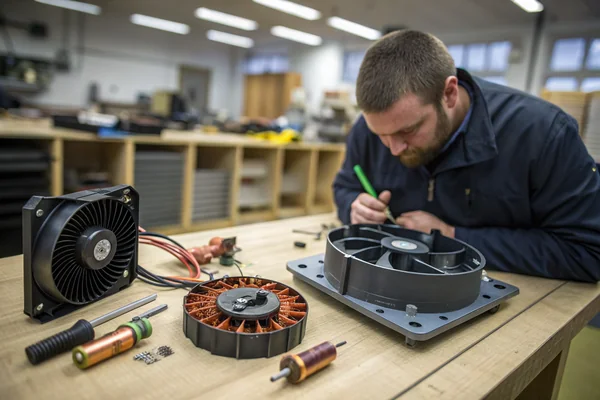
Mechanical noise from the bearing and motor assembly adds a white-noise-like floor beneath the aerodynamic tones. This includes bearing contact noise, motor coil vibration, and any imbalance in the rotor assembly that creates vibration transmitted through the fan frame into the mounting structure. Unlike aerodynamic noise, bearing-generated noise tends to worsen gradually over the fan's operational life as bearing surfaces wear -- which is why bearing selection is as much a long-term acoustic decision as an initial-performance one.
What Is It About Blade Design That Creates Tonal Noise?
Blade design is the primary driver of tonal noise, and several geometric decisions compound to determine how loud that tonal content becomes.
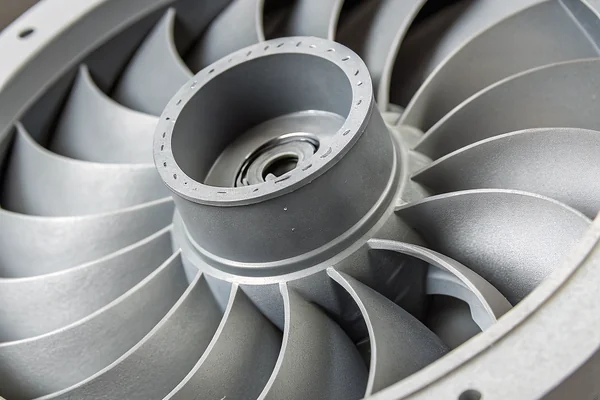
Blade shape, count, pitch angle, tip clearance, and surface finish all contribute to the aerodynamic tonal noise a fan generates -- not as isolated variables but as an interacting system, where a change to one parameter typically shifts the balance between noise, airflow, and pressure simultaneously.
Why Blade Count and Tip Clearance Matter Most
Blade count directly determines the blade pass frequency and how discrete or diffuse the resulting tonal signature sounds. More blades distribute the pressure pulse work more evenly, which can reduce individual pulse amplitude and shift the tonal frequency upward (generally less perceptible), but more blades also increase surface area contributing to trailing-edge turbulence noise. The tradeoff depends heavily on blade shape and the specific application.
Tip clearance -- the gap between blade tip and fan shroud -- is a significant and often underappreciated noise source. A larger gap allows air to recirculate from the high-pressure side to the low-pressure side of the blade at the tip, creating turbulence directly at the leading edge of the following blade. Tight, consistent tip clearance reduces this recirculation and is one of the more mechanically demanding aspects of precision fan manufacturing to maintain across a production run.
Pitch angle interacts with both: steeper pitch generates higher pressure per rotation, which means more aggressive blade-tip pressure gradients and more potential for turbulent recirculation. Shallower pitch tends to reduce tonal intensity alongside the pressure reduction.
| Blade Design Variable | Primary Noise Effect | Secondary Tradeoff |
|---|---|---|
| Higher blade count | Shifts tonal frequency upward, diffuses pulses | Can increase trailing-edge turbulence noise |
| Tighter tip clearance | Reduces tip recirculation turbulence | Demands tighter manufacturing tolerances |
| Steeper pitch angle | Increases tonal amplitude at blade pass frequency | Higher static pressure capability |
| Smoother blade surface | Reduces trailing-edge turbulence | Affects mold complexity and cost |
Does Bearing Type Really Change How Quiet a Fan Sounds?
Bearing choice has a larger effect on the long-term acoustic floor than most system designers account for at selection time.
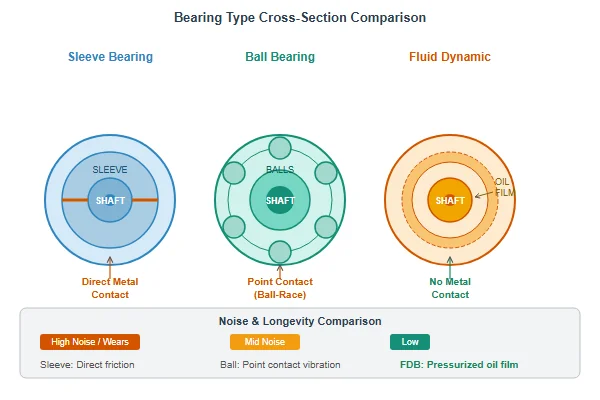
Bearing type sets the broadband noise floor of the fan and -- critically -- determines how much that floor drifts upward as the fan ages. Fluid dynamic bearings2 generally offer the best initial noise performance and the flattest degradation curve over time, while sleeve bearings start acceptably quiet but deteriorate faster, and ball bearings contribute audible high-frequency contact noise from the start.
Sleeve vs. Ball vs. Fluid Dynamic: What the Data Actually Shows
Sleeve bearings use a porous oil-impregnated bushing that works quietly when new but is genuinely orientation-sensitive and prone to oil migration over time -- particularly in horizontal shaft orientations -- leading to rising noise as the lubrication film thins. An independent long-term comparison by GamersNexus found measurable lifespan and noise performance differences across bearing types under real operating conditions, with fluid dynamic bearings outperforming sleeve bearings significantly in longevity.
Ball bearings introduce a different problem: the rolling contact between balls and race races generates a continuous high-frequency scraping or hissing noise that's spectrally distinct from aerodynamic tones. At high RPM or in precision-sensitive applications, this can be the dominant noise source. Ball bearings handle orientation and temperature extremes better than sleeve, but the acoustic penalty is real and should factor into quiet-application specification.
Fluid dynamic bearings use a pressurized oil film to keep the shaft fully separated from the bearing surface during operation, eliminating metal-to-metal contact entirely. The result is both a lower initial noise floor and substantially better noise stability over operating life -- making fluid dynamic the default choice for acoustic-priority applications where the cost premium is justified.
How Powerful Is Speed Control as an Acoustic Tool, and What Are Its Limits?
Speed reduction is the single most effective acoustic lever available after the fan is already designed and installed.
Fan noise scales roughly with the fifth to sixth power of tip speed aerodynamically, meaning even a modest RPM reduction delivers disproportionate noise benefit -- but the practical floor is set by thermal requirements, and using speed control to compensate for a fundamentally mismatched fan wastes the full potential of both the control strategy and the cooling system.
Why PWM Control Changes the Acoustic Equation
PWM (pulse-width modulation)3 speed control allows fan speed to track actual thermal load rather than running at maximum speed continuously. In most real applications, peak thermal load is intermittent -- the fan only needs to run at full speed for a fraction of its operating time. Reducing speed during low-load periods isn't just an acoustic nicety; it's a genuine engineering efficiency gain that also extends fan bearing life. The acoustic benefit at lower speeds is substantial: a fan running at 60% of its maximum speed isn't generating 40% less noise, it's generating far less because of the nonlinear scaling relationship.
The limit of speed control as an acoustic strategy is the minimum cooling requirement. A fan that's aerodynamically mismatched -- too small, wrong pitch, insufficient blade count for the required static pressure -- will spend most of its time at or near maximum speed just to meet the thermal target, leaving little room for speed-based noise reduction. Getting the initial fan specification right for the application is a prerequisite to speed control actually delivering acoustic headroom.
Tachometer Feedback and Acoustic Stability
Closed-loop RPM control via tachometer feedback also contributes to acoustic stability by preventing the hunting behavior (oscillating speed) that can create intermittent tonal shifts more irritating to occupants than steady-state noise at a somewhat higher level. A fan that holds its speed precisely also holds its blade pass frequency precisely, which is preferable to one that drifts.
How Do You Verify a Supplier's Noise Spec Is Actually Meaningful?
Acoustic specs on fan datasheets vary enormously in how and where they were measured -- and the measurement conditions determine everything about what the number is actually telling you.
A fan's dBA specification is only meaningful relative to the test conditions under which it was measured: distance, load point on the P-Q curve, ambient background level, and whether an anechoic environment was used all affect the result significantly -- and suppliers unwilling or unable to share test methodology details are implicitly telling you something about spec confidence.
What "Anechoic Chamber" Testing Actually Controls For
An anechoic chamber4 eliminates sound reflections from walls, floor, and ceiling, allowing noise to be measured as if the fan were radiating into free space. This removes the room's acoustic signature from the measurement, making results repeatable and comparable across facilities. Testing outside an anechoic environment -- even in a large, treated room -- introduces reflections that vary by room and measurement position, making the published number difficult to replicate or compare against other measurements made elsewhere.
Even with anechoic conditions, load point matters. Fan noise changes significantly across the operating range -- a fan running against low resistance (high airflow, low pressure) behaves differently than the same fan running against high resistance. A noise spec measured at free-delivery (no restriction) understates real-world noise in most installed applications. Asking which operating point the noise spec corresponds to is a reasonable and specific question that legitimate suppliers should be able to answer.
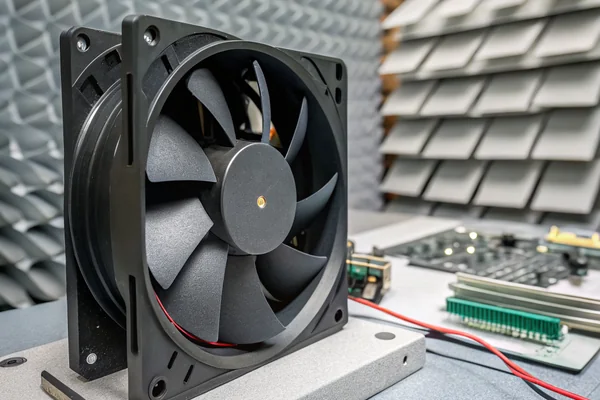
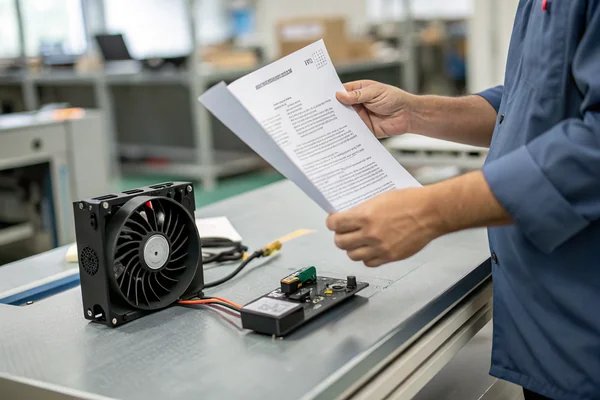
Our Dongguan facility validates noise performance in a dedicated anechoic noise test chamber as a standard part of the development and quality process, not as an afterthought. Automated dynamic balance test and correction equipment is used on every production run to control the mechanical noise contribution from rotor imbalance -- which is one of the less-discussed sources of fan noise that degrades most visibly in the field. Both capabilities are part of our ISO 9001 and IATF 16949 certified process, and we can share test methodology details for any fan we supply.
What Should Engineers Specify Differently When Acoustic Performance Is a Priority?
Acoustic-priority fan sourcing requires specifying several parameters that standard datasheet procurement typically overlooks entirely.
When acoustic performance is a genuine requirement, engineers should specify bearing type, test methodology for the noise figure, operational speed range for thermal load tracking, and tip clearance tolerance -- not just the headline dBA number -- because these are the parameters that actually determine whether the installed fan meets acoustic expectations or doesn't.
The Specification Gaps That Create Field Surprises
Most standard fan procurement is driven by airflow, static pressure, voltage, and size. The acoustic spec, when it appears at all, is typically a single dBA number at a single operating point under unspecified test conditions. That's enough information to compare fans on a shelf but not enough to predict installed acoustic performance with any confidence.
Adding bearing type to the spec prevents the common situation where a fan passes its initial acoustic measurement but drifts noisily as sleeve bearings age. Adding a noise spec at a defined operating point (rather than just free-delivery) gives a more realistic figure for the actual installed condition. Specifying PWM control capability and the expected RPM range ensures the thermal-acoustic tradeoff is designed in rather than discovered later. None of these additions require a custom fan -- they're procurement decisions, not engineering changes.
| Specification Addition | What It Controls | Why It's Often Omitted |
|---|---|---|
| Bearing type (fluid dynamic vs. sleeve) | Long-term acoustic floor stability | Not visible on standard datasheets |
| Noise test operating point | Relevance of dBA figure to installed use | Requires supplier documentation |
| PWM control range | Speed-based acoustic headroom | Treated as an electrical spec, not acoustic |
| Tip clearance tolerance | Aerodynamic tonal noise consistency | Rarely published, must be asked |
FAQ
What does dBA actually measure, and why isn't it always enough?
dBA is a frequency-weighted sound pressure level measurement calibrated to approximate human hearing sensitivity. It summarizes total perceived loudness but tells you nothing about the spectral character of the noise -- two fans with the same dBA rating can have very different tonal signatures that sound quite different in practice.
Is a fan with more blades always quieter than one with fewer?
Not necessarily. More blades can shift tonal frequency upward (often less perceptible) and distribute pressure work more evenly, but they also increase surface area for trailing-edge turbulence. The net acoustic result depends on the full blade design, not blade count alone.
How much does tip clearance actually affect noise in production fans?
Tip clearance is significant -- excessively large clearances allow tip vortex recirculation that adds measurably to aerodynamic noise. Maintaining tight, consistent clearance across a production run requires precise tooling and quality control, and it's one of the variables that separates well-manufactured fans from nominally identical-spec alternatives.
Can PWM control itself introduce noise into a fan system?
Yes, if the PWM switching frequency is in or near the audible range, the fan motor windings can emit an audible tone. Well-designed fan controllers push the switching frequency above 20 kHz to avoid this. It's worth confirming the control frequency with the fan or controller supplier if the application is noise-sensitive.
Does the fan's mounting method affect its acoustic performance?
Significantly. Fan vibration transmits through rigid mounting hardware into the surrounding structure, which then re-radiates noise into the space. Vibration-isolating mounts (rubber bushings, anti-vibration standoffs) decouple the fan from the chassis and can reduce perceived system noise meaningfully, particularly for bearing-generated low-frequency vibration.
How should I compare noise specs from two different suppliers?
Ask both for the test distance, the operating point on the P-Q curve at which noise was measured, and whether the measurement was made in an anechoic chamber. Without those three parameters, comparing the raw dBA numbers is not a meaningful exercise.
At what point is a custom blade design justified for acoustic requirements?
When a standard catalog fan cannot meet the noise target at the required airflow and static pressure combination, and speed reduction is insufficient to close the gap, a custom blade geometry discussion with the supplier becomes the right path -- particularly if volume justifies the tooling investment.
Quiet fan design isn't a single spec -- it's the product of blade geometry, bearing selection, speed strategy, and honest validation working together. Herays has engineered DC axial fan acoustic performance from our Dongguan facility for over 20 years, under ISO 9001, ISO 14001, and IATF 16949 certification, with in-house anechoic and dynamic balance testing to back every spec we publish. If your application has a specific noise target, we're glad to discuss the design tradeoffs behind meeting it.
Blade pass frequency is the rate at which blade pressure pulses reach a fixed point, equal to blade count multiplied by rotational speed in revolutions per second. It is the fundamental tonal frequency of fan aerodynamic noise and the primary reason blade count affects the subjective character of fan sound rather than just its level. ↩
Fluid dynamic bearing is a bearing type in which a pressurized hydrodynamic oil film fully separates the rotating shaft from the bearing surface during operation, eliminating metal-to-metal contact. This mechanism is why fluid dynamic bearings typically achieve both a lower initial noise floor and better acoustic stability over operating life compared to sleeve or ball alternatives. ↩
PWM (pulse-width modulation) is a speed control method that varies the fraction of time a fixed voltage is applied to the motor, effectively modulating average power without linear voltage reduction. Its relevance in acoustic applications is that it enables thermal-load-tracking speed reduction, where the nonlinear relationship between fan speed and noise power makes even moderate RPM reductions yield substantial acoustic gains. ↩
Anechoic chamber is a test room engineered with highly absorptive wall, ceiling, and floor treatments to eliminate sound reflections, creating conditions that approximate free-field acoustic radiation. Fan noise measurements made in an anechoic chamber are reproducible and facility-independent in a way that measurements in untreated or semi-treated rooms are not. ↩

Liang
I've been working with DC fans for 30 years — long enough to have seen the industry evolve from basic sleeve bearing designs to today's high-efficiency, IP68-rated systems built for the harshest environments imaginable. I founded Herays because I believed manufacturers and engineers deserved a supplier who could talk technical from day one. Not just hand over a datasheet, but actually help you select the right fan for your thermal load, your enclosure, your certification requirements. Most of what I write here comes directly from problems I've solved on the factory floor or in customer applications — medical devices, laser equipment, industrial automation, you name it. If it involves moving air efficiently and reliably, I've probably spent time thinking about it. When I'm not obsessing over airflow curves, I'm usually helping a customer figure out why their cooling system isn't performing the way their simulation said it would.
View all posts by Liang